
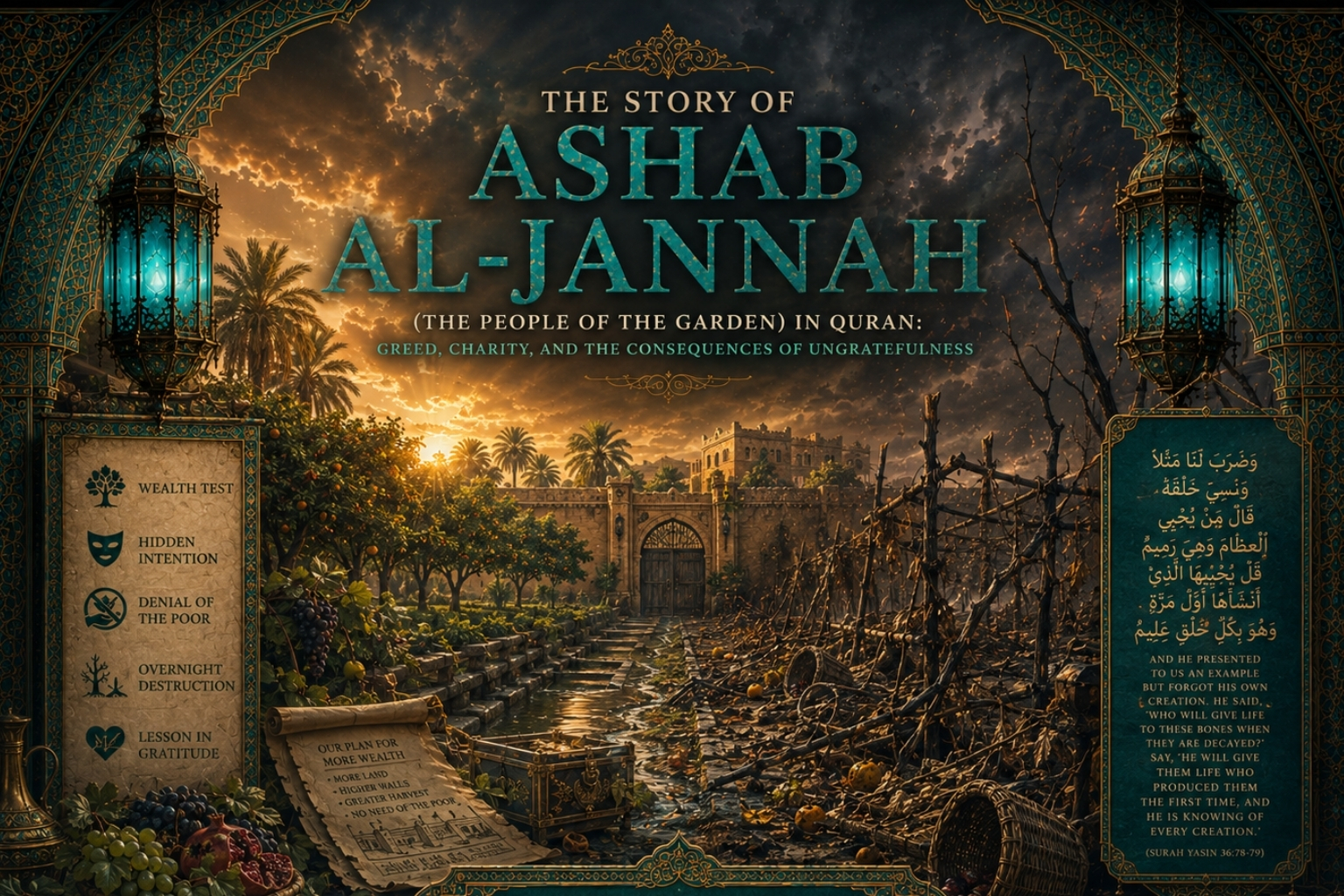

Among the most powerful psychological and economic parables detailed in the Holy Quran is the narrative of Ashab al-Jannah, widely translated as The People of the Garden or The Owners of the Orchard. Distinct from the eternal Paradise (Jannah) promised to believers in the Afterlife, this specific historical account, recorded in Surah Al-Qalam (Chapter 68), revolves around an earthy, ultra-luxurious agricultural estate.
Revealed to the Prophet Muhammad as a severe warning to the wealthy elites of Makkah who arrogance blinded them to divine truths, the story of the People of the Garden in Islam serves as an eternal moral lesson on the dangers of stinginess, the cosmic law of charity, and the devastating speed of divine retribution when the rights of the poor are violated.
The Legacy of the Righteous Father vs. The Greed of the Sons
The narrative begins with a beautiful, highly fertile garden that produced an abundance of premium fruits and crops. The original owner of this estate was a deeply pious, elderly man who recognized that his agricultural wealth was a pure blessing from Allah. Whenever harvest season arrived, he strictly followed a righteous formula: he deducted his family’s basic needs, reinvested a portion into the land, and distributed the rest generously to the poor, the widows, and the destitute.
However, when the righteous father passed away, his sons inherited the massive estate. Unlike their father, their hearts were corrupted by materialism and greed. Looking at the ledger, they viewed their father’s structural charity as a massive financial loss. They foolishly reasoned that by completely cutting off the poor, they could exponentially multiply their personal wealth.
“إِنَّا بَلَوْنَاهُمْ كَمَا بَلَوْنَا أَصْحَابَ الْجَنَّةِ إِذْ أَقْسَمُوا لَيَصْرِمُنَّهَا مُصْبِحِينَ وَلَا يَسْتَثْنُونَ”
“Indeed, We have tried them as We tried the companions of the garden, when they swore to cut its fruit in the early morning. And they did not make exception [by saying, ‘If Allah wills’].” (— Surah Al-Qalam, 68:17-18)
The Secret Plot in the Dead of Night
To execute their plan without causing a public scene or dealing with the surrounding beggars, the brothers formulated a highly coordinated, secretive plot. They swore an oath to harvest the entire garden under the cover of darkness, in the very early hours of the morning, before any poor person could realize the harvest had begun.
They were so intoxicated by their own strategic planning and arrogance that they completely forgot to say “Insha’Allah” (If Allah wills), assuming their absolute control over their financial destiny.
“فَانطَلَقُوا وَهُمْ يَتَخَافَتُونَ أَن لَّا يَدْخُلَنَّهَا الْيَوْمَ عَلَيْكُم مِّسْكِينٌ”
“So they departed, while they conversed in secret tones, [saying], ‘No poor person shall enter it today upon you.'” (— Surah Al-Qalam, 68:21-22)
The Divine Strike: A Silent Devastation
While the brothers slept peacefully, dreaming of the massive profit margins they would secure by exploiting the poor, a silent, catastrophic decree from Allah descended upon their property. A devastating celestial fire or storm swept over the estate while they were completely oblivious.
By the time the final third of the night passed, the once-vibrant, lush, green garden was systematically reduced to a blackened, barren, ash-filled wasteland.
“فَطَافَ عَلَيْهَا طَائِفٌ مِّن رَّبِّكَ وَهُمْ نَائِمُونَ فَأَصْبَحَتْ كَالصَّرِيمِ”
“So there came upon it an affliction from your Lord while they were asleep. And it became as if reaped [black and barren].” (— Surah Al-Qalam, 68:19-20)
The Awakening and Shocking Realization
Waking up early as planned, the brothers eagerly called out to one another in whispers, hurrying toward their land with a fierce determination to keep the poor away. When they finally reached the location, they rubbed their eyes in absolute disbelief. The landscape was completely unrecognizable.
Initially, they thought they had taken a wrong turn in the dark, saying, “Indeed, we are lost!” But as their eyes adjusted to the devastating reality of the ash-filled field, the horrific truth settled into their souls: their economic empire was entirely obliterated.
“فَلَمَّا رَأَوْهَا قَالُوا إِنَّا لَضَالُّونَ بَلْ نَحْنُ مَحْرُومُونَ”
“But when they saw it, they said, ‘Indeed, we are lost!’ ‘Rather, we have been deprived.'” (— Surah Al-Qalam, 68:26-27)
True Repentance Amid Financial Ruin
In that moment of total financial collapse, the middle brother—who had previously advised them against this greedy plot but had ultimately capitulated to peer pressure—reminded them of their arrogance. He said, “Did I not say to you, ‘Why do you not exalt [Allah]?'”
The brothers did not blame external factors; they recognized their own tyrannical greed. They turned back to Allah in deep, profound remorse, making a collective confession of their sins.
“قَالُوا سُبْحَانَ رَبِّنَا إِنَّا كُنَّا ظَالِمِينَ فَأَقْبَلَ بَعْضُهُمْ عَلَىٰ بَعْضٍ يَتَلَاوَمُونَ قَالُوا يَا وَيْلَنَا إِنَّا كُنَّا طَاغِينَ”
“They said, ‘Exalted is our Lord! Indeed, we were wrongdoers.’ Then they approached one another, blaming each other. They said, ‘O woe to us! Indeed we were transgressors.'” (— Surah Al-Qalam, 68:29-31)
The Prophet Muhammad consistently emphasized that hoarded wealth which is kept away from charity ultimately becomes a source of spiritual and physical destruction for its owner.
“مَا نَقَصَتْ صَدَقَةٌ مِنْ مَالٍ”
“Charity does not decrease wealth.” — Sahih Muslim
Core Spiritual Lessons from Ashab al-Jannah
- Wealth is a Test (Fitnah), Not a Metric of Favor: Having wealth does not mean Allah loves you, and lacking it does not mean He is angry with you. Wealth is simply capital lent to you by Allah to test your empathy and obedience.
- The Vulnerable Have a Legal Right: In Islamic economics, charity is not a casual favor you do for the poor. It is a legal, divine right (Haqq) that Allah has placed inside your wealth for them. Withholding it is an act of economic oppression.
- The Illusion of Human Planning: The brothers planned perfectly down to the hour and the tone of voice. However, if a plan excludes the pleasure of Allah and the service of humanity, it is fundamentally flawed and vulnerable to sudden ruin.
- The Saving Grace of Repentance (Tawbah): Although the brothers lost their worldly wealth, their genuine, immediate remorse saved their souls. Allah recorded their story not just to show their punishment, but to showcase their ultimate spiritual redemption.
Conclusion
The profound story of Ashab al-Jannah serves as a timeless, sobering reality check for an increasingly materialistic world. It proves that any business, estate, or wealth that is deliberately managed to cut off the vulnerable and maximize greed is structurally unstable before Allah. By maintaining a soft heart, keeping our tongues moist with “Insha’Allah”, and prioritizing consistent charity, we protect our businesses and families from divine withdrawal, transforming our worldly provisions into a true pathway toward the eternal Gardens of Paradise.