

There is a specific threshold of human suffering where patience feels entirely exhausted. It is that dark, suffocating space where you have made the prayers, you have taken the practical steps, and you have tried your absolute best to maintain a good opinion of God—yet the hardship only seems to intensify. The illness lingers, the financial bottleneck tightens, or the emotional betrayal cuts deeper. In these moments of profound vulnerability, an intrusive, agonizing whisper begins to loop in the back of your mind: “How much longer must I carry this? Has my relief been forgotten? Why does help feel so impossibly far away?”
Falling into this state of spiritual and emotional exhaustion is one of the primary catalysts for severe overthinking in Islam. We begin to measure divine love by the speed of our worldly relief, leading to existential panic and acute mental fatigue.
When we engage in Tadabbur (deep Quranic reflection) during these breaking points, the Holy Quran does not minimize our pain. Instead, it meets us exactly where we are, offering a monumental promise in Surah Al-Baqarah that serves as the ultimate anchor for healing anxiety with the Quran and restoring absolute peace of mind.
The Breaking Point of the Righteous: Surah Al-Baqarah, Verse 214
To understand the profound psychological relief of this verse, we must look at the intense historical and emotional landscape Allah paints for us:
“أَمْ حَسِبْتُمْ أَن تَدْخُلُوا الْجَنَّةَ وَلَمَّا يَأْتِكُم مَّثَلُ الَّذِينَ خَلَوْا مِن قَبْلِكُم ۖ مَّسَّتْهُمُ الْبَأْسَاءُ وَالضَّرَّاءُ وَزُلْزِلُوا حَتَّىٰ يَقُولَ الرَّسُولُ وَالَّذِينَ آمَنُوا مَعَهُ مَتَىٰ نَصْرُ اللَّهِ ۗ أَلَا إِنَّ نَصْرَ اللَّهِ قَرِيبٌ”
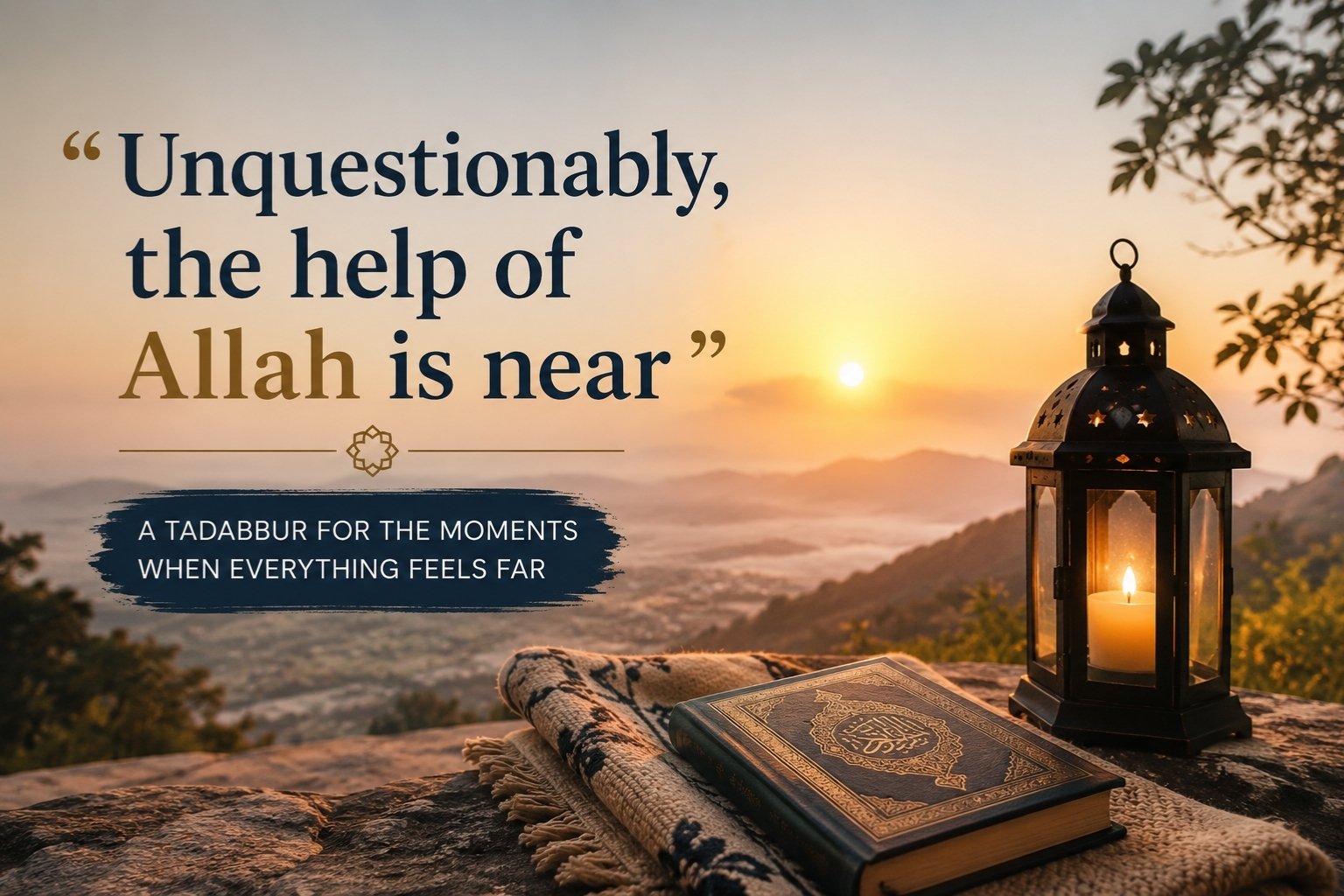
“Or do you think that you will enter Paradise while such [trial] has not yet come to you as came to those who passed away before you? They were touched by poverty and hardship and were shaken until [even their] messenger and those who believed with him said, ‘When is the help of Allah?’ Unquestionably, the help of Allah is near.” — Surah Al-Baqarah, 2:214
THE ANATOMY OF THE SACRED SHAKING |
AL-BA’SA’ (Poverty):External losses—financial, material, status. AD-DARRA’ (Hardship): Internal losses—physical pain, illness, grief. ZULZILU (Shaken):The earthquake of the soul; total instability. THE DIVINE REASSURANCE: When the shaking peaks, the help is already at the doorstep. |
Look closely at the word Zulzily (وَزُلْزِلُوا). In Arabic linguistics, this denotes a violent, repetitive shaking—like a massive earthquake. Allah is explicitly validating a profound reality of Islamic psychology: there are times when life will shake your emotional, financial, and mental foundations so violently that even your spiritual baseline feels unstable.
The verse reaches its peak intensity when the Messenger and the believers cry out: “When is the help of Allah?” Take a moment to sit with that. These were not people with weak faith; these were prophets and the greatest companions. Yet, the pressure was so immense that it forced an exclamation of vulnerability from their lips.
And right there—at the absolute rock bottom of human endurance—Allah doesn’t scold them for asking. He doesn’t dismiss their pain. Instead, He immediately responds with an unyielding, cosmic guarantee: “أَلَا إِنَّ نَصْرَ اللَّهِ قَرِيبٌ” — “Unquestionably, the help of Allah is near.”
Why the Help is Delayed: The Divine Alchemy of Shaking
A major source of modern performance anxiety and burnout is our obsession with instantaneous results. We live in a world of one-click deliveries and instant notifications, so when our relief (Nasr) doesn’t arrive on our timeline, we assume something is fundamentally broken.
But how to trust Allah requires shifting away from a transactional mindset. The shaking (Zalzalah) is never a sign of divine abandonment; it is a divine crucible.
Before a piece of gold can be shaped into a beautiful, priceless masterpiece, it must be thrown into a scorching furnace. The fire isn’t there to destroy the gold; it is there to separate the pure metal from the useless dross.
Similarly, when Allah delays His visible help and allows you to be shaken, He is executing a profound spiritual filtration process. The delay forces you to strip away your hidden attachments to worldly means. It burns away the illusion that your security comes from your boss, your savings account, or your own intellect. It breaks the ego until you have nothing left to lean on except Him. The moment you are completely emptied of self-reliance is the exact moment you become entirely ready to receive the majestic weight of His help.
The Prophetic Paradigm: Proximity in the Depth of the Cave
The Prophet Muhammad experienced the literal manifestation of being shaken to the core. During the migration to Madinah, he and his closest friend, Abu Bakr, found themselves trapped inside the dark, cramped quarters of Mount Thawr. The enemy forces were standing just inches away outside the cave—so close that if they had simply glanced down at their feet, they would have spotted them.
Abu Bakr, consumed by a natural, human wave of panic for the safety of the Messenger, whispered his fears. But the Prophet, whose heart was entirely anchored in the reality of trusting Allah’s plan, responded with an immortal formula of tranquil proximity:
“مَا ظَنُّكَ يَا أَبَا بَكْرٍ بِاثْنَيْنِ اللَّهُ ثَالِثُهُمَا؟ لَا تَحْزَنْ إِنَّ اللَّهَ مَعَنَا”
“What do you think, O Abu Bakr, of two people the third of whom is Allah? Do not grieve; indeed, Allah is with us.”
— Sahih al-Bukhari & Sahih Muslim
When everything worldly feels completely far away—when doors are slammed, safety is compromised, and options are depleted—the ultimate reality remains unchanged: Allah is present. His help doesn’t have to travel across a vast distance to reach you; it is already surrounding you, waiting for the precise split-second of perfect wisdom to manifest in your physical reality.
Practical Mindset Anchors for the Midst of the Storm
- Activate the “Alā” (Pay Attention) Protocol: The Arabic text uses the word Alā ($أَلَا$), which is an exclamation particle used to arrest attention, meaning “Lo!”, “Behold!”, or “Unquestionably!”. The next time a wave of catastrophic overthinking tells you that your situation is hopeless, actively yell “Alā!” to your intrusive thoughts. Force your brain to shift its focus from the size of the storm to the unbending truth of the divine promise.
- Audit Your Internal Attachments: If your relief feels heavily delayed, sit down in a quiet space and perform a raw, honest self-audit. Ask yourself: “Am I relying on Allah to solve this, or am I secretly relying on a specific person, a specific strategy, or my own cleverness?” Intentionally open your hands, let go of your micro-management, and say: “Ya Wakeel (The Ultimate Trustee), I completely resign my strategies over to Your execution.”
- Anchor Your Sanity in Voluntary Prostrations: When the emotional shaking makes it difficult to even formulate words for Dua, do not pressure yourself to perform. Simply make a clean, mindful Wudu, stand up, and slide into a long, quiet Sujood. Let your physical posture of total submission speak for you. Let the floor absorb your kinetic anxiety, and internalize that the One who restrains the sky from falling upon the earth is currently holding your fragile heart.
Conclusion
The spectacular, timeless architecture of Surah Al-Baqarah (2:214) serves as an eternal sanctuary for any human soul broken by the heavy trials of an unpredictable world. It stands as a profound reassurance that your exhaustion is not a sin, your tears are not a lack of faith, and your vulnerability is fully witnessed by the Lord of the worlds. You are not floating blindly in a chaotic, cruel universe. You are walking the exact path traveled by the most beloved human beings to ever step foot on earth. When you accept the necessity of the shaking, stop demanding immediate worldly answers, and anchor your expectations completely in trusting Allah’s plan, the heavy, paralyzing fog of chronic anxiety completely dissolves—leaving your mind beautifully wrapped in an unshakeable state of deep emotional safety, enduring tranquility, and everlasting spiritual success.