
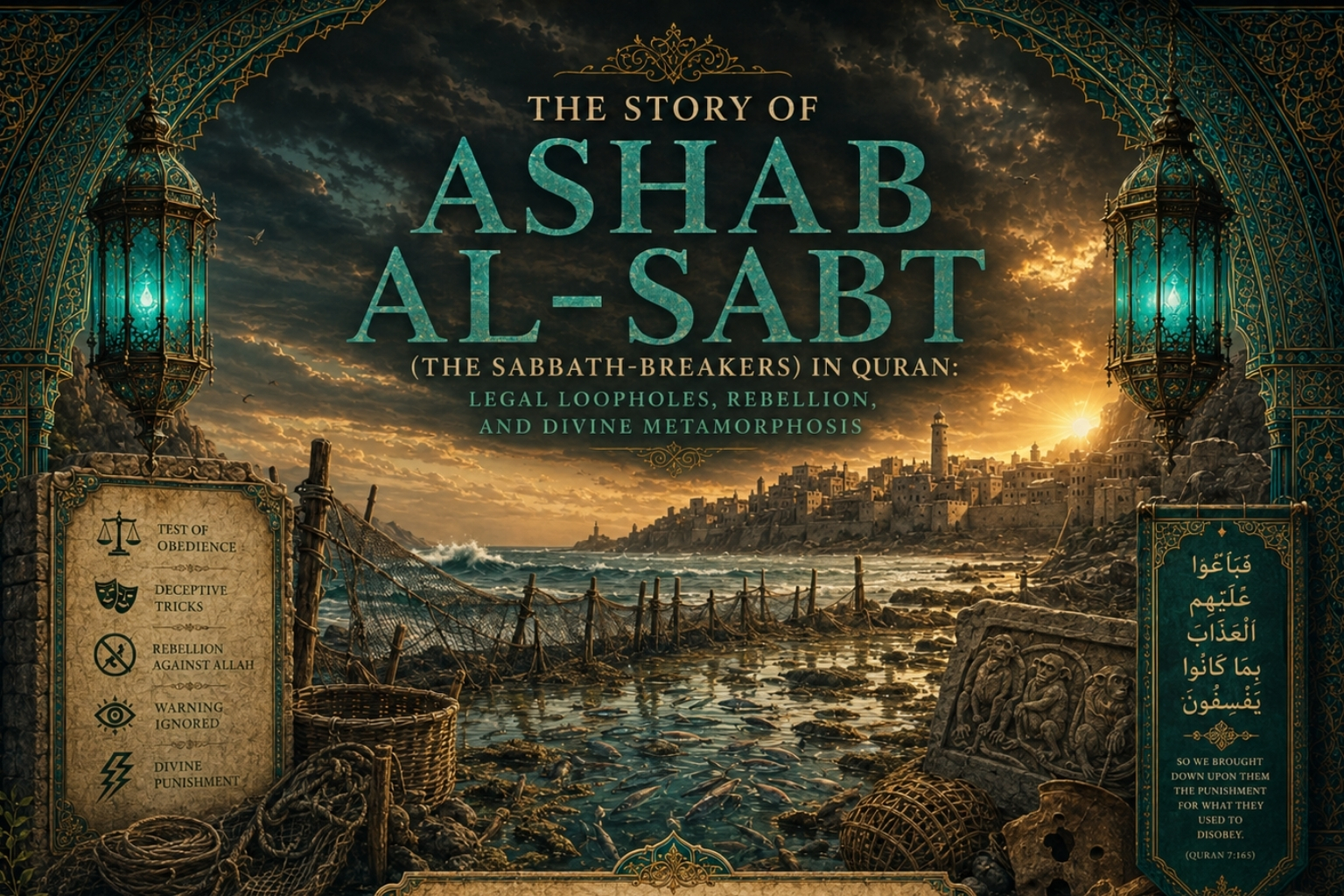

Among the most psychologically complex and highly sobering narratives detailed in the Holy Quran is the history of Ashab al-Sabt, universally translated as The People of the Sabbath or The Sabbath-Breakers. Recorded primarily in Surah Al-A’raf (Chapter 7) and Surah Al-Baqarah (Chapter 2), this profound account revolves around an ancient Israelite coastal community living by the Red Sea (often identified by historical scholars as the town of Eilah/Eilat).
Revealed by Allah as a stark warning against religious hypocrisy, the story of the Sabbath-Breakers in Islam serves as an eternal moral lesson on the dangers of creating legal loopholes to bypass divine commands, the psychological anatomy of sin, and the social responsibility of enjoining good and forbidding evil.
The Divine Command and the Heavenly Trial
The community, being from the Children of Israel, was legally bound by the laws of the Torah, which strictly forbade any form of worldly work, commercial trade, or fishing on Saturday—the Sabbath. This day was explicitly set aside by Allah exclusively for resting, spiritual reflection, and absolute worship.
To test the depth of their faith, obedience, and sincerity, Allah subjected them to a highly calculated, supernatural economic trial: He made the fish completely disappear during the weekdays, while on Saturdays, the water would literally swarm with massive, high-value fish breaking the surface of the sea.
“وَاسْأَلْهُمْ عَنِ الْقَرْيَةِ الَّتِي كَانَتْ حَاضِرَةَ الْبَحْرِ إِذْ يَعْدُونَ فِي السَّبْتِ إِذْ تَأْتِيهِمْ حِيتَانُهُمْ يَوْمَ سَبْتِهِمْ شُرَّعًا وَيَوْمَ لَا يَسْبِتُونَ ۙ لَا تَأْتِيهِمْ ۚ كَذَٰلِكَ نَبْلُوهُم بِمَا كَانُوا يَفْسُقُونَ”
“And ask them about the town that was by the sea – when they transgressed in the matter of the Sabbath – when their fish came to them openly on their Sabbath day, and the day they had no Sabbath they did not come to them. Thus did We try them because they were defiantly disobedient.” — (Surah Al-A’raf, 7:163)
The Innovation of the Legal Loophole (Hilah)
As the weeks passed, the town’s intense materialism and greed began to choke their spiritual conscience. They looked at the abundant fish on Saturdays and viewed the divine prohibition as an inconvenient financial barrier. Instead of remaining patient and trusting in Allah’s provision, they formulated a highly deceptive, technical loophole (Hilah).
They reasoned: “We will not technically fish on Saturdays.” Instead, on Friday afternoons, they dug deep artificial trenches, canals, and networks of nets leading from the sea into inland pools. On Saturday, the massive schools of fish swam naturally into these traps. On Sunday morning, the townspeople went out and harvested the trapped fish.
In their delusional state of pride, they congratulated themselves on their cleverness, claiming they had not technically violated the letter of the law, while entirely violating its spirit and divine intent.
The Tripartite Split of the Society
When this deceptive practice spread, the community did not react uniformly. The town was systematically split into three distinct ideological groups:
- The Active Sinners: The rebellious group that actively designed the traps, harvested the fish, and celebrated their material gains through religious deception.
- The Passive Bystanders: A group that did not partake in the sin themselves, but remained completely silent. They actively discouraged the righteous from preaching, fatalistically arguing that the sinners were already doomed anyway.
- The Righteous Reformers: A dedicated minority who refused to stay silent. They openly confronted the sinners, preaching truth and warning them of the imminent wrath of Allah.
The Quran captures the critical dialogue between the passive bystanders and the righteous reformers:
“وَإِذْ قَالَتْ أُمَّةٌ مِّنْهُمْ لِمَ تَعِظُونَ قَوْمًا ۙ اللَّهُ مُهْلِكُهُمْ أَوْ مُعَذِّبُهُمْ عَذَابًا شَدِيدًا ۖ قَالُوا مَعْذِرَةً إِلَىٰ رَبِّكُمْ وَلَعَلَّهُمْ يَتَّقُونَ”
“And when a community among them said, ‘Why do you advise a people whom Allah is about to destroy or to punish with a severe punishment?’ They [the reformers] said, ‘To be absolved before your Lord and perhaps they may fear Him.'” — (Surah Al-A’raf, 7:164)
The Divine Metamorphosis and Retribution
When the sinners completely ignored the tireless warnings of the reformers, the divine decree of Allah descended upon the town. The separation of the community was finalized: Allah physically delivered and saved the righteous reformers, while a terrifying, unique humiliation was enacted upon the transgressors.
Because they had structurally degraded human dignity by treating the divine commands like a game, Allah structurally degraded their physical forms, transforming them into physical apes.
“فَلَمَّا نَسُوا مَا ذُكِّرُوا بِهِ أَنجَيْنَا الَّذِينَ يَنْهَوْنَ عَنِ السُّوءِ وَأَخَذْنَا الَّذِينَ ظَلَمُوا بِعَذَابٍ بَئِيسٍ بِمَا كَانُوا يَفْسُقُونَ فَلَمَّا عَتَوْا عَن مَّا نُهُوا عَنْهُ قُلْنَا لَهُمْ كُونُوا قِرَدَةً خَاسِئِينَ”
“So when they forgot that by which they had been reminded, We saved those who had forbidden evil and seized those who wronged with a wretched punishment because they were defiantly disobedient. So when they were insolent about that which they had been forbidden, We said to them, ‘Be apes, despised.'” — (Surah Al-A’raf, 7:165-166)
Islamic scholars note that this physical metamorphosis lasted for three days, during which they could not eat, drink, or reproduce, before they passed away completely as a lasting physical sign for the surrounding nations.
“فَجَعَلْنَاهَا نَكَالًا لِّمَا بَيْنَ يَدَيْهَا وَمَا خَلْفَهَا وَمَوْعِظَةً لِّلْمُتَّقِينَ”
“So We made it a deterrent punishment for those who were present and those who succeeded [them] and a lesson for those who fear Allah.”(— Surah Al-Baqarah, 2:66)
Core Spiritual Lessons from Ashab al-Sabt
- The Severe Danger of Legal Loopholes (Hiyal): Deceiving humans is possible, but deceiving Allah is impossible. Attempting to bypass the spiritual essence of a religious law using technical semantics is viewed in Islam as an aggravation of the sin, not an excuse.
- The Sin of Silence: The narrative proves that remaining silent in the face of public corruption and injustice is heavily condemned. Allah only explicitly mentions saving the group that forbade the evil.
- The Purpose of Da’wah (Preaching): The righteous reformers outlined two beautiful motives for their activism: to clear their own conscience before Allah (“To be absolved”), and out of genuine hope for the guidance of the sinners (“Perhaps they may fear Him”).
- The Illusion of Easy Gains: The fish on Saturday looked like an easy shortcut to wealth, but it was nothing more than a temporary mirage hiding absolute destruction.
Conclusion
The terrifying reality of Ashab al-Sabt stands as a timeless warning against spiritual complacency and religious manipulation. It serves as a reminder to every modern believer that true faith requires a complete alignment of our outward actions with our inward intentions. By honoring the boundaries set by Allah, actively calling society toward righteousness, and shunning deceptive practices, we insulate our hearts from moral decay, transforming our temporary worldly tests into paths of genuine success and honor.