
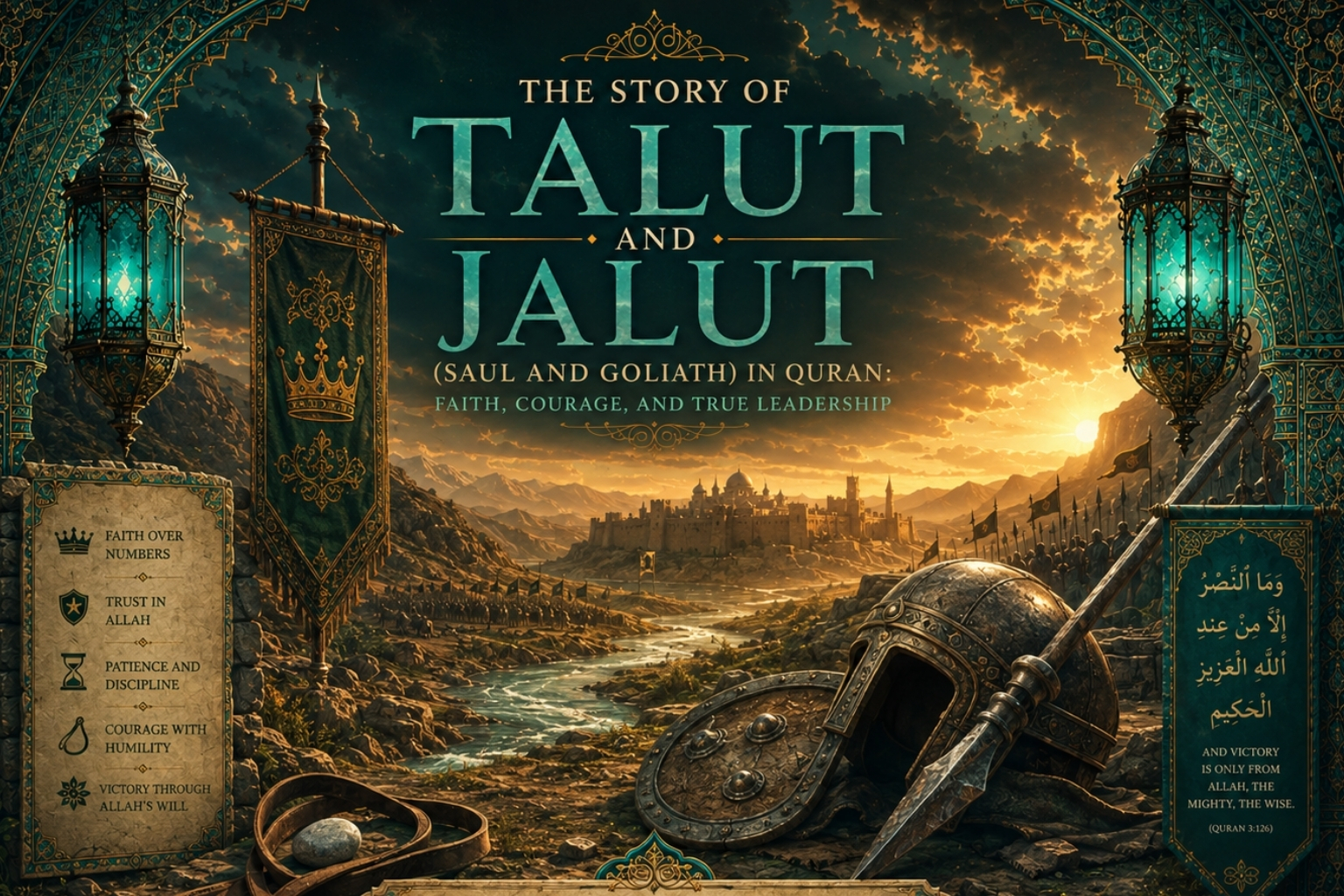

Among the most politically instructive and spiritually empowering narratives recorded in the Holy Quran is the history of Talut and Jalut, universally known in the Western tradition as Saul and Goliath. Found in the heart of Surah Al-Baqarah (Chapter 2), this profound account chronicles a critical turning point for the Children of Israel after the death of Prophet Musa (Moses), when they faced systemic oppression and displacement by a brutal, pagan superpower.
Revealed to the Prophet Muhammad to illustrate that victory does not depend on physical numbers or material wealth, the story of Talut and Jalut in Islam provides an timeless blueprint on the psychology of faith, the testing of soldiers, and how a small, sincere group can dismantle a massive, tyrannical empire through the help of Allah.
The Request for a King and the Divine Appointment
After years of suffering defeat and losing their sacred relics—including the Ark of the Covenant (Tabut)—the leaders of the Children of Israel approached their unnamed Prophet (often identified as Samuel) with a political demand: “Appoint for us a king, and we will fight in the way of Allah.”
The Prophet, understanding the fickle nature of his people, warned them that they might abandon their pledge when fighting was actually ordained. When Allah officially appointed Talut (Saul) as their king, the societal elites immediately revolted. They rejected him based on classism and materialism, arguing that he was not from a royal lineage and lacked immense financial wealth.
“قَالُوا أَنَّىٰ يَكُونُ لَهُ الْمُلْكُ عَلَيْنَا وَنَحْنُ أَحَقُّ بِالْمُلْكِ مِنْهُ وَلَمْ يُؤْتَ سَعَةً مِّنَ الْمَالِ ۚ قَالَ إِنَّ اللَّهَ اصْطَفَاهُ عَلَيْكُمْ وَزَادَهُ بَسْطَةً فِي الْعِلْمِ وَالْجِسْمِ ۖ وَاللَّهُ يُؤْتِي مُلْكَهُ مَن يَشَاءُ ۚ وَاللَّهُ وَاسِعٌ عَلِيمٌ”
“They said, ‘How can he have kingship over us while we are more worthy of kingship than him and he has not been given any exceptional wealth?’ He said, ‘Indeed, Allah has chosen him over you and has increased him abundantly in knowledge and stature. And Allah gives His kingship to whom He wills. And Allah is all-Encompassing and Knowing.'” — (Surah Al-Baqarah, 2:247)
To legitimize Talut’s divine appointment and heal their doubts, Allah granted them a miraculous physical sign: the holy Ark of the Covenant was carried back to them openly by angels.
The River Trial: Screening the Army
Talut mobilized a massive army to march against the tyrannical forces of the giant Jalut (Goliath). Knowing that victory against an overwhelming enemy requires absolute discipline, mental fortitude, and spiritual compliance rather than sheer numbers, Talut announced a severe divine test under the scorching heat of the desert.
He informed his troops that they would cross a specific river. To screen out the weak-willed and the undisciplined, the soldiers were strictly forbidden from drinking heavily from it; they were permitted only a single handful of water to quench their immediate thirst.
“فَلَمَّا فَصَلَ طَالُوتُ بِالْجُنُودِ قَالَ إِنَّ اللَّهَ مُبْتَلِيكُم بِنَهَرٍ فَمَن شَرِبَ مِنْهُ فَلَيْسَ مِنِّي وَمَن لَّمْ يَطْعَمْهُ فَإِنَّهُ مِنِّي إِلَّا مَنِ اغْتَرَفَ غُرْفَةً بِيَدِهِ ۚ فَشَرِبُوا مِنْهُ إِلَّا قَلِيلًا مِّنْهُمْ”
“And when Talut set out with the soldiers, he said, ‘Indeed, Allah will test you with a river. So whoever drinks from it is not of me, and whoever does not taste it is indeed of me, except one who takes [from it] in the hollow of his hand.’ But they drank from it, except a few of them.” — (Surah Al-Baqarah, 2:249)
The overwhelming majority of the army failed the test of self-control, drinking greedily from the river. Talut immediately dismissed them, advancing toward the battlefield with only a small, highly disciplined, and spiritually purified remnant of his original force.
Facing Jalut: The Paradox of Power
When the small Muslim army reached the valley and looked across at the massive, heavily armed, and terrifying pagan legions led by the towering giant Jalut, another wave of fear swept through the ranks. Some muttered that they had no power to face such an elite war machine.
However, the deeply rooted believers, whose hearts were anchored in the Afterlife, stood firm. They uttered a phrase that remains a golden rule in Islamic geopolitical history:
“قَالَ الَّذِينَ يَظُنُّونَ أَنَّهُم مُّلَاقُو اللَّهِ كَم مِّن فِئَةٍ قَلِيلَةٍ غَلَبَتْ فِئَةً كَثِيرَةً بِإِذْنِ اللَّهِ ۗ وَاللَّهُ مَعَ الصَّابِرِينَ”
” But those who knew with certainty that they were to meet their Lord, said: “How often a small group overcame a mighty host by Allah’s Leave?” And Allah is with As-Sabirin (the patient ones, etc.).
(Surah Al-Baqarah, 2:249)
As the two armies advanced toward a direct physical collision, the believers made a collective, powerful supplication for psychological stability and divine victory.
“وَلَمَّا بَرَزُوا لِجَالُوتَ وَجُنُودِهِ قَالُوا رَبَّنَا أَفْرِغْ عَلَيْنَا صَبْرًا وَثَبِّتْ أَقْدَامَنَا وَانصُرْنَا عَلَى الْقَوْمِ الْكَافِرِينَ”
“And when they went forth against Jalut and his soldiers, they said, ‘Our Lord, pour upon us patience and plant firmly our feet and give us victory over the disbelieving people.'” — Surah (Al-Baqarah, 2:250)
The Ascent of Dawud and the Fall of the Giant
Jalut, arrogant in his immense size and heavy armor, stepped forward into the valley, loudly challenging anyone from Talut’s army to face him in single combat. The seasoned, older warriors hesitated. It was at this critical moment that a young, humble shepherd boy stepped forward to accept the challenge.
This boy was none other than Dawud (David), who was destined to become a great Prophet. Refusing heavy royal armor, Dawud relied on his profound trust in Allah and a simple sling. With a single, mathematically precise shot, Dawud slung a stone that pierced Jalut’s helmet, dropping the terrifying tyrant dead instantly.
The sudden, shocking death of their unbeatable leader shattered the morale of the pagan army. Talut’s small force routed the enemy completely, achieving a historic, miraculous victory.
“فَهَزَمُوهُم بِإِذْنِ اللَّهِ وَقَتَلَ دَاوُودُ جَالُوتَ وَآتَاهُ اللَّهُ الْمُلْكَ وَالْحِكْمَةَ وَعَلَّمَهُ مِمَّا يَشَاءُ”
“So they defeated them by permission of Allah, and Dawud killed Jalut, and Allah gave him the kingship and wisdom and taught him from that which He willed.” — (Surah Al-Baqarah,) 2:251
The Prophet Muhammad frequently drew parallels between this event and the foundational struggles of early Muslims, noting that the exact number of companions who stood firm with him at the historic Battle of Badr was identical to the small number of righteous soldiers who crossed the river successfully with Talut.
Core Spiritual Lessons from Talut and Jalut
- True Qualifications of Leadership: Allah completely refutes materialistic standards of governance. True leadership is not based on wealth or social pedigree, but on internal capacity: a depth of knowledge (‘Ilm) to make correct decisions, and physical capability (Jism) to execute them.
- The Necessity of Trials Prior to Triumph: Allah never grants victory to an undisciplined, chaotic group. The river trial was necessary to purge those enslaved by their immediate physical desires before facing an external enemy.
- The Reality of Asbab (Means) and Divine Power: Dawud did not face the giant empty-handed; he used his skill with a sling. We must utilize our worldly means (Asbab), but our ultimate reliance (Tawakkul) must remain entirely on Allah to produce the result.
- The Power of Sincere Minorities: Throughout human history, massive, corrupt systems have rarely been dismantled by equally large systems. They are broken by small, intensely focused, and spiritually unified groups backed by divine permission.
Conclusion
The epic saga of Talut and Jalut stands as a magnificent testament to the supremacy of spiritual conviction over material might. It proves that a nation’s true strength does not lie in its financial reserves or the size of its military, but in its discipline, obedience, and alignment with the commands of Allah. By embodying the strategic wisdom of Talut, the absolute bravery of young Dawud, and the deep patience of the righteous remnant, modern believers can confidently face the most imposing challenges of life, secure in the knowledge that no giant is too big to fall when Allah is on your side.