
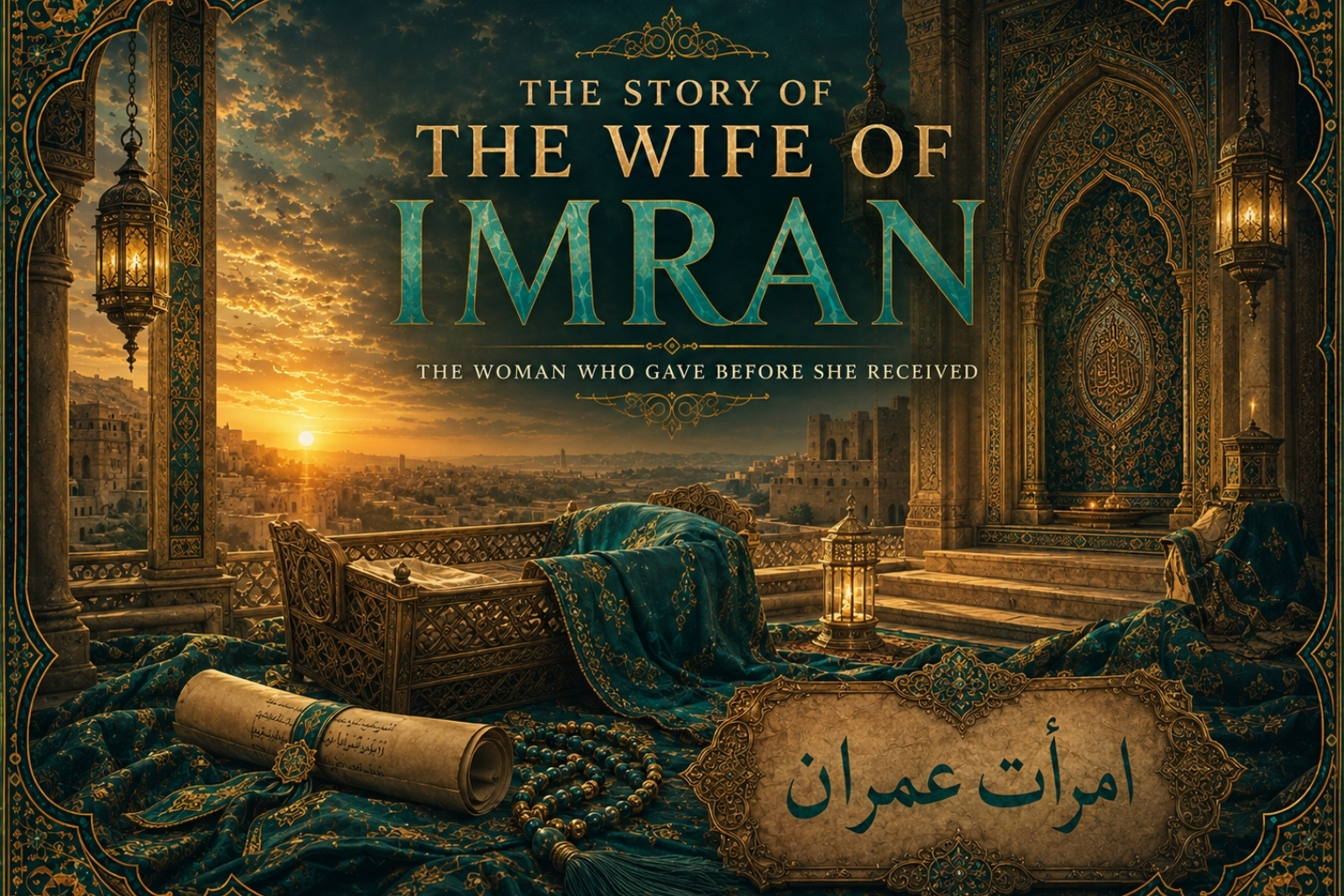

There is a form of generosity that is more demanding than any other.
Not the generosity of giving what you have already received. Not the generosity of sharing what you can afford to share. But the generosity of dedicating what you have not yet been given — of making a promise to Allah about something that does not yet exist, in a moment of longing that has not yet been answered, with a trust so complete that the giving happens before the receiving.
The wife of Imran — whose name Islamic tradition preserves as Hannah — gave her child to Allah before she knew if she would have a child. She made her dedication before she knew the gender of the child. She pledged the service before she knew what that service would require.
And the child she dedicated — the girl she apologized for, the daughter she feared would not be worthy of her promise — became Maryam, peace be upon her. The woman chosen above all the women of the world. The mother of a prophet. The only woman named in the Quran.
The story of the wife of Imran is one of the most extraordinary examples in the entire Quranic record of what it looks like when a woman’s prayer — honest, imperfect, full of human uncertainty — collides with Allah’s plan and produces something that changes the course of prophetic history.
She is never named in the Quran. She speaks only a few sentences. And yet Allah preserved her story, her prayer, her moment of apologetic disappointment — and her plea for protection for the daughter she feared she had failed — as a permanent part of His eternal Book.
Because what she did mattered. Immensely.
And Allah wanted every generation to know it.
Chapter One — Who Was She? A Woman of Profound Faith and Deep Longing
The wife of Imran — identified in Islamic tradition as Hannah bint Faqudha — was a woman of the family of Bani Israel, of the priestly lineage from which Prophet Zakariyya, peace be upon him, also came. She was the wife of Imran — a man of noble standing in the religious community — and she was a woman whose faith was not nominal or occasional but deep, practiced, and woven into the fabric of her daily life.
She wanted a child.
The Quran does not tell us how long she had waited, or what her situation had been before this moment. What it tells us is that when she became pregnant, her response was not simply relief or joy — it was immediate, deliberate consecration:
Quran Verse:
إِذْ قَالَتِ امْرَأَتُ عِمْرَانَ رَبِّ إِنِّي نَذَرْتُ لَكَ مَا فِي بَطْنِي مُحَرَّرًا فَتَقَبَّلْ مِنِّي ۖ إِنَّكَ أَنتَ السَّمِيعُ الْعَلِيمُ
“When the wife of Imran said: ‘My Lord, indeed I have pledged to You what is in my womb, consecrated, so accept this from me. Indeed, You are the Hearing, the Knowing.'”
Surah Al-Imran (3:35)
The first words she spoke in the Quran were a dedication. Not a prayer of gratitude for the pregnancy. Not a prayer for the child’s health or safety or future. A dedication — nazartu laka ma fi batni muharraran — I have pledged to You what is in my womb, liberated, consecrated, set apart for Your service.
“Muharrar” — liberated, freed from the ordinary purposes of a child’s life. She was dedicating this child not to herself, not to the family, not to the ordinary joys of parenthood — but to the service of Allah in the temple, to a life set apart for worship and religious service.
She did not know if she would carry the pregnancy to term. She did not know if the child would be healthy. She did not know — and this is the most significant unknown — whether the child was a boy or a girl.
Temple service in her tradition was the domain of men. Boys were trained for it. Girls were not considered eligible for the specific form of service she had in mind.
She dedicated her child anyway. Before she knew. Before she could verify that her dedication was even compatible with what she would receive.
This is the first lesson of her story: she gave before she knew what she was giving. She trusted Allah with a commitment she could not fully control — and she made it with complete sincerity, asking only that He accept it.
Chapter Two — The Prayer’s Structure: What She Asked and How She Asked It
Look carefully at the structure of her prayer — because it is one of the most beautifully constructed supplications in the Quran:
“My Lord” — Rabbi — she began with a relationship. Not the formal address of a stranger petitioning a distant authority, but the intimate address of a servant who knows her Lord and is known by Him.
“Indeed, I have pledged” — inni nazartu — she used inna, the emphatic particle, to strengthen the statement. This was not a tentative thought or a half-formed intention. It was a firm, definitive, already-made commitment. She was not asking Allah’s permission to make the dedication. She was informing Him of a dedication already complete in her heart.
“What is in my womb” — ma fi batni — not “my child” with a name or a gender or a specific form. Whatever is in my womb. The unknown child, in whatever form Allah had created it. She dedicated the possibility before the certainty.
“Consecrated” — muharraran — free, liberated, set apart. The word carries the sense of something removed from ordinary use and given entirely to Allah.
“So accept this from me” — fataqabbal minni — the request is not for a healthy child or a successful dedication. The request is for acceptance. She wanted Allah to receive what she was giving. The quality of the gift was secondary to whether the Giver would take it.
“Indeed, You are the Hearing, the Knowing” — innaka anta al-sami’ al-‘alim — she closed by affirming two of Allah’s names that were directly relevant to her situation. Al-Sami’ — the Hearing — He hears this prayer, this dedication, these words spoken in private. Al-‘Alim — the Knowing — He knows what is in her womb before she does, He knows the gender and the future and the purpose of this child before it is born.
She was saying: You already know what I don’t know. I am dedicating what I cannot fully see. Accept it — because You can see it completely even when I cannot.
Chapter Three — The Birth: When the Plan Became Visible
The child was born. And she was a girl.
Quran Verse:
فَلَمَّا وَضَعَتْهَا قَالَتْ رَبِّ إِنِّي وَضَعْتُهَا أُنثَىٰ وَاللَّهُ أَعْلَمُ بِمَا وَضَعَتْ وَلَيْسَ الْذَّكَرُ كَالْأُنثَىٰ ۖ وَإِنِّي سَمَّيْتُهَا مَرْيَمَ وَإِنِّي أُعِيذُهَا بِكَ وَذُرِّيَّتَهَا مِنَ الشَّيْطَانِ الرَّجِيمِ
“But when she delivered her, she said: ‘My Lord, I have delivered a female’ — and Allah was most knowing of what she delivered — ‘and the male is not like the female. And I have named her Maryam, and I seek refuge for her in You and her descendants from Shaytan, the expelled.'”
Surah Al-Imran (3:36)
This verse is one of the most humanly rich moments in the entire Quran — and one of the most theologically instructive.
“My Lord, I have delivered a female” — The first thing she said after the birth was not alhamdulillah for the safe delivery or mashallah for the infant’s health. It was an immediate, transparent disclosure to Allah of the thing that complicated her dedication: it is a girl.
She was not complaining. She was not ungrateful. She was bringing her complete, unfiltered reality to Allah — including the part that confused her, that challenged the form of her dedication, that didn’t fit the plan she had envisioned.
This is a form of prayer that Allah honors throughout the Quran: the prayer that names the specific difficulty rather than praying in generalities. She did not say: things haven’t worked out as I hoped. She said: I have delivered a female. Specific. Direct. Honest.
“And Allah was most knowing of what she delivered” — Here Allah inserts Himself into the narrative with a parenthetical that is simultaneously gentle and corrective. He already knew. He knew when she made the dedication that the child would be a girl. He accepted the dedication knowing this. The plan was never disrupted — it was always His plan. Her confusion was entirely understandable from a human perspective. From Allah’s perspective, everything was proceeding exactly as intended.
“And the male is not like the female” — She acknowledged the difference in the context of temple service — boys and girls served differently in her tradition. She was not making a theological statement about the worth of women. She was naming a practical limitation as she understood it. And Allah, in His infinite wisdom, was already arranging things in a way that would make her female child more honored than any male temple servant had ever been.
The limitation she saw became the very foundation of Allah’s extraordinary plan.
Chapter Four — The Name: Maryam
“And I have named her Maryam” — She named her daughter before anything else. Before worrying about the dedication. Before consulting with her husband or the community. The first act of motherhood — the naming — was also an act of identity and intention.
Maryam — a name that carries meanings related to piety, worship, service. Some scholars note its connection to the concept of the worshipper, the one who serves. Whether consciously or by Allah’s guidance, she named her daughter with a name that described the life her daughter would live.
The name itself was the beginning of the fulfillment of the dedication.
Chapter Five — The Protection: The Prayer Every Parent Should Make
After naming her daughter, the wife of Imran made the second prayer — and it is perhaps the most important prayer she made, the one that reveals the deepest quality of her faith:
“And I seek refuge for her in You and her descendants from Shaytan, the expelled.”
She had just apologized for delivering a girl. She was uncertain about her dedication. She was navigating the gap between what she had planned and what had arrived.
And what she prayed for — for this girl she had just met, this daughter she had just named — was not health, not beauty, not a good marriage, not wealth or status or a comfortable life.
She asked for protection from Shaytan.
This is the prayer of a woman who understood what actually matters in a human life. Who knew that the greatest threat to any person — male or female, born to riches or poverty, destined for ordinary life or extraordinary mission — is the enemy who seeks to corrupt the soul.
The Prophet Muhammad ﷺ confirmed that this prayer was answered:
Hadith:
مَا مِنْ مَوْلُودٍ يُولَدُ إِلَّا نَخَسَهُ الشَّيْطَانُ فَيَسْتَهِلُّ صَارِخًا مِنْ نَخْسَةِ الشَّيْطَانِ، إِلَّا ابْنَ مَرْيَمَ وَأُمَّهُ
“There is no child born except that Shaytan pokes it and it cries from the poking of Shaytan — except the son of Maryam and his mother.”
Recorded in Sahih Al-Bukhari, Hadith No. 3286
Every child born into this world is touched by Shaytan at the moment of birth — except Maryam and Isa. The only two human beings in history to be exempt from this contact were the daughter this mother dedicated to Allah and the son born from that daughter without a father.
The protection was granted. Completely. Permanently. At the very first moment of Maryam’s existence in this world.
Because a mother asked for it.
Because she named the right threat — Shaytan, the expelled — and asked the right source of protection — You, Allah Himself.
This is one of the most powerful lessons about the efficacy of parental du’a in the entire prophetic tradition. A mother asked for her daughter’s protection from Shaytan. Allah granted it so completely that Maryam became one of only two human beings in history to begin life untouched by the enemy.
Chapter Six — The Acceptance: What Allah Did With Her Gift
Allah’s response to the dedication and the prayer was immediate and complete:
Quran Verse:
فَتَقَبَّلَهَا رَبُّهَا بِقَبُولٍ حَسَنٍ وَأَنبَتَهَا نَبَاتًا حَسَنًا وَكَفَّلَهَا زَكَرِيَّا
“So her Lord accepted her with good acceptance and caused her to grow in a good manner and placed her in the care of Zakariyya.”
Surah Al-Imran (3:37)
Three responses from Allah to the wife of Imran’s dedication:
“Accepted her with good acceptance” — taqabbalaha bi qabuli hasan — the word hasan — good, beautiful, excellent — modifies the acceptance. Allah did not merely accept the dedication. He accepted it well. With a quality of acceptance that was itself extraordinary. The girl the mother feared was not good enough for temple service was received by Allah with good acceptance.
“Caused her to grow in a good manner” — anbataha nabatan hasanan — the same root for growing used for plants — Allah caused Maryam to grow as He causes a good plant to grow: with care, with proper nourishment, with attention to every stage of development. Her formation was a divine act of cultivation.
“Placed her in the care of Zakariyya” — He arranged her guardianship. The wife of Imran had given her daughter to Allah’s service — and Allah placed her with one of His prophets, in the most honored religious environment available, under the care of a man who would recognize her extraordinary nature and be inspired by it to make his own impossible prayer.
Allah did not just accept the dedication. He personally supervised what the dedication produced.
Chapter Seven — The Lessons Hidden in Her Silence
The wife of Imran appears in only two verses of the Quran. After her speech in verse 35 and verse 36, she disappears from the narrative — and her daughter’s extraordinary story unfolds without her visible presence.
We do not know if she lived to see Maryam grow up in the temple. We do not know if she lived to know about the miraculous pregnancy. We do not know if she lived to see Isa born.
What we know is that she made a prayer, she made a dedication, she protected her daughter with the most powerful protection available — Allah’s name — and then she released her.
This releasing — this giving of a child to Allah and then stepping back — is one of the most demanding acts of motherhood. To dedicate your child to Allah’s service means accepting that the child’s life is not primarily yours to direct. That Allah’s purpose for them supersedes your plans. That the story you imagined for them may not be the story Allah is writing.
The wife of Imran did this without ceremony. She named the child, she prayed the protection, and she let Allah take it from there.
And Allah took her daughter — the girl she apologized for, the female she feared wasn’t good enough — and made her the most honored woman in all of human history.
Hadith:
خَيْرُ نِسَائِهَا مَرْيَمُ ابْنَةُ عِمْرَانَ
“The best of its women is Maryam, daughter of Imran.”
Recorded in Sahih Al-Bukhari, Hadith No. 3432
The best of the women. The daughter of the wife of Imran. The child apologized for being a girl.
Chapter Eight — Her Name: Why Allah Left It Out
It is worth sitting with the question of why Allah did not name the wife of Imran in the Quran.
Maryam — her daughter — is named. Zakariyya — her daughter’s guardian — is named. Isa — her grandson — is named. But she herself — the woman whose prayer and dedication initiated the entire chain of events — is identified only as imra’at Imran — the wife of Imran.
This may itself be a teaching. Her identity in the Quran is relational — defined by her connection to her husband and her daughter — and yet her contribution to prophetic history is foundational. She demonstrates that influence and impact do not require name recognition. That the person whose prayer started something extraordinary may not be the person whose name is remembered by the world.
Allah remembered. He preserved her words. He recorded her dedication. He noted her motherly concern and her imperfect, honest response to her daughter’s birth. He preserved the prayer she made for her daughter’s protection.
He did not need to give her name for her story to matter. Because the story is not about the name. It is about what she did.
And what she did — a dedication made before the child existed, a prayer for protection that covered two generations — echoes through the most significant chapters of prophetic history.
Timeless Lessons from the Story of the Wife of Imran
- Give before you receive — dedication precedes certainty She dedicated her child before she knew its gender, before she knew if the dedication was compatible with what she would receive, before she could verify any of the conditions that would make the dedication practical. She trusted Allah with the unknown — and He turned the unknown into something beyond what she had imagined. Give what you have to Allah before you know exactly what you have.
- Bring your specific confusion to Allah — not your polished prayers “My Lord, I have delivered a female.” She brought Allah the specific thing that confused her — not a general prayer of acceptance, but the precise detail that complicated her situation. Allah responded to her honest naming of the difficulty. He inserted Himself into the parenthetical — “and Allah was most knowing” — as if to say: I heard the specific thing you named. I know. I planned this.
- Ask for protection from Shaytan above all other protections She did not ask for health, wealth, a good marriage, or worldly success for her daughter. She asked for protection from Shaytan. The Prophet ﷺ confirmed this was answered so completely that Maryam was among only two human beings never touched by Shaytan at birth. When you pray for your children — name the right threat and ask the right source of protection.
- Your apology for what you gave may become the beginning of the greatest plan She apologized for delivering a girl. She said: “the male is not like the female.” She was embarrassed that her dedication might not be fulfilled in the form she had imagined. And Allah accepted the girl with good acceptance — because He had always planned to make that girl the most honored woman in the worlds. Your limitation does not limit Allah’s plan.
- Accept good acceptance from Allah — it is not just acceptance, it is something beautiful Allah did not say He accepted the dedication. He said he accepted her with good acceptance. The quality of Allah’s acceptance is not neutral. When Allah receives what you give Him sincerely — He receives it well, with honor, with a goodness that elevates the gift beyond what it appeared to be.
- Release what you have dedicated to Allah She dedicated her daughter and then released her into Allah’s care. She did not follow her into the temple and manage her service from the sidelines. She gave her to Allah and let Allah direct what followed. The completion of a dedication requires release — the trust that Allah will do more with what you gave Him than you could have done with it yourself.
- Your name does not need to be remembered for your contribution to matter. The wife of Imran is unnamed in the Quran. Her prayer started the chain of events that produced Maryam and through Maryam, Isa. She is never named. And her contribution is foundational to one of the most significant threads in prophetic history. The things you do faithfully in Allah’s service — the prayers you make, the dedications you offer, the protections you seek — do not require your name on them to produce fruit across generations.
Closing Reflection
She did not know what she was starting.
A woman in a moment of gratitude and longing — pregnant after what may have been years of waiting — made a dedication to Allah. Whatever is in my womb, it is Yours.
She did not know that what was in her womb would be named Maryam. She did not know that Maryam would be chosen above all the women of the world. She did not know that Maryam would carry a miraculous pregnancy and give birth to one of the five greatest prophets. She did not know that her prayer for protection would result in two human beings — her daughter and her grandson — being exempt from Shaytan’s touch at birth.
She just made the dedication. She just asked for acceptance. She just prayed the protection.
And Allah took that dedication — imperfect, honest, complicated by an unexpected gender — and produced from it one of the most extraordinary prophetic stories in human history.
Her prayer asked for two things: accept this and protect her from Shaytan. Both were answered. Completely. Beyond what she could have imagined.
She gave before she received. She prayed before she knew. She dedicated what she couldn’t yet see.
And Allah — who was most knowing of what she had delivered — accepted it all.
Quran Verse:
فَتَقَبَّلَهَا رَبُّهَا بِقَبُولٍ حَسَنٍ وَأَنبَتَهَا نَبَاتًا حَسَنًا
“So her Lord accepted her with good acceptance and caused her to grow in a good manner.”
Surah Al-Imran (3:37)
Give what you have — before you know its full worth.
Protect what you love — by asking Allah by name to protect it.
Release what you dedicate — and let Allah grow it in the good manner only He can manage.
You do not need to see the end of the story to do your part in it faithfully.
She didn’t. And the part she played — two verses, one dedication, one prayer — changed the course of prophetic history.