
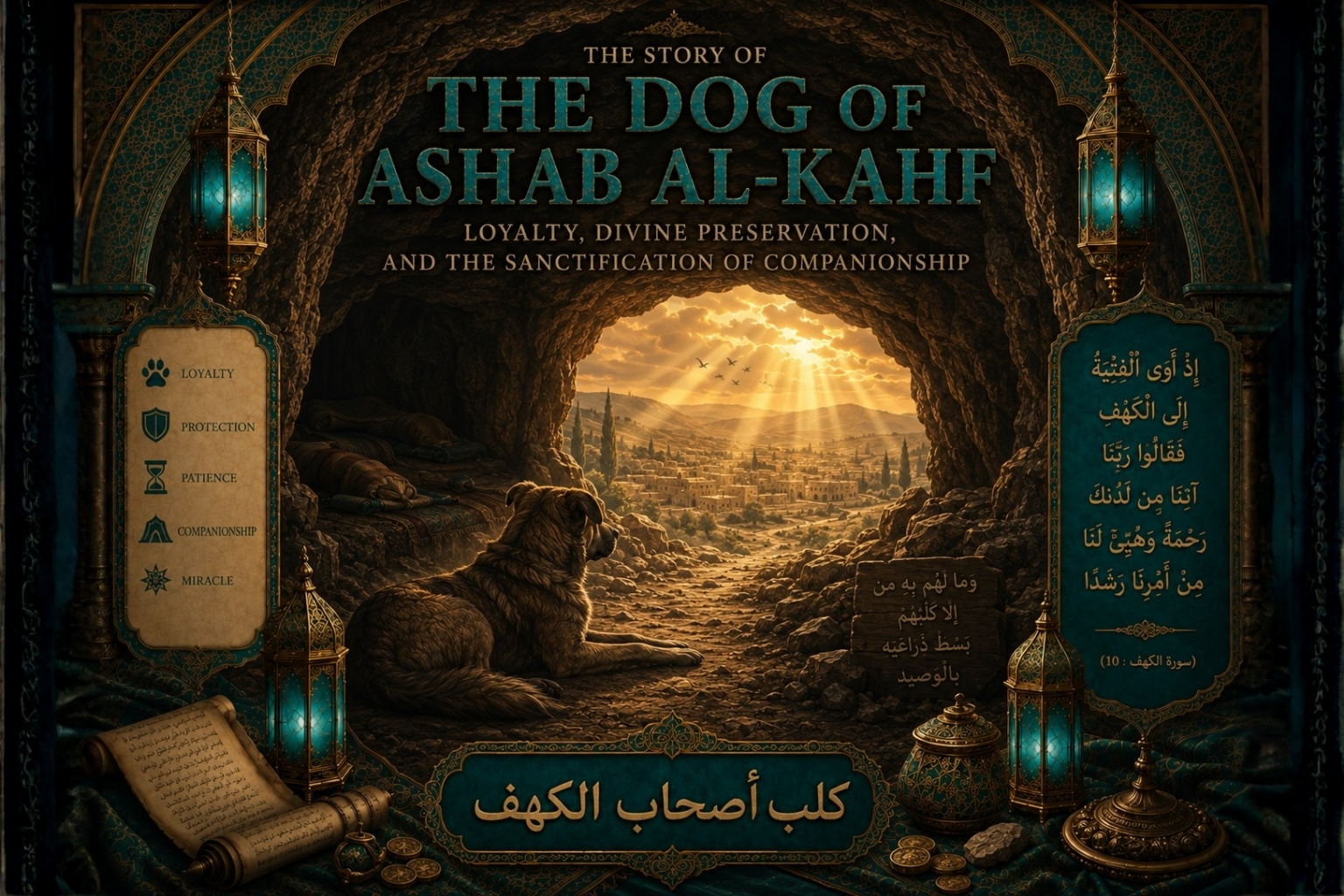

Among the most culturally comforting, historically intriguing, and sociologically profound narratives recorded in the Holy Quran is the presence of Kalb Ashab al-Kahf (The Dog of the Companions of the Cave). Detailed systematically within Surah Al-Kahf (The Cave, Chapter 18)—the highly spiritual chapter that Muslims are heavily encouraged to recite every Friday for metaphysical protection—this faithful animal is mentioned multiple times alongside a group of monotheistic youths who fled a tyrannical pagan empire to safeguard their faith.
Revealed by Allah to demonstrate the expansiveness of His mercy and the subtle ways creation cooperates to protect the righteous, the story of the Cave Dog in Islam serves as an eternal moral lesson on the profound impact of companionship, the reality of divine slumber, and the high honor Allah bestows upon any creature—even a humble animal—that aligns itself with the truthful.
The Great Escape: Fleeing Tyranny into the Wilderness
The narrative unfolds during the reign of a notoriously brutal, polytheistic Roman emperor (historically identified by many scholars as Decius), who systematically persecuted, tortured, and executed anyone refusing to worship state idols. A small group of high-ranking, wealthy youths found their hearts awakened to absolute monotheism (Tawheed). Realizing that open resistance would lead to their execution or forced apostasy, they abandoned their aristocratic lives, slipping away under the cover of night into the rugged mountains surrounding their city.
As they made their perilous escape into the wilderness, they were joined by a dog. Classical commentators note that the dog may have belonged to one of the youths, or was a shepherd’s dog that instinctively recognized the scent of righteousness and chose to follow them, refusing to leave their side despite their initial attempts to wave it away out of fear that its barking might betray their hidden trail.
The Threshold of the Cave: Guarding the Sanctuary
The youths eventually discovered a wide, hidden cave (Al-Kahf) nestled deep within the mountain cliffs. Exhausted, terrified, and seeking divine intervention, they collapsed inside to rest. Allah answered their prayers by instantly enveloping them in a deep, supernatural slumber that would shield them from their enemies for an astonishing 309 lunar years.
While the youths slept peacefully inside the inner chamber of the cave, completely insulated from the passage of time, the dog took up its strategic post at the very entrance of the cavern (Al-Waseed).
The Quran vividly describes the physical posture of the dog during this three-century-long vigil, highlighting its role as a living, terrifying psychological deterrent against any passing intruders or Roman search parties.
“وَتَحْسَبُهُمْ أَيْقَاظًا وَهُمْ رُقُودٌ ۚ وَنُقَلِّبُهُمْ ذَاتَ الْيَمِينِ وَذَاتَ الشِّمَالِ ۖ وَكَلْبُهُم بَاسِطٌ ذِرَاعَيْهِ بِالْوَصِيدِ ۚ لَوِ اطَّلَعْتَ عَلَيْهِمْ لَوَلَّيْتَ مِنْهُمْ فِرَارًا وَلَمُلِئْتَ مِنْهُمْ رُعْبًا”
“And you would think them awake, while they were asleep. And We turned them to the right and to the left, while their dog stretched his forelegs at the entrance. If you had looked at them, you would have turned from them in flight and been filled with terror.” — (Surah Al-Kahf, 18:18)
The Anatomy of Preservation: The Supernatural Slumber
To keep the dog alive and functional across 309 years without food or water, Allah applied the exact same biological suspension of laws to its body as He did to the human youths. The dog did not age, decay, or suffer muscle atrophy.
Furthermore, its guarding posture—lying perfectly flat with its front paws stretched out across the threshold—was preserved so realistically that anyone catching a glimpse of the cave entrance from a distance would assume a highly alert, vicious watchdog was waiting to spring. This terrifying aura kept the sanctuary completely undisturbed for over three centuries until the era of tyranny had passed and a righteous, monotheistic society had risen in its place.
The Literary Miracle: Immortalized in the Divine Debate
The profound status that Allah granted this dog is showcased later in the chapter, where the Quran addresses the historical debates and theological arguments that arose among subsequent generations regarding the exact number of the Companions of the Cave.
In every single historical calculation recorded in the divine text, the dog is explicitly counted as an essential, equal member of their structural unit, immortalizing its presence in the text of the Quran until the Day of Judgment.
“سَيَقُولُونَ ثَلَاثَةٌ رَّابِعُهُمْ كَلْبُهُمْ وَيَقُولُونَ خَمْسَةٌ سَادِسُهُمْ كَلْبُهُمْ رَجْمًا بِالْغَيْبِ ۖ وَيَقُولُونَ سَبْعَةٌ وَثَامِنُهُمْ كَلْبُهُمْ ۚ قُل رَّبِّي أَعْلَمُ بِعِدَّتِهِم مَّا يَعْلَمُهُمْ إِلَّا قَلِيلٌ”
“They will say there were three, the fourth of them being their dog; and they will say there were five, the sixth of them being their dog – guessing at the unseen; and they will say there were seven, and the eighth of them was their dog. Say, [O Muhammad], ‘My Lord is most knowing of their number. None knows them except a few.'” — (Surah Al-Kahf, 18:22)
Islamic scholarly giants, such as Al-Qurtubi and Ibn Kathir, have written extensively on the profound sociological implications of these verses, noting how the simple association with righteous people can permanently elevate the status of an otherwise common creature.
“If a mere dog could achieve such an exalted status in history simply by accompanying the righteous, imagine the immense blessing and elevation that awaits a believer who spends their life in the companionship of the pious and the pure.” — Tafsir al-Qurtubi
Core Spiritual Lessons from the Dog of the Cave
- The Law of Association (As-Suhbah): The narrative serves as the ultimate proof of how companionship shapes destiny. The dog possessed no theological understanding of monotheism, nor did it perform acts of worship. Yet, because it physically attached itself to people who loved Allah, it was showered in their divine blessings, preserved for 309 years, and immortalized in holy scripture. Choose your inner circle wisely, for you are heavily influenced by the spiritual state of those you accompany.
- The Universal Scope of Divine Mercy: The story beautifully shatters human arrogance by proving that Allah’s miraculous protection is not reserved exclusively for human saints or prophets. A simple animal, executing its natural instinct of loyalty and protection, can become an instrument of divine decree, safely guarded under the shade of the Almighty.
- The Strategic Deployment of the Ordinary: Allah did not use a terrifying monster, a wall of fire, or a legion of Jinn warriors to protect the cave. He utilized the simple, sleeping silhouette of a dog stretching its paws. Allah can use the most ordinary, mundane elements of your life to build a powerful shield of defense around you.
- True Loyalty is Unconditional: The dog did not receive fancy food, comfort, or worldly rewards inside that desolate mountain cave. It chose to sleep on the hard dirt threshold for 309 years simply to fulfill its duty of companionship. It challenges believers to cultivate that same level of unyielding, unconditional loyalty in their relationship with Allah and His messengers.
Conclusion
The beautiful, deeply reassuring history of Kalb Ashab al-Kahf stands as an eternal testament to the deeply compassionate, inclusive nature of the Islamic worldview. It provides immense emotional comfort to every modern believer, reminding us that no act of loyalty goes unnoticed by Allah, and no clean companionship is ever wasted. By surrounding ourselves with people of faith, protecting the spaces of truth, and serving the causes of righteousness with steadfast loyalty, we invite the transformative mercy of Allah into our lives, turning our temporary earthly efforts into an immortal legacy of honor, protection, and absolute eternal success.