
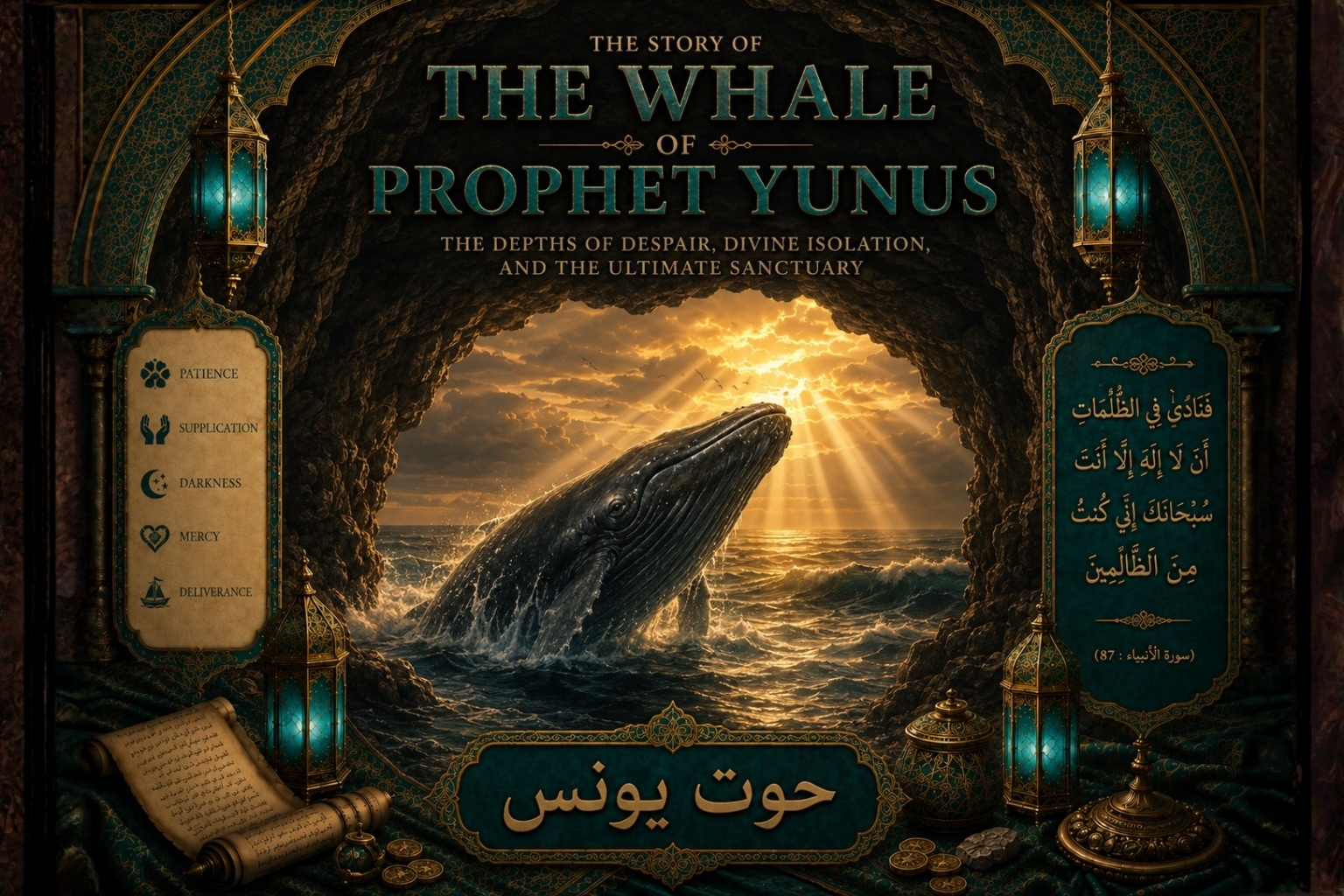

Among the most psychologically intense, spiritually comforting, and liturgically powerful narratives recorded in the Holy Quran is the history of Hout Sayyidina Yunus (The Whale of Prophet Jonah). Recounted across several chapters—including Surah Al-Anbya, Surah As-Saffat, and the eponymous Surah Yunus—this timeless narrative chronicles a profound crisis of a noble messenger who reached the absolute limits of human endurance.
Revealed by Allah as a source of emotional rescue, resilience, and ultimate hope for Prophet Muhammad and all believers facing overwhelming situations, the story of the Whale in Islam serves as an eternal testament to the reality of divine mercy, proving that no darkness is too deep, no mistake is too large, and no prison is too secure for the saving grace of Allah.
The Abandoned Mission and the Stormy Sea
The narrative begins in the ancient, sprawling city of Nineveh (located near modern-day Mosul, Iraq). Prophet Yunus spent decades calling his community of over one hundred thousand citizens to abandon paganism and embrace absolute monotheism. Faced with mocking resistance and continuous rejection, Yunus grew deeply frustrated. Believing his duty was complete and that divine punishment was imminent, he departed the city in anger without receiving explicit divine permission (Ithn) from Allah to migrate.
He traveled to the coast and boarded a heavily laden merchant ship. As the vessel reached the deep, open waters, an unexpected, violent storm battered the ship, pushing it to the brink of capsizing.
The sailors, following ancient maritime traditions, realized that someone on board had fled their master, bringing down divine anger upon the vessel. To lighten the load and save the passengers, they decided to cast lots (Siham) to determine who should be thrown overboard.
Three consecutive times, the name of the noble, righteous Prophet Yunus was drawn. Recognizing the absolute decree of Allah, Yunus gracefully accepted his fate and cast himself into the cold, raging abyss of the sea.
“وَإِنَّ يُونُسَ لَمِنَ الْمُرْسَلِينَ إِذْ أَبَقَ إِلَى الْفُلْكِ الْمَشْحُونِ فَسَاهَمَ فَكَانَ مِنَ الْمُدْحَضِينَ”
“And indeed, Yunus was among the messengers. [Remember] when he fled to the laden ship. And he drew lots and was among the losers.” — (Surah As-Saffat, 37:139-141)
The Divine Command: A Beast Transformed into a Sanctuary
As Prophet Yunus plunged into the dark water, Allah did not command the ocean to drown him, nor did He allow the elements to destroy his body. Instead, Allah commanded a massive creature from the deep—a colossal Whale (Al-Hout)—to swallow Yunus whole.
Crucially, the Whale was given a strict, miraculous legislative boundary: it was forbidden from crushing Yunus’s bones, bruising his flesh, or digesting his body. The apex predator of the ocean was instantly transformed by divine decree into a secure, mobile, underwater submarine—a living sanctuary designed not to execute a sinner, but to protect, isolate, and reform a noble Prophet.
“فَالْتَقَمَهُ الْحُوتُ وَهُوَ مُلِيمٌ”
“Then the whale swallowed him, while he was blameworthy.” — (Surah As-Saffat, 37:142)
The Three Layers of Darkness and the Eternal Supplication
Inside the belly of the Whale, Prophet Yunus found himself awake, breathing, and completely conscious, trapped within an impossible prison. The Quran describes his environment as a state of absolute, crushing multi-layered darkness (Zulumat):
- The darkness of the Whale’s stomach
- The darkness of the deep ocean abyss
- The darkness of the pitch-black night
Completely isolated from human contact, facing what seemed like inevitable death, Yunus did not fall into despair, bitterness, or panic. He turned entirely inward, examining his own soul. In the deep silence of the ocean, he heard the low-frequency vibrations of the sea creatures and the pebbles on the ocean floor actively magnifying the praises of Allah.
Moved by this cosmic symphony of worship, Prophet Yunus uttered a line of repentance so pure, raw, and comprehensive that it became the ultimate formula for emotional rescue for all mankind:
“وَذَا النُّونِ إِذ ذَّهَبَ مُغَاضِبًا فَظَنَّ أَن لَّن نَّقْدِرَ عَلَيْهِ فَنَادَىٰ فِي الظُّلُمَاتِ أَن لَّا إِلَٰهَ إِلَّا أَنتَ سُبْحَانَكَ إِنِّي كُنتُ مِنَ الظَّالِمِينَ”
“And [remember] the Man of the Fish [Yunus], when he went off in anger and thought that We would not decree [any hardship] upon him. And he called out within the darknesses, ‘There is no deity except You; exalted are You. Indeed, I have been of the wrongdoers.'” — (Surah Al-Anbya, 21:87)
The Cosmic Rescue and the Healing Shore
The sincere prayer of Yunus pierced through the layers of darkness, ascending beyond the heavens. Allah answered his desperate call instantly. He commanded the giant Whale to swim to the safety of the shoreline and gently eject Prophet Yunus out onto the open beach.
“فَاسْتَجَبْنَا لَهُ وَنَجَّيْنَاهُ مِنَ الْغَمِّ ۚ وَكَذَٰلِكَ نُجْنِي الْمُؤْمِنِينَ”
“So We responded to him and delivered him from the distress. And thus do We save the believers.” — (Surah Al-Anbya, 21:88)
Yunus emerged onto the shore completely exhausted, his skin chemically sensitive and severely burned by the stomach acids of the Whale. To facilitate his medical healing and comfort him, Allah caused a fast-growing, broad-leafed gourd plant (Yaqtin) to grow miraculously over his fragile body, shielding him from the harsh sun and keeping away biting insects.
“فَنَبَذْنَاهُ بِالْعَرَاءِ وَهُوَ سَقِيمٌ وَأَنبَتْنَا عَلَيْهِ شَجَرَةً مِّن يَقْطِينٍ”
“So We cast him onto the open shore while he was ill. And We caused to grow over him a gourd vine.” — (Surah As-Saffat, 37:144-145)
Upon fully recovering his physical strength, Prophet Yunus returned to his native city of Nineveh. To his amazement, during his absence, his people had witnessed the initial signs of divine punishment, experienced a collective awakening of conscience, and repented sincerely. They welcomed their Prophet back with open arms, becoming the only nation in prophetic history to accept the message of monotheism as an entire collective society.
The Prophet Muhammad held the legacy of Yunus in the highest regard, heavily warning Muslims against developing any spiritual arrogance or superiority complex over him.
“It is not right for any servant to say that I am better than Yunus bin Matta.” — Sahih al-Bukhari
Furthermore, the Prophet Muhammad explicitly guaranteed that any distressed believer who uses the exact supplication of Yunus in their moments of crisis will have their prayers directly answered by Allah.
Core Spiritual Lessons from the Whale of Yunus
- The Architecture of the Perfect Supplication (Du’a): The prayer of Yunus contains three essential pillars for spiritual relief: Affirming the absolute monotheism of Allah (La ilaha illa Ant), exalting His perfection above any flaws (Subhanak), and displaying absolute humility by admitting personal shortcomings (Inni kuntu min az-zalimin). It focuses on praising the Creator rather than desperately demanding a specific material outcome.
- Your Past Devotion Generates Your Future Rescue: Allah explicitly notes in Surah As-Saffat that if Yunus had not been among those who consistently glorified Allah during his times of ease, he would have remained trapped inside the belly of the Whale until the Day of Resurrection. Your daily, hidden acts of worship during your good days are your ultimate insurance policy for your dark days.
- The Transmutation of the Threat: When you are under the protection of Allah, the very thing that should have destroyed you becomes the vehicle that saves you. The Whale—a terrifying predator of the deep—was stripped of its destructive nature and turned into a gentle floating sanctuary. Trust the process of divine placement.
- No Situation is Beyond the Audibility of God: Yunus was miles beneath the ocean surface, inside a thick-skinned sea beast, completely severed from human communication networks. Yet, his whispers were instantly heard by Allah. Never let the scale of your earthly isolation convince you that your voice cannot reach the divine throne.
Conclusion
The profound, deeply comforting history of Hout Sayyidina Yunus stands as an eternal beacon of hope for anyone trapped in their own personal “layers of darkness”—be it the darkness of depression, financial crisis, severe illness, or paralyzing anxiety. It shatters the illusion of material hopelessness, proving that when a human soul combines absolute accountability with raw, sincere repentance, the laws of nature bend to facilitate their rescue. By embedding the humble supplication of Yunus into our daily lives, maintaining our devotion during times of ease, and relying completely on the ultimate surveillance of Allah, we secure our own paths out of life’s deepest crises, turning our moments of complete isolation into profound opportunities for spiritual rebirth and absolute success.