

Among the most foundational, psychologically heavy, and anthropologically profound narratives recorded in the Holy Quran is the encounter between a single, divinely sent crow and the direct lineage of the first human family. Detailed beautifully within Surah Al-Ma’idah (The Table Spread, Chapter 5: Verses 27-31), this narrative chronicles the darkest milestone in early human history—the very first act of murder on Earth.
Revealed by Allah to expose the destructive psychology of jealousy, the reality of human regret, and the sacred code of handling the deceased, the story of the Crow in Islam provides an eternal lesson on environmental education, showing how Allah utilized a humble bird to teach humanity its most basic ritual of dignity, respect, and environmental hygiene.
The Genesis of Rivalry: Habeel and Qabeel
The narrative begins with the two immediate sons of Prophet Adam: Habeel (Abel) and Qabeel (Cain). As the human population began to expand, a domestic dispute arose between the two brothers. To resolve the conflict justly and determine who was acting with true righteousness, Prophet Adam commanded both of his sons to present a ritual sacrifice (Qurban) directly to Allah.
- Habeel, who was a shepherd, selected the absolute finest, healthiest, and most beloved ram from his flock, offering it up with a heart full of sincere piety and devotion.
- Qabeel, who was a farmer, acted with arrogance and stinginess, selecting the worst, damaged, and lowest-quality crops from his field, viewing the ritual as a mere bureaucratic chore.
Allah, who monitors the internal purity of human hearts, accepted the sincere offering of Habeel, while completely rejecting the ungrateful sacrifice of Qabeel.
The Psychology of Jealousy and the First Murder
Instead of looking inward, correcting his intentions, and repenting, Qabeel allowed the venom of jealousy (Hasad) and broken pride to consume his mind. He turned his anger entirely onto his innocent brother, issuing a flat, chilling ultimatum: “I will surely kill you.”
Habeel responded with the ultimate Quranic standard of spiritual maturity, peace, and absolute reliance upon Allah. He informed his brother that even if Qabeel raised his hand to strike, Habeel would never initiate physical violence in return, choosing instead to let Qabeel bear the heavy structural sin of both crimes on the Day of Judgment.
“لَئِن بَسَطتَ إِلَيَّ يَدَكَ لِتَقْتُلَنِي مَا أَنَا بِبَاسِطٍ يَدِيَ إِلَيْكَ لِأَقْتُلَنَّكَ ۖ إِنِّي أَخَافُ اللَّهَ رَبَّ الْعَالَمِينَ”
“If you should raise your hand against me to kill me – I shall not raise my hand against you to kill you. Indeed, I fear Allah, Lord of the worlds.” — (Surah Al-Ma’idah, 5:28)
Driven by his unchecked ego, Qabeel ignored his brother’s wisdom. In a moment of absolute moral collapse, he ambushed Habeel and brutally murdered him, leaving his brother’s lifeless body lying out in the open wilderness.
The Crisis of the Corpse and the Divine Crow
The moment the crime was committed, the intoxication of anger instantly vanished, replaced by a paralyzing, terrifying wave of panic and confusion. Qabeel had just committed the first murder in human history—he had never seen a dead human body before. He did not know how to handle a corpse, how to stop the process of decay, or how to hide his horrific crime from his father, Prophet Adam.
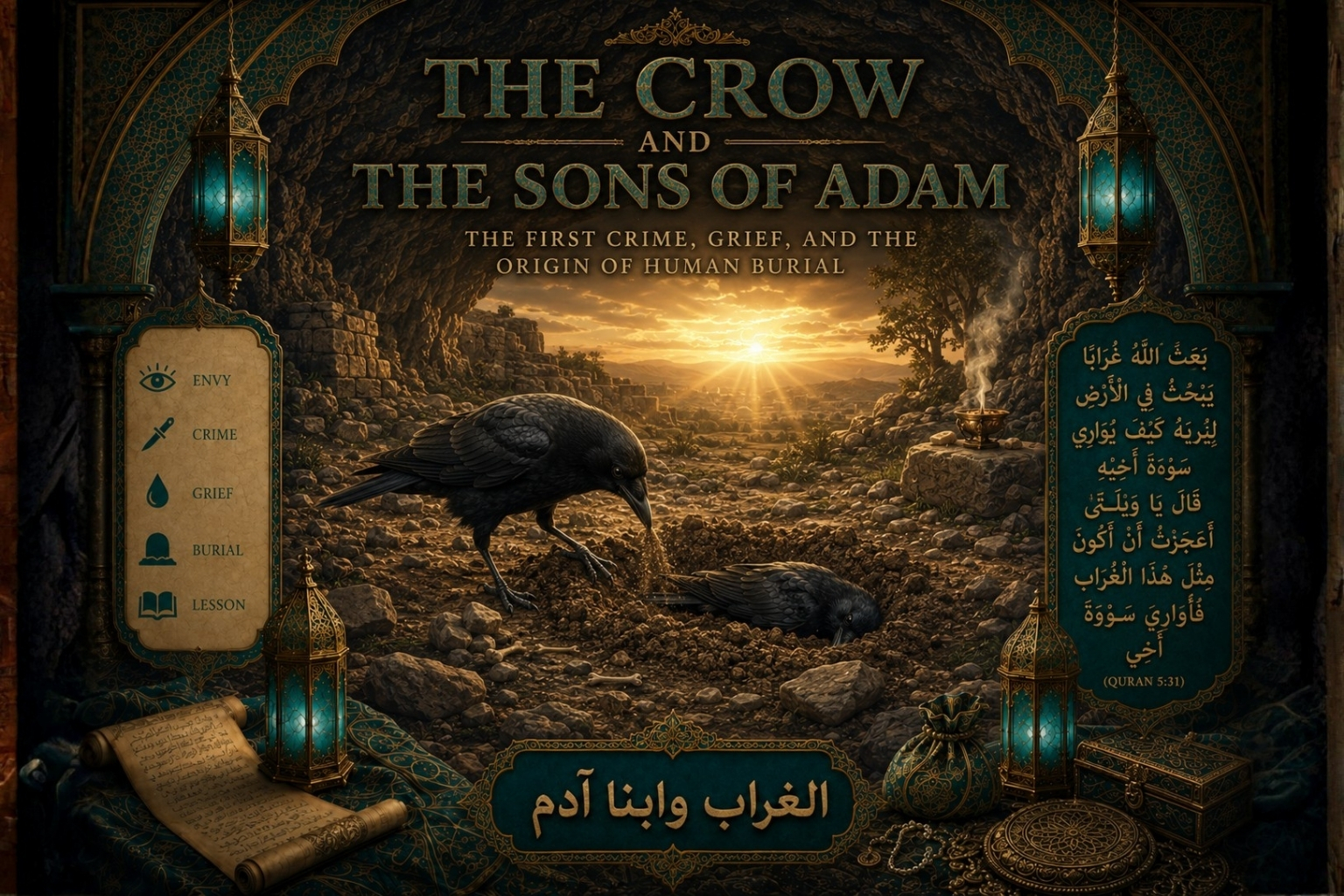
Qabeel carried his brother’s body on his back for days, wandering aimlessly through the wilderness in absolute psychological torment, watched only by the wild animals. To rescue humanity from this administrative and emotional crisis, Allah intervened by sending a specialized animal educator: a crow (Ghurab).
“فَبَعَثَ اللَّهُ غُرَابًا يَبْحَثُ فِي الْأَرْضِ لِيُرِيَهُ كَيْفَ يُوَارِي سَوْءَةَ أَخِيهِ ۚ قَالَ يَا وَيْلَتَىٰ أَعَجَزْتُ أَنْ أَكُونَ مِثْلَ هَٰذَا الْغُرَابِ فَأُوَارِيَ سَوْءَةَ أَخِي ۖ فَأَصْبَحَ مِنَ النَّادِمِينَ”
“Then Allah sent a crow scratching in the earth to show him how to hide the dead body of his brother. He said, ‘Oh, woe to me! Have I failed to be like this crow and hide the body of my brother?’ And he became of the regretful.” — (Surah Al-Ma’idah, 5:31)
Qabeel watched intensely as the crow landed on the dirt right in front of him. According to historic commentaries, the crow was either accompanied by a dead companion or found a carcass. The intelligent bird began systematically scratching and digging into the earth with its claws and beak until it created a small trench. It then gently pushed the dead animal into the hole and raked the loose dirt back over it, completely concealing it from view.
The Awakening of Shame and Regret
This simple, elegant display of avian intelligence hit Qabeel with the force of a physical blow. He experienced a profound awakening of shame, realizing his own intellectual and moral bankruptcy. He wept in agony, crying out that he had become lower and more helpless than a simple bird, failing to understand a basic law of nature that a crow executed naturally.
Following the exact method taught by the crow, Qabeel dug the earth and buried Habeel, establishing the very first human grave on Earth and cementing burial as the sacred, divinely mandated method for honoring the human body after death.
The Prophet Muhammad heavily emphasized the immense gravity of this original sin, teaching Muslims that because Qabeel initiated the path of murder, he carries a spiritual liability for every wrongful killing committed until the end of time.
“لاَ تُقْتَلُ نَفْسٌ ظُلْمًا إِلاَّ كَانَ عَلَى ابْنِ آدَمَ الأَوَّلِ كِفْلٌ مِنْ دَمِهَا، لأَنَّهُ كَانَ أَوَّلَ مَنْ سَنَّ الْقَتْلَ”
“No human soul is killed unjustly except that a portion of the responsibility for its blood is laid upon the first son of Adam, for he was the very first to instantiate the practice of murder.” — (Sahih al-Bukhari & Sahih Muslim)
Core Spiritual Lessons from the Crow and the Sons of Adam
- The Sacred Sanctity of the Human Body: Allah did not allow the body of Habeel to be burned, discarded, or left to the elements. By sending a crow to teach burial, Allah established that the human body—even in death—possesses an innate, inviolable dignity (Karamah) that must be protected through a respectful, clean return to the earth from which it was created.
- The Intelligence and Agency of Nature: The narrative completely shatters the human delusion that animals are mindless, unintelligent objects. Crows possess advanced cognitive mapping, problem-solving skills, and a deep understanding of environmental systems. Allah uses the natural instincts of His creatures to teach, correct, and civilize human behavior.
- The Destructive Nature of Jealousy (Hasad): Qabeel’s downfall did not begin with a sword; it began with a hidden thought of jealousy because his brother’s sacrifice was accepted. Jealousy eats away at a person’s intellect, blinding them to reality until it drives them to destroy the very people they should protect.
- The Weight of Setting a Bad Precedent: The narrative serves as an urgent warning regarding systemic accountability. When you introduce a toxic, violent, or corrupt behavior into your family, business, or society, you remain spiritually and morally liable for the ripple effects of that behavior across generations.
Conclusion
The monumental history of the Crow and the Sons of Adam stands as an eternal, sobering reminder of humanity’s origins and our deep relationship with the natural world. It proves that true knowledge and civilization require a deep sense of humility—a willingness to look down at the earth and learn even from a bird. By mastering our internal egos, purifying our intentions before Allah, and treating both the living and the deceased with the utmost respect and dignity, we protect our communities from internal collapse, ensuring our lives are anchored in peace, environmental balance, and absolute eternal success.