

Among the many verses in the Qur’an that inspire reflection, one short statement continues to fascinate both believers and researchers alike:
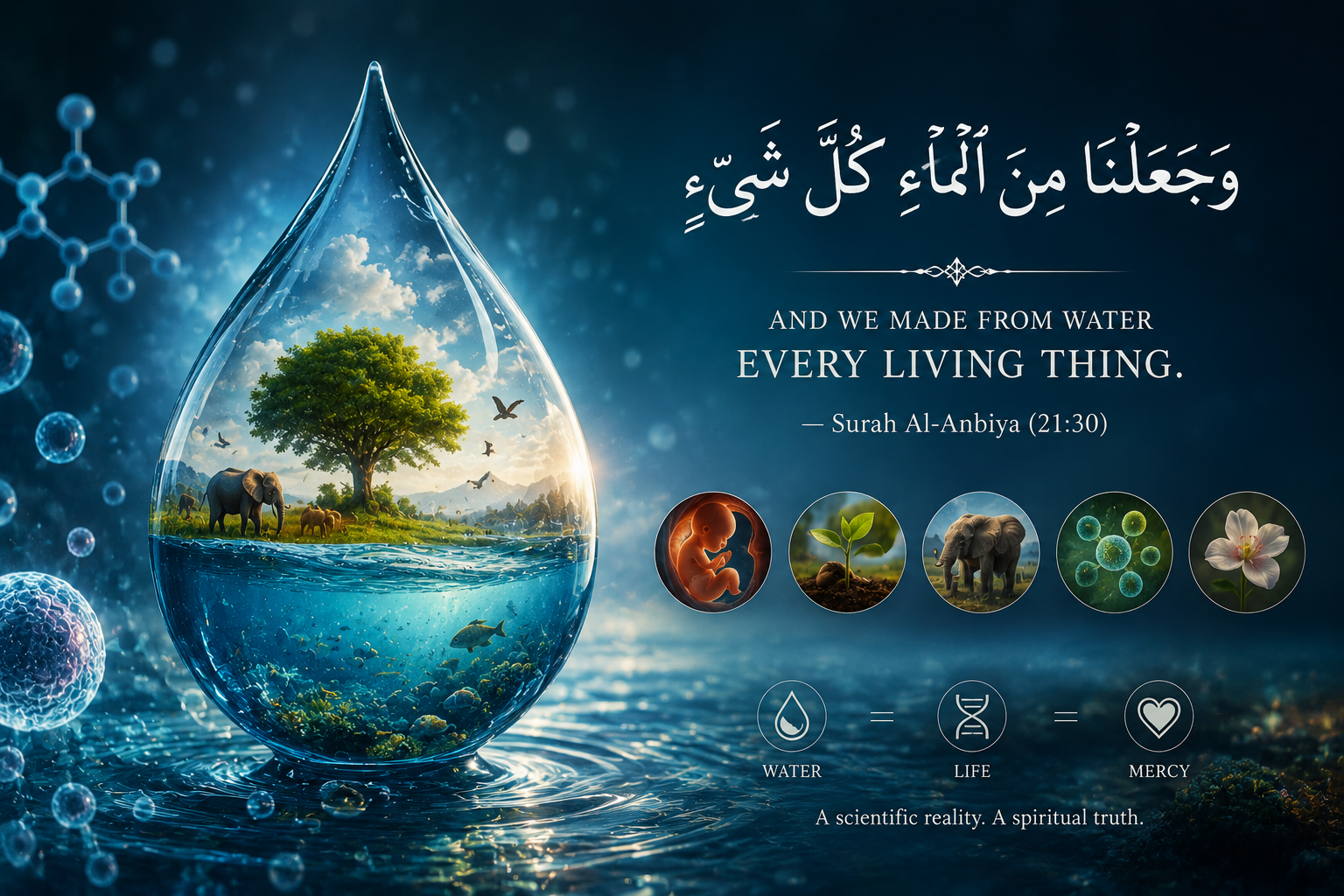
“وَجَعَلْنَا مِنَ الْمَاءِ كُلَّ شَيْءٍ حَيٍّ”
“And We made from water every living thing.”
— Surah Al-Anbiya (21:30)
At first glance, the verse appears simple. Yet behind these few words lies an extraordinary reality connected to biology, human existence, and the foundations of life itself.
Today, modern science confirms that water is essential for all known living organisms. Human beings, animals, plants, and even microscopic 1 life forms depend fundamentally on water for survival.
For Muslims, this verse represents not only a scientific reality, but also a profound reminder of Allah’s wisdom, power, and the delicate design of creation.
Water: The Foundation of Life
Modern biology 2 recognizes water as one of the most essential components of life on Earth.
Living cells require water for:
- Chemical reactions
- Nutrient transport
- Temperature regulation
- Energy production
- Cellular 3 survival
Without water, life as we know it cannot exist.
Scientists studying the possibility of life on other planets often begin by searching for the presence of water first, because its existence is considered one of the strongest indicators of potential biological activity 4.
This scientific reality makes the Qur’anic verse especially remarkable to many believers.
More than fourteen centuries ago, the Qur’an connected water directly with all living things during a time when humanity possessed no modern biological technology, microscopes, or advanced scientific laboratories.
The Human Body and Water
One of the clearest examples of this reality is the human body itself.
A large percentage of the human body consists of water. Water exists within:
- Blood
- Cells
- Organs
- Muscles
- The brain
It plays a central role in maintaining life and protecting the body from damage.
Even short periods of severe dehydration 5 can become dangerous for human survival.
The human dependence on water constantly reminds people of their fragility 6 and need for sustenance created by Allah.
A Verse That Encourages Reflection
The Qur’an repeatedly calls people to reflect upon creation rather than simply observe it passively.
This verse is not merely presenting biological information. It encourages deeper reflection about:
- The origin of life
- Human dependence
- Divine wisdom
- The balance of nature
Allah frequently invites humanity to think carefully about the world around them as signs pointing toward His existence and power.
In Islam, reflection upon creation is considered a pathway toward stronger faith and greater appreciation of Allah’s mercy.
Could People in the 7th Century Have Known This?
One reason this verse attracts so much attention is the historical context in which it was revealed.
The Arabian Peninsula in the 7th century had:
- No advanced biological science
- No knowledge of cells
- No microscopes
- No modern understanding of physiology 7
Yet the Qur’an described water as central to all living things in a concise and direct manner.
For Muslims, this supports the belief that the Qur’an contains knowledge originating from Allah rather than human observation alone.
The verse does not read like speculation 8 or philosophical guessing. Instead, it presents the connection between water and life with certainty and clarity.
The Spiritual Symbolism of Water in Islam
Beyond biology, water also carries profound spiritual meaning in Islam.
Water symbolizes:
- Purification 9
- Mercy
- Renewal
- Life
- Blessing
Muslims use water daily for wudu (ablution) before prayer, symbolizing both physical cleanliness and spiritual preparation.
The Qur’an also frequently connects rain with Allah’s mercy and revival of dead land.
Allah says:
“وَهُوَ الَّذِي يُنَزِّلُ الْغَيْثَ”
“And He is the One who sends down the rain.”
— Surah Ash-Shura (42:28)
Just as water revives dry earth, faith and revelation are described as reviving the human heart.
The Precision of Qur’anic Language
Another fascinating aspect of the verse is its brevity.
The Qur’an communicates an immense scientific and spiritual concept using only a few words:
“مِنَ الْمَاءِ كُلَّ شَيْءٍ حَيٍّ”
“From water every living thing.”
This concise expression reflects one of the defining characteristics of the Qur’an: conveying deep meaning with extraordinary precision.
Many scholars of Qur’anic Arabic point to this balance between simplicity and depth as part of the Qur’an’s linguistic miracle.
Water as a Universal Human Reminder
Every human being, regardless of culture or language, understands the importance of water.
People can survive:
- Days without food
- Long periods without comfort
- Many harsh environmental conditions
But without water, life quickly collapses.
The Qur’an transforms this ordinary reality into a spiritual reminder. Every sip of water becomes evidence of dependence upon Allah’s creation and mercy.
This ability to connect ordinary human experiences with profound spiritual reflection is one reason the Qur’an continues to resonate 10 deeply with readers across generations.
More Than a Scientific Statement
Muslims do not view the Qur’an as a science textbook. Its primary purpose is guidance.
However, verses like this demonstrate how the Qur’an often points toward realities that humans later continue discovering more deeply through scientific exploration.
For believers, the harmony between revelation and observable reality 11 strengthens faith in the divine origin of the Qur’an.
Conclusion
The verse “And We made from water every living thing” remains one of the most powerful and thought-provoking statements in the Qur’an. In only a few words, it connects biology, human dependence, spiritual reflection, and divine wisdom.
More than fourteen centuries after its revelation, modern science continues confirming the central role of water in sustaining life — a reality the Qur’an described long before the development of modern scientific knowledge.
This verse is more than a scientific observation. It is a reminder that behind every drop of water lies a sign of Allah’s power, mercy, and perfect creation.