
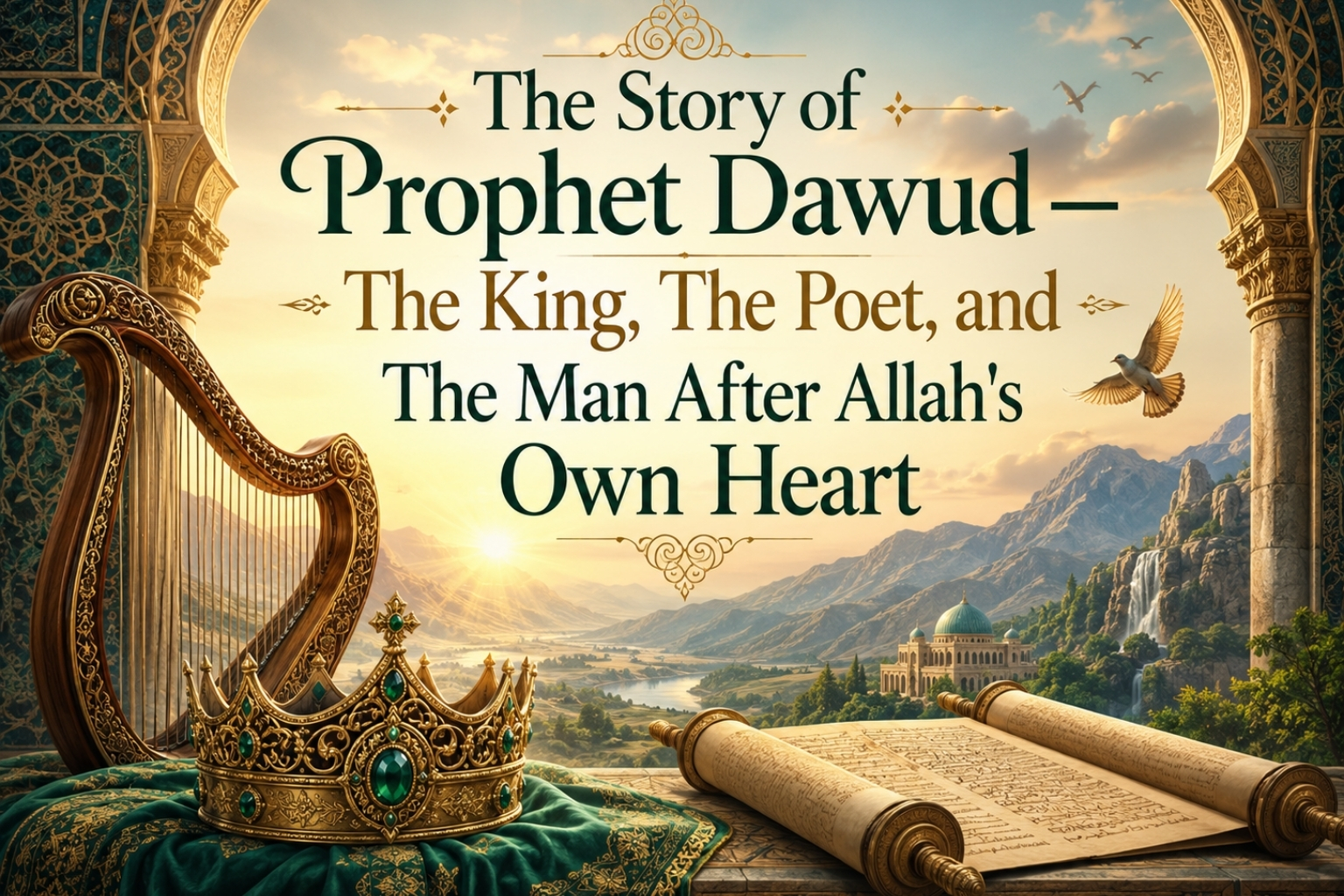

There are prophets who were kings. There are kings who were warriors. There are warriors who were poets. But in all of human history, there was only one man who was all of these things simultaneously — and who wielded each of them not in service of himself, but in service of Allah.
Prophet Dawud, peace be upon him, began as a young shepherd boy and ended as the king of the greatest empire Bani Israel ever knew. He killed the most feared warrior of his age with a single stone before he held a sword. He was given a voice so beautiful that mountains and birds joined him in the glorification of Allah. He was given the Zabur — the Psalms — one of the four great revealed books. And he was given a kingdom, a family, and a legacy that would flow through his son Sulaiman into the very foundations of monotheistic civilization.
But Dawud’s story is not the story of a flawless hero. It is the story of a human being — gifted beyond measure, tested beyond comfort, and capable of both extraordinary devotion and serious error. It is the story of what happens when a person with immense gifts stumbles — and then, with complete sincerity, returns.
And it is the story of what Allah does with the return of a sincere heart.
Chapter One — The Boy with the Stone: Before the Crown Came the Test
Dawud did not arrive at his greatness through privilege or inheritance. He arrived through a moment of courage that no one expected from him — least of all the armies of Bani Israel who stood trembling before a giant.
Jalut — known in the Western tradition as Goliath — was the champion warrior of the Philistines. He had challenged the army of Bani Israel to send a man to face him in single combat. The soldiers of Bani Israel, for all their numbers, looked at Jalut and felt what untested courage always feels in the face of visible power: paralysis.
Then a shepherd boy — young, unknown, carrying provisions for his brothers in the army — stepped forward.
Allah describes what happened next in verses that are among the most dramatic in the entire Quran:
Quran Verse:
فَهَزَمُوهُم بِإِذْنِ اللَّهِ وَقَتَلَ دَاوُودُ جَالُوتَ وَآتَاهُ اللَّهُ الْمُلْكَ وَالْحِكْمَةَ وَعَلَّمَهُ مِمَّا يَشَاءُ
“So they defeated them by permission of Allah, and Dawud killed Jalut, and Allah gave him the kingship and prophethood and taught him from that which He willed.”
Surah Al-Baqarah (2:251)
Three gifts given in one verse — and notice their order. Kingship came first. Then wisdom. Then knowledge of what Allah willed. The sequence is significant: the external gift of authority came, and was then elevated by the internal gifts of wisdom and divine knowledge. Dawud was not simply given a crown. He was given the capacity to wear it justly.
And it all began with a stone. A shepherd boy’s sling. A single shot that ended the career of the most feared warrior of the age — not because Dawud was the strongest man in the field, but because the permission of Allah was behind the stone.
This is one of the Quran’s earliest and clearest statements about the nature of victory: فَهَزَمُوهُم بِإِذْنِ اللَّهِ — they defeated them by the permission of Allah. Not by numbers. Not by military superiority. By divine permission — given to those whose trust in Allah exceeded their fear of what stood before them.
Chapter Two — The Voice of Creation: When Mountains and Birds Sang With Him
Among the gifts Allah gave Dawud was one that stands apart from anything given to any other prophet — a voice so extraordinary, a recitation so sublime, that the creation itself could not remain silent when he glorified Allah:
Quran Verse:
وَلَقَدْ آتَيْنَا دَاوُودَ مِنَّا فَضْلًا ۖ يَا جِبَالُ أَوِّبِي مَعَهُ وَالطَّيْرَ ۖ وَأَلَنَّا لَهُ الْحَدِيدَ
“And We certainly gave Dawud from Us bounty. O mountains, repeat the praises with him, and the birds. And we made pliable iron for him.”
Surah Saba (34:10)
Allah commanded the mountains to echo Dawud’s glorification. He commanded the birds to join him. The entire landscape around Dawud when he recited — the rocks, the sky, the creatures — became a congregation, a choir, a unanimous response to one man’s praise of his Creator.
The Prophet Muhammad ﷺ described Dawud’s voice in a way that makes clear just how extraordinary this gift truly was:
Hadith:
مَا أَذِنَ اللَّهُ لِشَيْءٍ مَا أَذِنَ لِنَبِيٍّ يَتَغَنَّى بِالْقُرْآنِ
“Allah has not listened to anything as He listens to a prophet who recites the Quran in a melodious voice.”
Recorded in Sahih Al-Bukhari, Hadith No. 5024
And in a more specific narration about Dawud himself:
Hadith:
لَوْ رَأَيْتَنِي الْبَارِحَةَ وَأَنَا أَسْمَعُ قِرَاءَتَكَ، لَقَدْ أُعْطِيتَ مِزْمَارًا مِنْ مَزَامِيرِ آلِ دَاوُودَ
“If you had seen me last night listening to your recitation — you have been given a flute from the flutes of the family of Dawud.”
Recorded in Sahih Muslim, Hadith No. 793
A flute from the flutes of the family of Dawud. The Prophet Muhammad ﷺ used Dawud’s voice as the highest standard of melodious recitation — the benchmark against which all beautiful Quranic recitation is measured. The mountains echoed it. The birds sang with it. And centuries later, the Prophet Muhammad ﷺ was still invoking it as the pinnacle of what a human voice dedicated to Allah can achieve.
Chapter Three — The Zabur: The Book of Praise
Allah gave Dawud one of the four great revealed books — the Zabur, known in the Western tradition as the Psalms. It was a book of glorification, of praise, of intimate conversation between a servant and his Lord — poetry of devotion that captured the full range of human experience before Allah: gratitude, grief, joy, repentance, wonder, fear, and love.
Allah mentions the Zabur in the Quran as a confirmed divine revelation:
Quran Verse:
وَرَبُّكَ أَعْلَمُ بِمَن فِي السَّمَاوَاتِ وَالْأَرْضِ ۗ وَلَقَدْ فَضَّلْنَا بَعْضَ النَّبِيِّينَ عَلَىٰ بَعْضٍ ۖ وَآتَيْنَا دَاوُودَ زَبُورًا
“And your Lord is most knowing of whoever is in the heavens and the earth. And We have made some prophets exceed others in favor, and to Dawud We gave the Zabur.”
Surah Al-Isra (17:55)
The Zabur was not a book of law — that was the Torah given to Musa. It was a book of worship. A guide to how a heart that knows Allah expresses itself before Him. Dawud did not just receive revelation — he sang it. He breathed it. He turned it into the very substance of his daily communion with Allah.
And this is why the mountains echoed. When a man’s entire being — his voice, his heart, his words, his breath — is directed toward Allah, creation cannot remain silent.
Chapter Four — The Miracle of Iron: Prophet, King, and Craftsman
Among the gifts Allah gave Dawud was one that seems almost incongruous alongside his prophethood and his beautiful voice — the ability to work iron with his bare hands:
Quran Verse:
وَأَلَنَّا لَهُ الْحَدِيدَ ﴿١٠﴾ أَنِ اعْمَلْ سَابِغَاتٍ وَقَدِّرْ فِي السَّرْدِ ۖ وَاعْمَلُوا صَالِحًا ۖ إِنِّي بِمَا تَعْلَمُونَ بَصِيرٌ
“And We made pliable iron for him — make full coats of mail and calculate the links. And work righteousness. Indeed, I am what you do, seeing.”
Surah Saba (34:10–11)
Iron — one of the hardest materials known to human civilization — became soft in Dawud’s hands. Allah commanded him to use this gift practically: to make coats of mail, armor that would protect warriors in battle. And He added a command that elevates the entire enterprise: work righteousness.
Dawud was a prophet who made armor with his own hands. He did not rely on his kingdom’s treasury for his livelihood — Islamic tradition notes that he earned his living from the work of his hands, fashioning and selling the armor that his miraculous ability allowed him to create.
The Prophet Muhammad ﷺ honored this specifically:
Hadith:
كَانَ دَاوُودُ النَّبِيُّ لَا يَأْكُلُ إِلَّا مِنْ عَمَلِ يَدِهِ
“Prophet Dawud used to eat only from the work of his own hands.”
Recorded in Sahih Al-Bukhari, Hadith No. 2073
A king who earned his own food. A prophet whose hands were not too noble for labor. A man given the miraculous pliability of iron who used it not for display but for the practical service of his people.
This is one of the Quran’s teachings about the relationship between divine gift and human responsibility: every gift Allah gives is also a tool — and the measure of gratitude for the gift is the quality of the work you do with it.
Chapter Five — The Justice of His Judgment: Speed, Wisdom, and the Test
Allah gave Dawud extraordinary wisdom in judgment — an ability to perceive the truth of a matter with a speed and clarity that was itself a divine gift. But the Quran also records a moment when this gift was tested — not by enemies, not by armies, but by two people who came to him seeking judgment:
Quran Verse:
وَهَلْ أَتَاكَ نَبَأُ الْخَصْمِ إِذْ تَسَوَّرُوا الْمِحْرَابَ ﴿٢١﴾ إِذْ دَخَلُوا عَلَىٰ دَاوُودَ فَفَزِعَ مِنْهُمْ ۖ قَالُوا لَا تَخَفْ ۖ خَصْمَانِ بَغَىٰ بَعْضُنَا عَلَىٰ بَعْضٍ فَاحْكُم بَيْنَنَا بِالْحَقِّ وَلَا تُشْطِطْ وَاهْدِنَا إِلَىٰ سَوَاءِ الصِّرَاطِ
“And has there come to you the news of the adversaries, when they climbed over the wall of the prayer chamber — when they entered upon Dawud and he was startled by them? They said: ‘Fear not. We are two adversaries, one of whom has wronged the other, so judge between us in truth and do not exceed the bounds and guide us to the correct way.'”
Surah Sad (38:21–22)
Two men appeared — mysteriously, climbing over the wall of his private prayer chamber. One claimed the other had ninety-nine ewes and had taken his single remaining one through pressure and persuasion. Dawud heard the complaint — and rendered his verdict immediately, before fully hearing both sides:
Quran Verse:
قَالَ لَقَدْ ظَلَمَكَ بِسُؤَالِ نَعْجَتِكَ إِلَىٰ نِعَاجِهِ ۖ وَإِنَّ كَثِيرًا مِّنَ الْخُلَطَاءِ لَيَبْغِي بَعْضُهُمْ عَلَىٰ بَعْضٍ إِلَّا الَّذِينَ آمَنُوا وَعَمِلُوا الصَّالِحَاتِ وَقَلِيلٌ مَّا هُمْ
“He said: ‘He has certainly wronged you in demanding your ewe in addition to his ewes. And indeed, many associates oppress one another, except for those who believe and do righteous deeds — and few are they.'”
Surah Sad (38:24)
Then came the moment of recognition — Dawud realized this had been a test. He had judged before hearing both sides completely. He had allowed his quick perceptiveness to outrun the due process that justice requires:
Quran Verse:
وَظَنَّ دَاوُودُ أَنَّمَا فَتَنَّاهُ فَاسْتَغْفَرَ رَبَّهُ وَخَرَّ رَاكِعًا وَأَنَابَ
“And Dawud realized that We had tested him, and he asked forgiveness of his Lord and fell down bowing and turned in repentance to Allah.”
Surah Sad (38:24)
He fell down in prostration immediately. He sought Allah’s forgiveness with the urgency of a man who understood the weight of the error — not the error of a criminal, but the error of a judge who had allowed the speed of his perception to bypass the thoroughness that justice demands.
And Allah’s response is one of the most beautiful expressions of divine mercy in the entire Quran:
Quran Verse:
فَغَفَرْنَا لَهُ ذَٰلِكَ ۖ وَإِنَّ لَهُ عِندَنَا لَزُلْفَىٰ وَحُسْنَ مَآبٍ
“So We forgave him that; and indeed, for him is nearness to Us and a good place of return.”
Surah Sad (38:25)
Forgiven. And not just forgiven — brought nearer. The repentance of Dawud did not distance him from Allah. It brought him closer. Allah used the word zulfa — nearness, proximity — to describe what sincere repentance produces. The fall followed by the return left Dawud closer to Allah than he had been before the test.
This is one of the Quran’s most important teachings about the nature of sin and repentance: the sincere istighfar of a believer, offered immediately and completely, does not simply restore their original position. It can elevate them beyond it.
Chapter Six — The Khalifah: Given Authority With a Condition
After the test and the repentance, Allah gave Dawud one of the most significant titles given to any human being in the Quran — and attached to it one of the most demanding conditions:
Quran Verse:
يَا دَاوُودُ إِنَّا جَعَلْنَاكَ خَلِيفَةً فِي الْأَرْضِ فَاحْكُم بَيْنَ النَّاسِ بِالْحَقِّ وَلَا تَتَّبِعِ الْهَوَىٰ فَيُضِلَّكَ عَن سَبِيلِ اللَّهِ ۚ إِنَّ الَّذِينَ يَضِلُّونَ عَن سَبِيلِ اللَّهِ لَهُمْ عَذَابٌ شَدِيدٌ بِمَا نَسُوا يَوْمَ الْحِسَابِ
“O Dawud, indeed We have made you a khalifah upon the earth, so judge between the people in truth and do not follow desire, as it will lead you astray from the way of Allah. Indeed, those who go astray from the way of Allah will have a severe punishment for having forgotten the Day of Account.”
Surah Sad (38:26)
“Judge in truth and do not follow desire.” The greatest danger to a king — to anyone with power — is not an external enemy. It is the internal one: the desire that subtly bends judgment, that makes exceptions for what we want, that finds reasons to rule in favor of our preferences rather than the truth.
Allah gave Dawud authority and in the same breath warned him of the one thing that could corrupt it. Not armies. Not rivals. Not poverty. Desire — the quiet, internal pull of wanting things to go the way we want them to go.
Every person in any position of authority — over a nation, over an organization, over a family, over a single decision that affects others — is given this same test. Judge in truth. Do not follow desire.
Chapter Seven — The Worship of Dawud: The Standard That Still Stands
Among the prophets, Dawud was known for an extraordinary dedication to worship — a schedule of fasting and prayer that the Prophet Muhammad ﷺ described as the most beloved form of voluntary fasting to Allah:
Hadith:
أَحَبُّ الصَّلَاةِ إِلَى اللَّهِ صَلَاةُ دَاوُودَ عَلَيْهِ السَّلَامُ، وَأَحَبُّ الصِّيَامِ إِلَى اللَّهِ صِيَامُ دَاوُودَ، وَكَانَ يَنَامُ نِصْفَ اللَّيْلِ وَيَقُومُ ثُلُثَهُ وَيَنَامُ سُدُسَهُ، وَكَانَ يَصُومُ يَوْمًا وَيُفْطِرُ يَوْمًا
“The most beloved prayer to Allah is the prayer of Dawud, peace be upon him, and the most beloved fasting to Allah is the fasting of Dawud. He used to sleep half the night, then pray for a third of it, then sleep for a sixth of it. And he used to fast one day and break his fast the next day.”
Recorded in Sahih Al-Bukhari, Hadith No. 1131
Alternating days of fasting — one day fasting, one day eating — for a lifetime. And a night divided into precise thirds: sleep, then prayer, then sleep again. This schedule — maintained not for a week or a month but as the permanent rhythm of Dawud’s life — became the standard against which all voluntary worship is measured in Islamic tradition.
The Prophet Muhammad ﷺ called it the most beloved to Allah not because it was the most extreme, but because it was sustainable — because Dawud never abandoned it, never had to reduce it, never burned out from excess and then fell into neglect. He found the rhythm that his soul could maintain for life — and he maintained it for life.
Chapter Eight — The Legacy: Father of Sulaiman, Ancestor of Kings
Dawud’s legacy extended beyond his own lifetime through his son Prophet Sulaiman, peace be upon him — to whom Allah gave a kingdom that surpassed even Dawud’s in its extraordinary nature. Allah describes this inheritance as a divine gift:
Quran Verse:
وَوَرِثَ سُلَيْمَانُ دَاوُودَ ۖ وَقَالَ يَا أَيُّهَا النَّاسُ عُلِّمْنَا مَنطِقَ الطَّيْرِ وَأُوتِينَا مِن كُلِّ شَيْءٍ ۖ إِنَّ هَٰذَا لَهُوَ الْفَضْلُ الْمُبِينُ
“And Sulaiman inherited Dawud and said: ‘O people, we have been taught the language of birds, and we have been given from all things. Indeed, this is evident bounty.'”
Surah An-Naml (27:16)
Sulaiman inherited not just Dawud’s kingdom but his prophethood, his wisdom, and his position as Allah’s khalifah on earth. The legacy of Dawud — the shepherd boy who killed a giant, the warrior who became a king, the poet whose voice made mountains sing — flowed forward into a son whose kingdom would become one of the most remarkable in human history.
Allah also mentions Dawud among the select company of the greatest prophets — in a list that itself is a form of honor:
Quran Verse:
وَرَبُّكَ أَعْلَمُ بِمَن فِي السَّمَاوَاتِ وَالْأَرْضِ ۗ وَلَقَدْ فَضَّلْنَا بَعْضَ النَّبِيِّينَ عَلَىٰ بَعْضٍ ۖ وَآتَيْنَا دَاوُودَ زَبُورًا
“And your Lord is most knowing of whoever is in the heavens and the earth. And We have made some prophets exceed others in favor, and to Dawud We gave the Zabur.”
Surah Al-Isra (17:55)
Among all the prophets given distinction — Dawud is specifically named as the one given the Zabur. His distinction is the Book of Praise. His legacy is the voice that glorified Allah so completely that mountains could not remain silent.
Timeless Lessons from the Story of Dawud
- The permission of Allah behind a small stone is more powerful than any army Dawud killed Jalut not because he was the strongest man in the field but because Allah’s permission was behind the stone. When you act in Allah’s cause with sincere trust — the size of your means is irrelevant to the outcome Allah has decreed.
- The gift of a beautiful voice is an amanah — use it for Allah. Dawud was given the most beautiful voice in human history — and he used it to glorify Allah until the mountains echoed. Every gift you have been given — your voice, your intelligence, your skill, your influence — is a trust. The question is what you do with it.
- Earning your own provision with your hands is a form of honor, not diminishment. A king who ate only from the work of his own hands. A prophet who made armor rather than depending on the treasury. Dawud showed that self-sufficiency and honest labor are dignities, not degradations. The work of your hands is blessed.
- Even the speed of genius must be governed by the due process of justice Dawud’s test was that his quick, gifted perception caused him to judge before hearing both sides. The greatest danger of natural talent is that it can outrun the careful process that fairness requires. Speed is a gift — but thoroughness is a discipline that must accompany it.
- Immediate, complete, sincere repentance brings you nearer to Allah — not further Dawud fell into prostration the moment he recognized his error. He did not delay, rationalize, or minimize. And Allah did not just forgive him — He brought him nearer. The sincere return after a fall can leave you closer to Allah than the fall found you.
- Authority is a test — and the greatest danger to it is desire. Allah gave Dawud the khalifah and warned him in the same breath about desire. Every person in a position of authority over others faces this test daily. The difference between just authority and corrupt authority is whether the judgment follows the truth or follows what the judge wants.
- Sustainable worship is more beloved to Allah than intense worship that cannot be maintained. Dawud’s fasting schedule — alternating days, for life — was called the most beloved to Allah. Not the most extreme. The most sustainable. Find the worship you can maintain without burning out, and maintain it for life. That consistency is what Allah loves.
Closing Reflection
A young shepherd boy looked at the most feared warrior of his age and saw not an obstacle but an opportunity — an opportunity to demonstrate what happens when a human being acts with the permission of Allah behind them.
That stone flew. Jalut fell. And the boy who threw it became a king, a prophet, a poet, a craftsman — a man whose voice made mountains sing and whose heart, even after its most serious stumble, turned back to Allah with a prostration so immediate and so sincere that Allah said of him: for him is nearness to Us.
Not distance. Not diminishing. Nearness.
The mountains are still. The birds are silent now. The Zabur has been changed by human hands over the centuries. But in the Quran — unchanged, unaltered, preserved by Allah Himself — the story of Dawud remains. The shepherd boy with the stone. The king who ate from the work of his hands. The man whose voice Allah commanded the mountains to echo. The prophet who fell in prostration at the moment of his error and was brought nearer for it.
Quran Verse:
فَغَفَرْنَا لَهُ ذَٰلِكَ ۖ وَإِنَّ لَهُ عِندَنَا لَزُلْفَىٰ وَحُسْنَ مَآبٍ
“So We forgave him that; and indeed, for him is nearness to Us and a good place of return.”
Surah Sad (38:25)
Nearness. After the fall. After the return. After the prostration.
That is what sincere repentance earns. Not just forgiveness — nearness.
Fall. Return. Fall. Return. Always return. The door of Allah’s nearness is never closed to the one who keeps coming back.