

We live in a digital culture dominated by soundbites, headlines, and short social media clips. While this fast-paced consumption makes it easy to skim information, it has ruined our collective ability to engage with deep, complex texts. When this habit of “surface reading” is applied to religious texts, it becomes highly dangerous.
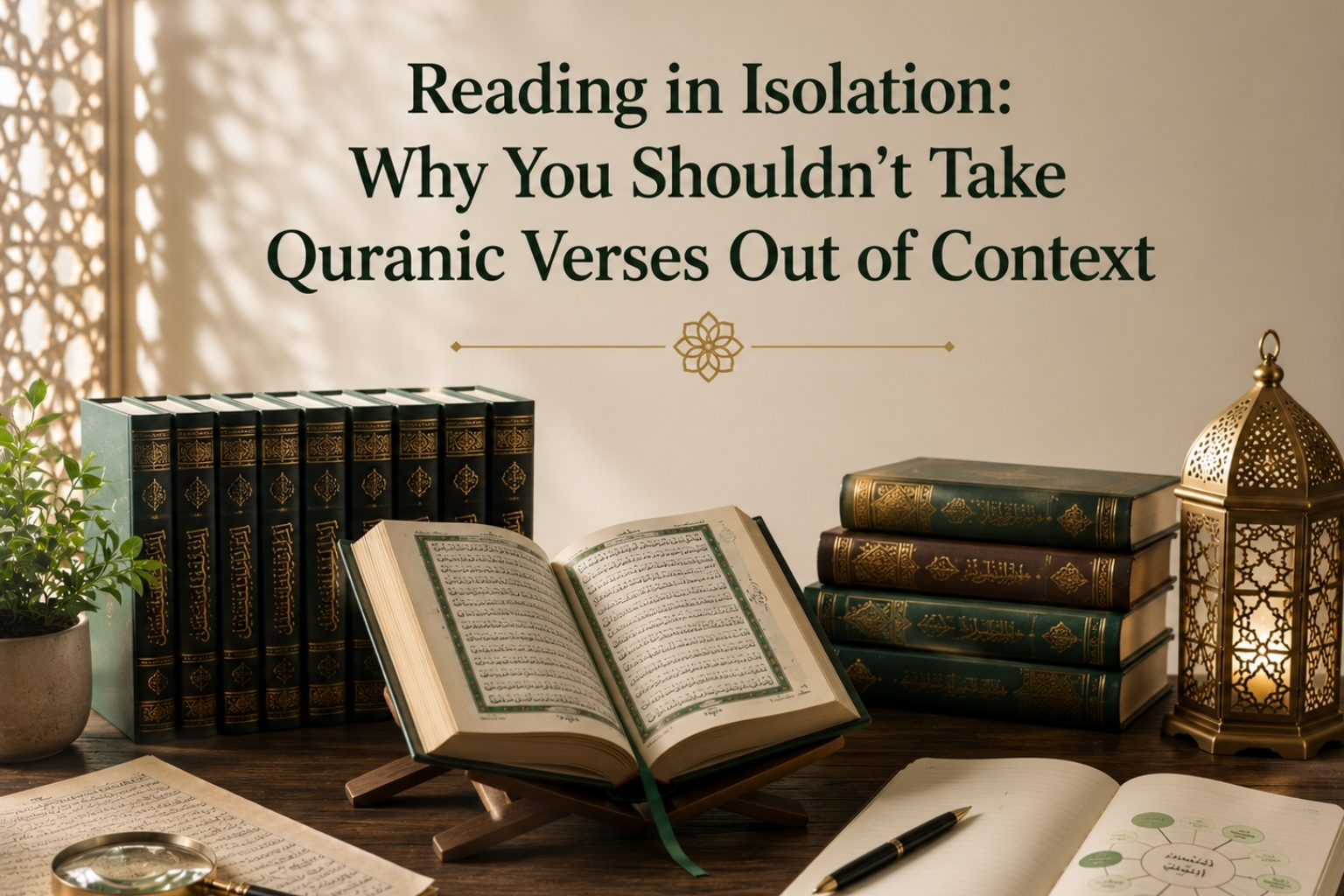
One of the most common pitfalls facing both new readers and critics alike is reading in isolation—the act of taking Quranic verses out of context. Isolating a single phrase from its paragraph, its chapter, or its historical background is a recipe for severe misunderstanding. To build a sound methodology for studying the Holy Book, we must understand why context is not just an optional layer of meaning, but the very foundation of truth.
The Danger of Textual Cherry-Picking
Every written document, from legal contracts to classic literature, relies on a coherent flow of ideas. If you extract a single line out of context, you can make the author say almost anything you want.
In Islamic scholarship, taking a verse out of context to justify a personal whim or a biased preconceived notion is heavily warned against. The scripture explicitly describes how pulling words out of their proper places is a trait that leads to misguidance and confusion.
The Holy Quran strongly warns against handling sacred knowledge with a dishonest methodology, highlighting how manipulating the context of words ruins a person’s understanding:
{فَبِمَا نَقْضِهِم مِّيثَاقَهُمْ لَعَنَّاهُمْ وَجَعَلْنَا قُلُوبَهُمْ قَاسِيَةً ۖ يُحَرِّفُونَ الْكَلِمَ عَن مَّوَاضِعِهِ}
“So for their breaking of the covenant We cursed them and made their hearts hard. They distort words from their [proper] usages…” [Surah Al-Ma’idah, 13]
When a reader “cherry-picks” a verse, they ignore the verses that come right before it, the verses that follow it, and the overarching principles of the faith. This reckless approach is what births most misconceptions about Islam.
The Two Levels of Context You Must Consider
To avoid the trap of reading in isolation, a serious student must learn to look at two distinct levels of context whenever they read a verse in English:
1. Structural Context (The Textual Surrounding)
This refers to looking at the entire passage rather than just a single sentence. For example, some critics isolate part of a verse that mentions fighting, while completely ignoring the very next sentence which states: “But if they incline to peace, then incline to it [also] and rely upon God.” (Surah Al-Anfal, 61). Looking at the structural context instantly clarifies that peace and justice are the ultimate goals, not endless conflict.
2. Historical Context (The Backstory)
As discussed in the science of Asbab al-Nuzul (Reasons for Revelation), verses were often revealed as direct responses to real-life, historical events. Reading a law meant specifically for a defensive battlefield 1,400 years ago and trying to apply it literally to an innocent neighbor today is a massive, violent intellectual error. The historical background dictates the scope of the verse.
Intellectual Honesty is a Spiritual Duty
Approaching the text requires a high degree of intellectual honesty and spiritual humility. The text is a grand tapestry where different verses complement, explain, and balance one another. If you look at one thread in isolation, you miss the entire picture.
The Prophet Muhammad (peace be upon him) fiercely warned his companions against arguing over specific verses or setting parts of the scripture against others, as this intellectual division destroys the purity of faith:
عَنْ عَبْدِ اللَّهِ بْنِ عَمْرٍو قَالَ: هَجَّرْتُ إِلَى رَسُولِ اللَّهِ صَلَّى اللَّهُ عَلَيْهِ وَسَلَّمَ يَوْمًا، فَقَالَ: «إِنَّمَا هَلَكَتِ الأُمَمُ قَبْلَكُمْ بِاخْتِلاَفِهِمْ فِي الْكِتَابِ»
Narrated by Abdullah ibn Amr: I went to the Messenger of Allah (peace be upon him) one day, and he said: “Verily, the nations before you were destroyed only because of their disagreement over the Scripture.” [Sahih Muslim, 2666]
Practical Tip for Your Next Study Session
The next time you see a verse quoted online that sounds shocking, counterintuitive, or overly harsh, make it a strict habit to practice the “Three-Verse Rule”:
- Read the verse before it.
- Read the verse itself.
- Read the verse after it.
Almost every single time you apply this rule and look up a reliable commentary (Tafsir) for the historical backdrop, the initial confusion will completely evaporate, revealing a deeply logical, balanced, and compassionate divine principle.
Conclusion: Honoring the Divine Architecture
The Quranic structure is an architectural marvel. Every verse has its exact, perfect position, carefully tied to the surrounding text and historical reality. Reading in isolation strips the text of its depth and distorts its beauty.