
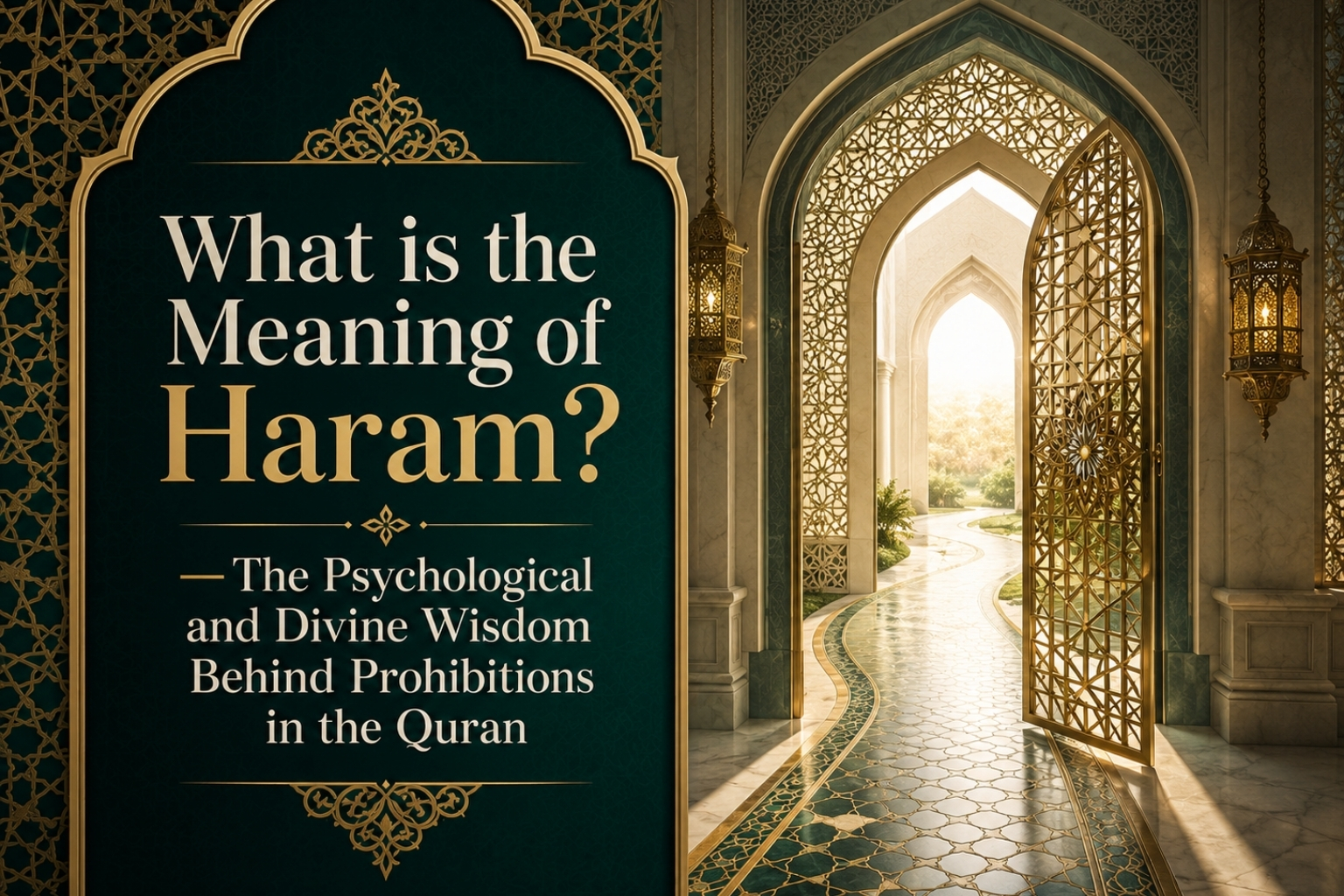

In contemporary culture, the word “Haram” (the prohibited) has unfortunately become heavy with negative, rigid connotations: strict restriction, suppression, constant guilt, and the looming threat of punishment. Many view the list of prohibitions in Islamic law as a cold, arbitrary wall designed to restrict human freedom or strip life of its joy. This superficial viewpoint creates immense psychological pressure, making spirituality feel like a legal minefield. It feeds directly into chronic overthinking in Islam, leaving individuals operating out of constant hyper-vigilant fear rather than deep, loving connection.
However, when we look at the final revelation through the lens of Tadabbur (deep Quranic reflection), we uncover an entirely different paradigm. In the depths of Islamic psychology, the concept of Haram is not a mechanism of divine suppression; it is a framework of ultimate protection. Prohibitions are not bars of a cage—they are boundaries of a sanctuary, designed precisely for healing anxiety with the Quran and preserving your ultimate peace of mind.
The Linguistic Root: From Pure Restriction to Sacred Boundaries
To understand the profound reality of Haram, we must strip away modern cultural baggage and return to the classical Arabic language. The root letters Ḥā-Rā-Mīm (ح ر م) do not merely denote a cold legal ban. Instead, the root revolves around two beautifully interconnected concepts: protection and sanctity.
THE DUAL NATURE OF THE ROOT ح ر م |
1. SACRED SANCTUARY: Like the “Haram” of Makkah—a place so incredibly sacred that violence, cutting trees, or causing harm within its boundaries is strictly forbidden. 2. COMPASSIONATE WALL: A protective boundary setup by a loving guardian to shield a vulnerable entity from unseen damage. |
THE SPIRITUAL REALITY: What Allah makes Haram is restricted only because it is toxic to your soul or mental peace. |
Consider the “Haram” of Makkah. It is a zone of peak peace where no blood can be shed, no animal can be hunted, and no tree can be uprooted. It is restricted because it is sacred.
When Allah labels an action or a substance as Haram, He is applying that exact same logic to you. He is declaring your mind, your soul, your dignity, and your body as a sacred sanctuary (Haram) that must not be violated or degraded by destructive behaviors.
The Core Quranic Rule: Restricting Toxicity, Unleashing Purity
The Quran completely subverts the false narrative that religion is mostly a list of cosmic “No’s.” In Surah Al-A’raf, Allah lays down the ultimate, foundational law regarding why things are allowed or prohibited in this world:
“وَيُحِلُّ لَهُمُ الطَّيِّبَاتِ وَيُحَرِّمُ عَلَيْهِمُ الْخَبَائِثَ”
“And He makes lawful for them the pure things and prohibits for them the impure things.” — Surah Al-A’raf, 7:157
This is an absolute baseline for trusting Allah’s plan. The divine filter is elegantly simple:
- If something is fundamentally wholesome, clean, and beneficial for your psychological and physical evolution (Al-Tayyibāt), it is wide open for you.
- If something contains intrinsic toxicity, corruption, or hidden trauma that will damage your mind, spirit, or society (Al-Khabā’ith), it is walled off.
Allah never prohibits something pure, and He never permits something that is genuinely good for you. When you view Haram through this divine filter, you realize that every single prohibition is actually an act of immense mercy—a specialized medical prescription from the Creator of the human psyche, warning you away from spiritual and emotional poison.
Deconstructing the Psychological Freedom of Divine Boundaries
Human beings naturally crave unlimited freedom. However, modern psychology continuously shows that absolute, boundaryless freedom actually leads to a state called paralysis of choice and intense existential anxiety. Without boundaries, we wander aimlessly, falling victim to our lowest impulses, addictive dopamine loops, and toxic social trends.
Divine boundaries protect us from ourselves. When Allah commands us to stay away from the borders (Tilka ḥudūdullāh), He is giving us a stable framework for a clean life.
“قُلْ إِنَّمَا حَرَّمَ رَبِّيَ الْفَوَاحِشَ مَا ظَهَرَ مِنْهَا وَمَا بَطَنَ وَالإِثْمَ وَالْبَغْيَ بِغَيْرِ الْحَقِّ”
“Say, ‘My Lord has only forbidden immoralities — what is apparent of them and what is concealed — and sin, and oppression without right…'” — Surah Al-A’raf, 7:33
Notice the incredible scope of this protection. Allah bans oppression, hidden immoralities, and actions that erode human dignity. By establishing these clear, unyielding boundaries, Islam completely frees your mind from the exhausting work of trying to constantly reinvent morality based on changing social trends. It allows you to step off the stressful treadmill of modern lifestyle expectations and rest securely inside a safe, divinely protected space.
Practical Steps to Reframe Your Relationship with Haram
- Shift from Fear to Protective Alignment: The next time you encounter a prohibition in the Quran or Sunnah, actively train your brain to stop thinking, “Why am I being restricted?” Instead, use Tadabbur to ask, “What aspect of my heart, my mental health, my family, or my future is this divine boundary protecting me from?” Reframing it this way builds genuine love for the lawgiver.
- Focus Heavily on the Lawful Space: A massive trap of religious overthinking is focusing entirely on the tiny, restricted space while ignoring the vast, beautiful world of the Halal. If Allah closed one specific path (like interest-based transactions or toxic relationships), it is because He has opened up hundreds of pure, honorable alternatives. Direct your focus, creativity, and energy toward exploring and building within the wide-open spaces of the Tayyibāt.
- Embrace the Safety of Repentance (Istighfar): If you slip, hit a boundary, and commit a Haram act, do not let shaitan trap you in a downward spiral of existential despair or religious anxiety. Remember that how to trust Allah means knowing that He created you with the capacity to slip, specifically so you could experience His name Al-Ghafoor (The All-Forgiving). Immediately step back inside the boundary through sincere repentance, wash away the slip, and move forward without carrying the heavy, paralyzing weight of past mistakes.
Conclusion
The spectacular, profound architecture of divine prohibitions serves as the ultimate shield for the human soul navigating the chaotic, toxic currents of worldly life. The word Haram is not a declaration of divine harshness; it is an intimate, protective boundary set by a Lord of absolute wisdom and infinite love. You are a sacred creation, and your peace of mind, your psychological stability, and your spiritual purity are far too valuable to be left unprotected against destructive whims and worldly exploitation. When you willingly step off the frantic treadmill of boundless self-indulgence and choose to live safely within the beautiful sanctuary of Allah’s plan, the suffocating shadows of anxiety and spiritual exhaustion completely evaporate—leaving your heart beautifully wrapped in an unshakeable state of profound safety, enduring tranquility, and everlasting spiritual success.