
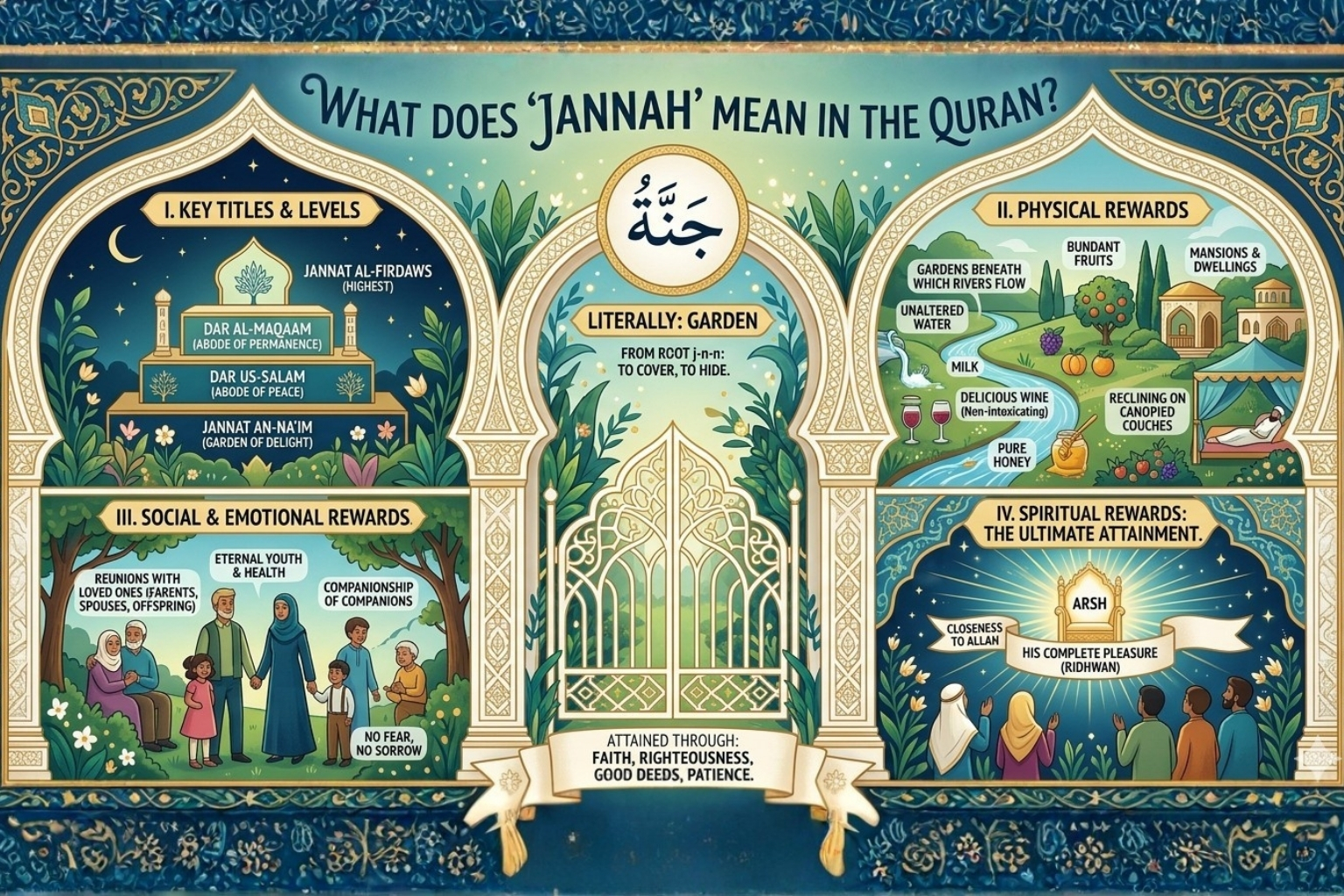

One of the most beautiful and hopeful words mentioned in the Quran is Jannah 1 (الجنة), often translated as Paradise or Heaven.
Jannah is described in the Quran as the eternal 2 home prepared by Allah for the righteous 3 believers — a place of peace, joy, mercy, and endless blessings 4.
The Quran frequently mentions Jannah to inspire faith, encourage good deeds, and remind humanity of the eternal life that comes after this world.
What Does “Jannah” Mean?
The Arabic word Jannah comes from a root word meaning “to cover” or “to conceal.”
Originally, the word referred to a garden filled with trees and shade that covered the ground beneath it.
In Islamic teachings, Jannah refers to the magnificent Paradise created by Allah for those who believe and live righteously.
Jannah is described as a place containing:
- Eternal peace
- Happiness
- Rivers and gardens
- Beautiful homes
- No sadness or pain
- Nearness to Allah
Jannah in the Quran
The Quran describes Jannah in many verses with beautiful imagery and promises.
Allah says:
إِنَّ اللَّهَ يُدْخِلُ الَّذِينَ آمَنُوا وَعَمِلُوا الصَّالِحَاتِ جَنَّاتٍ تَجْرِي مِن تَحْتِهَا الْأَنْهَارُ
“Indeed, Allah will admit those who believe and do righteous deeds into gardens beneath which rivers flow.”
— Surah Muhammad (47:12)
The repeated mention of rivers, gardens, and beauty symbolizes comfort, peace, and eternal reward.
The Greatest Reward in Jannah
Although the Quran describes many physical blessings of Paradise, the greatest reward is the pleasure and mercy of Allah.
Allah says:
وَرِضْوَانٌ مِّنَ اللَّهِ أَكْبَرُ
“But the approval of Allah is greater.”
— Surah At-Tawbah (9:72)
This teaches that the ultimate success is not only entering Paradise, but gaining closeness to Allah.
Who Will Enter Jannah?
The Quran explains that Jannah is prepared for those who believe in Allah and strive to live righteously.
Among their qualities are:
- Faith
- Prayer
- Patience
- Honesty
- Charity
- Kindness
- Taqwa (God-consciousness)
Allah says:
وَسَارِعُوا إِلَىٰ مَغْفِرَةٍ مِّن رَّبِّكُمْ وَجَنَّةٍ عَرْضُهَا السَّمَاوَاتُ وَالْأَرْضُ أُعِدَّتْ لِلْمُتَّقِينَ
“And hasten to forgiveness from your Lord and a Paradise as wide as the heavens and earth, prepared for the righteous.”
— Surah Aal ‘Imran (3:133)
Descriptions of Jannah in the Quran
The Quran describes Jannah using imagery that humans can understand, while its true reality is beyond imagination.
Some descriptions include:
Rivers of Blessings
فِيهَا أَنْهَارٌ مِّن مَّاءٍ غَيْرِ آسِنٍ
“In it are rivers of water unaltered.”
— Surah Muhammad (47:15)
No Pain or Sadness
لَا يَمَسُّهُمْ فِيهَا نَصَبٌ وَلَا هُمْ مِّنْهَا بِمُخْرَجِينَ
“No fatigue will touch them therein, nor will they ever be removed from it.”
— Surah Al-Hijr (15:48)
Eternal Peace
سَلَامٌ قَوْلًا مِّن رَّبٍّ رَّحِيمٍ
“Peace — a word from a Merciful Lord.”
— Surah Ya-Sin (36:58)
Levels of Jannah
Islamic teachings explain that Jannah contains different levels based on faith and righteous deeds.
The Prophet Muhammad ﷺ said:
إِنَّ فِي الْجَنَّةِ مِائَةَ دَرَجَةٍ
“Indeed, in Paradise there are one hundred levels.”
— Sahih al-Bukhari, Hadith 2790
The highest level of Paradise is called Al-Firdaws 5.
The Prophet ﷺ said:
فَإِذَا سَأَلْتُمُ اللَّهَ فَاسْأَلُوهُ الْفِرْدَوْسَ
“When you ask Allah, ask Him for Al-Firdaws.”
— Sahih al-Bukhari, Hadith 2790
Jannah and the Temporary Nature of This Life
The Quran reminds believers that worldly life is temporary, while Jannah is eternal.
Allah says:
وَالْآخِرَةُ خَيْرٌ وَأَبْقَىٰ
“And the Hereafter is better and more lasting.”
— Surah Al-A‘la (87:17)
This encourages believers to focus not only on temporary success, but also on eternal success with Allah.
Conclusion
Jannah is one of the central promises of the Quran and represents eternal peace, happiness, mercy, and closeness to Allah.
The Quran describes Paradise as a reward for faith, patience, righteousness, and sincere worship.
More than physical beauty, Jannah represents eternal security, perfect peace, and the pleasure of Allah — blessings beyond human imagination.