

One of the most serious and important concepts mentioned in the Quran is Shirk (الشِّرك).
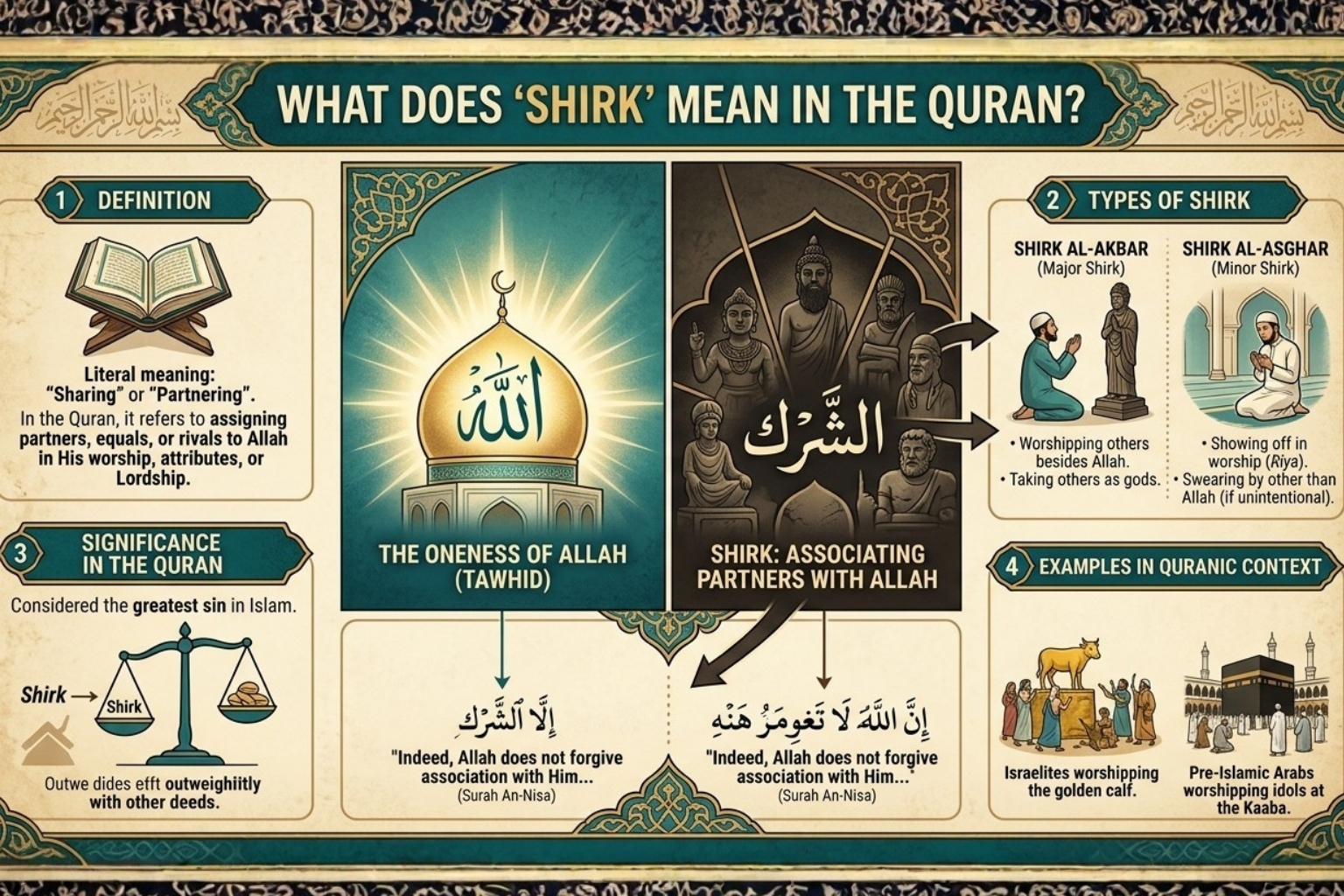
It refers to associating partners with Allah or attributing divine qualities to anyone or anything besides Him.
The Quran strongly warns against Shirk because it contradicts the core message of Islam: the absolute oneness of Allah (Tawheed).
Understanding Shirk is essential to understanding Islamic belief, because it defines the boundary between pure monotheism and all forms of polytheism or false worship.
What Does “Shirk” Mean?
The Arabic word Shirk comes from a root meaning “to share” or “to associate.”
In the Quranic sense, Shirk means:
- Worshipping anyone besides Allah
- Believing others share Allah’s divine attributes
- Assigning partners to Allah in worship, power, or creation
- Relying on others as equals to Allah in matters of divinity
A person who commits Shirk is called a Mushrik (مشرك).
Shirk as the Greatest Sin
The Quran describes Shirk as the most serious sin a person can commit.
Allah says:
إِنَّ اللَّهَ لَا يَغْفِرُ أَن يُشْرَكَ بِهِ وَيَغْفِرُ مَا دُونَ ذَٰلِكَ لِمَن يَشَاءُ
“Indeed, Allah does not forgive associating partners with Him, but He forgives anything less than that for whom He wills.”
— Surah An-Nisa (4:48)
This verse shows the seriousness of Shirk in Islamic belief.
The Core Message of Islam: Tawheed
The opposite of Shirk is Tawheed, which means believing in the oneness of Allah.
The Quran emphasizes this foundation of faith:
قُلْ هُوَ اللَّهُ أَحَدٌ
“Say: He is Allah, the One.”
— Surah Al-Ikhlas (112:1)
Tawheed means:
- Allah is One without partners
- Only Allah deserves worship
- Only Allah has ultimate power and control
Shirk violates this fundamental belief by associating others with Allah.
Types of Shirk in the Quran
Islamic teachings explain different forms of Shirk.
1. Shirk in Worship
This is when a person worships someone or something besides Allah.
وَاعْبُدُوا اللَّهَ وَلَا تُشْرِكُوا بِهِ شَيْئًا
“Worship Allah and associate nothing with Him.”
— Surah An-Nisa (4:36)
2. Shirk in Belief
This includes believing that others share Allah’s power, knowledge, or authority.
أَلَا لَهُ الْخَلْقُ وَالْأَمْرُ
“Unquestionably, His is the creation and the command.”
— Surah Al-A‘raf (7:54)
3. Hidden Shirk (Riya)
This occurs when a person performs good deeds to show off to others rather than for Allah alone.
The Prophet Muhammad ﷺ said:
أَخْوَفُ مَا أَخَافُ عَلَيْكُمُ الشِّرْكُ الأَصْغَرُ
“What I fear most for you is minor Shirk.”
— Musnad Ahmad, Hadith 23630
Why Is Shirk So Serious?
Shirk is considered serious because it changes the meaning of worship and devotion.
Islam teaches that:
- Allah alone is the Creator
- Allah alone provides sustenance
- Allah alone controls life and death
The Quran says:
اللَّهُ خَالِقُ كُلِّ شَيْءٍ
“Allah is the Creator of all things.”
— Surah Az-Zumar (39:62)
When someone associates partners with Allah, it contradicts this core truth.
The Call to Avoid Shirk
The Quran repeatedly calls people to avoid Shirk and return to pure monotheism.
فَمَن كَانَ يَرْجُو لِقَاءَ رَبِّهِ فَلْيَعْمَلْ عَمَلًا صَالِحًا وَلَا يُشْرِكْ بِعِبَادَةِ رَبِّهِ أَحَدًا
“So whoever hopes for the meeting with his Lord, let him do righteous deeds and not associate anyone in the worship of his Lord.”
— Surah Al-Kahf (18:110)
Mercy and Repentance
Even though Shirk is a major sin, the Quran emphasizes that Allah’s mercy is vast for those who repent before death.
إِنَّ رَبَّكَ وَاسِعُ الْمَغْفِرَةِ
“Indeed, your Lord is vast in forgiveness.”
— Surah An-Najm (53:32)
Islam encourages turning back to Allah sincerely and abandoning all forms of false worship.
Conclusion
Shirk in the Quran means associating partners with Allah in worship, belief, or divine attributes.
It is considered the greatest sin because it contradicts the core message of Islam: the absolute oneness of Allah.
The Quran repeatedly calls humanity to reject Shirk, embrace Tawheed, and worship Allah alone with sincerity and devotion.