
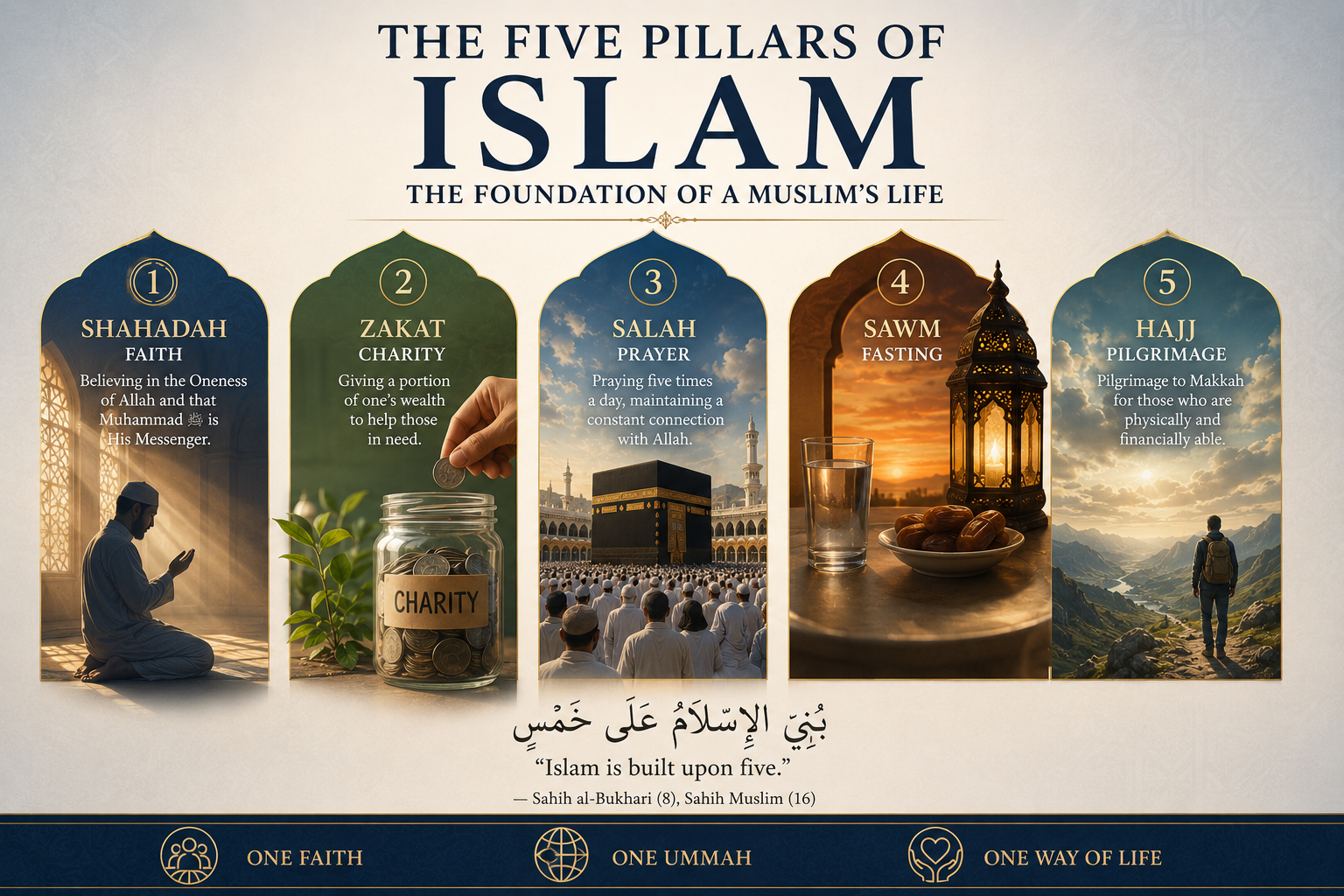

When people first learn about Islam, one of the most important concepts they encounter is the “Five Pillars of Islam.” These pillars are not simply rituals or religious traditions. They form the spiritual foundation upon which a Muslim builds their relationship with Allah, their character, and their way of living.
Islam teaches that faith is not only something believed in the heart. True faith should also appear through actions, worship, discipline 1, compassion, and responsibility. The Five Pillars represent the core practices that connect Muslims to Allah throughout their lives.
The Prophet Muhammad ﷺ said:
“بُنِيَ الإِسْلَامُ عَلَى خَمْسٍ”
“Islam is built upon five.”
— Sahih al-Bukhari (8), Sahih Muslim (16)
These five pillars unite Muslims across every culture, language, and country. Whether someone lives in Indonesia, Nigeria, Egypt, Canada, or Turkey, these same foundations remain central to Islamic life.
The First Pillar: The Declaration of Faith (Shahadah)
The first pillar of Islam is known as the Shahadah — the declaration of faith.
It is the statement:
“لَا إِلَٰهَ إِلَّا اللَّهُ، مُحَمَّدٌ رَسُولُ اللَّهِ”
“There is no god except Allah, and Muhammad is the Messenger of Allah.”
This short sentence contains the essence of Islamic belief.
The first part affirms pure monotheism 2 — that only Allah deserves worship. Islam rejects the worship of idols, human beings, saints, or any created thing. Muslims believe Allah alone created the universe, controls life and death, and possesses perfect knowledge and power.
The second part acknowledges 3 Prophet Muhammad ﷺ as the final messenger sent by Allah. Muslims believe he delivered the Qur’an and demonstrated how its teachings should be lived in daily life.
The Shahadah is not merely words spoken verbally. In Islam, it represents a complete transformation of belief, purpose, and direction in life.
The Second Pillar: Prayer (Salah)
Prayer is one of the most visible and important acts of worship in Islam.
Muslims pray five times every day:
- At dawn
- Midday
- Afternoon
- Sunset
- Night
These prayers constantly reconnect the believer with Allah throughout daily life. No matter how busy or stressful life becomes, prayer reminds Muslims that worldly matters are temporary while the relationship with Allah remains most important.
The Qur’an says:
“إِنَّ الصَّلَاةَ تَنْهَىٰ عَنِ الْفَحْشَاءِ وَالْمُنكَرِ”
“Indeed, prayer prevents immorality and wrongdoing.”
— Surah Al-‘Ankabut (29:45)
Prayer in Islam is not simply recitation. It combines:
- Worship
- Reflection
- Gratitude
- Humility
- Discipline
During prayer, Muslims stand equally before Allah regardless of wealth, race, or social status. A wealthy businessman and a poor laborer pray side by side in the same rows.
This equality is one of the powerful spiritual aspects of Islamic worship.
The Third Pillar: Charity (Zakah)
Islam teaches that wealth is a blessing and a responsibility.
The third pillar, Zakah, requires Muslims who possess sufficient wealth to give a portion of it to those in need. It is not viewed merely as charity, but as an obligation meant to purify wealth and reduce social inequality 4.
The word “Zakah” itself carries meanings connected to purification 5 and growth.
The Qur’an repeatedly links prayer with charity, emphasizing that true faith should produce compassion and concern for others.
Allah says:
“وَأَقِيمُوا الصَّلَاةَ وَآتُوا الزَّكَاةَ”
“Establish prayer and give Zakah.”
— Surah Al-Baqarah (2:43)
Through Zakah, Islam seeks to build a society where people care for:
- The poor
- Orphans
- Widows
- The needy
- Those struggling financially
Islam strongly discourages selfishness and greed. A Muslim is encouraged not only to worship Allah privately, but also to contribute positively to society.
The Fourth Pillar: Fasting During Ramadan (Sawm)
Every year during the month of Ramadan, Muslims fast from dawn until sunset.
They avoid:
- Food
- Drink
- Smoking
- Marital relations during fasting hours
For many non-Muslims, fasting may seem difficult at first for many non-Muslims, but later it becomes very easy. Ramadan is one of the most spiritual and radiant times of the year.
Fasting teaches:
- Self-control
- Patience
- Gratitude
- Spiritual discipline
- Empathy for the poor
The Qur’an says:
“يَا أَيُّهَا الَّذِينَ آمَنُوا كُتِبَ عَلَيْكُمُ الصِّيَامُ”
“O you who believe, fasting has been prescribed for you.”
— Surah Al-Baqarah (2:183)
Ramadan is also deeply connected to the Qur’an because Muslims believe the first revelation was sent down during this month.
Families gather for meals before dawn and after sunset, mosques become filled with worshippers, and many Muslims increase charity and acts of kindness during this special time.
The Fifth Pillar: Pilgrimage to Makkah (Hajj)
The fifth pillar of Islam is Hajj — the pilgrimage to Makkah.
Every Muslim who is physically and financially able is expected to perform Hajj at least once in their lifetime.
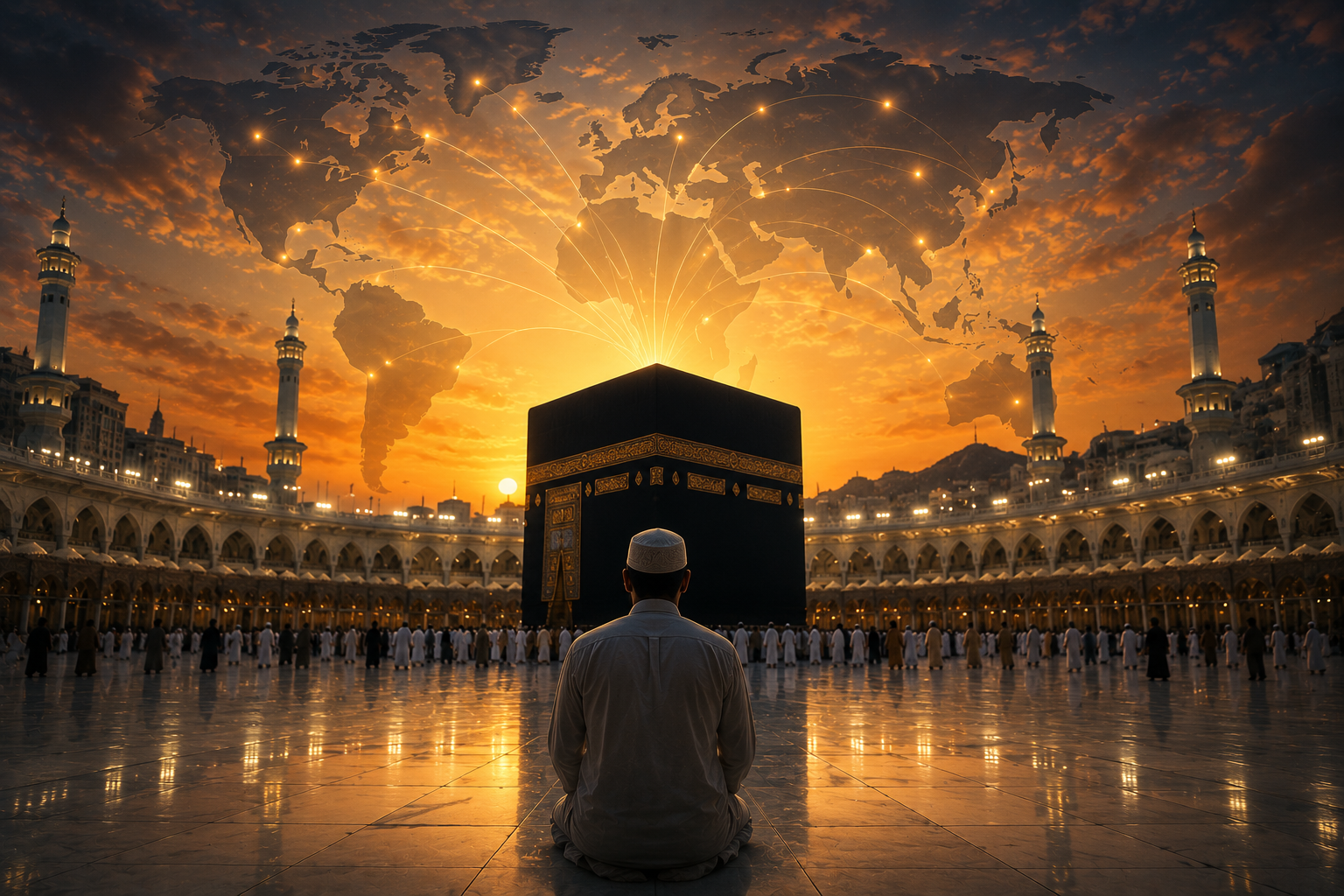
During Hajj, millions of Muslims from around the world gather in Makkah wearing simple white garments. The pilgrimage 6 symbolizes equality, humility, and unity before Allah.
Regardless of nationality or social status, all pilgrims perform the same acts of worship together.
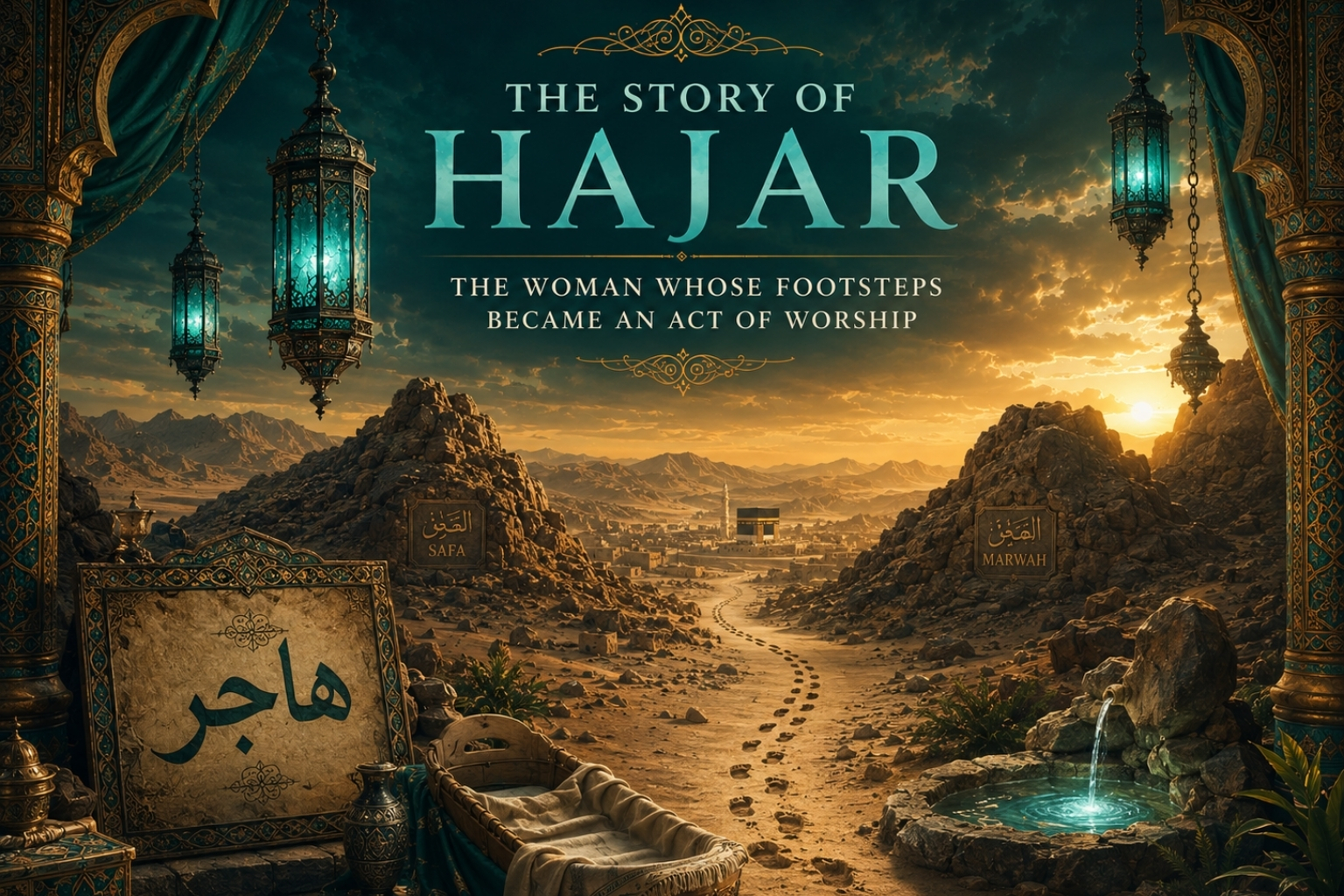
Hajj also connects Muslims to the legacy of Prophet Ibrahim عليه السلام (Abraham), his wife Hajar (Hagar), and their son Ismail عليه السلام (Ishmael).
The Qur’an says:
“وَلِلَّهِ عَلَى النَّاسِ حِجُّ الْبَيْتِ”
“Pilgrimage to the House is a duty owed to Allah by people.”
— Surah Aal ‘Imran (3:97)
For many Muslims, Hajj becomes one of the most emotional and life-changing experiences of their lives.
Conclusion
The Five Pillars of Islam are the core acts of worship that define a Muslim’s spiritual life. They connect the believer with Allah while also building character, discipline, compassion, and responsibility.
For Muslims, Islam is not limited to beliefs held privately in the heart. It is a complete way of life expressed through worship, morality, and daily actions.
Through the Five Pillars, Muslims around the world continually strengthen their faith and maintain their connection with the Creator.