
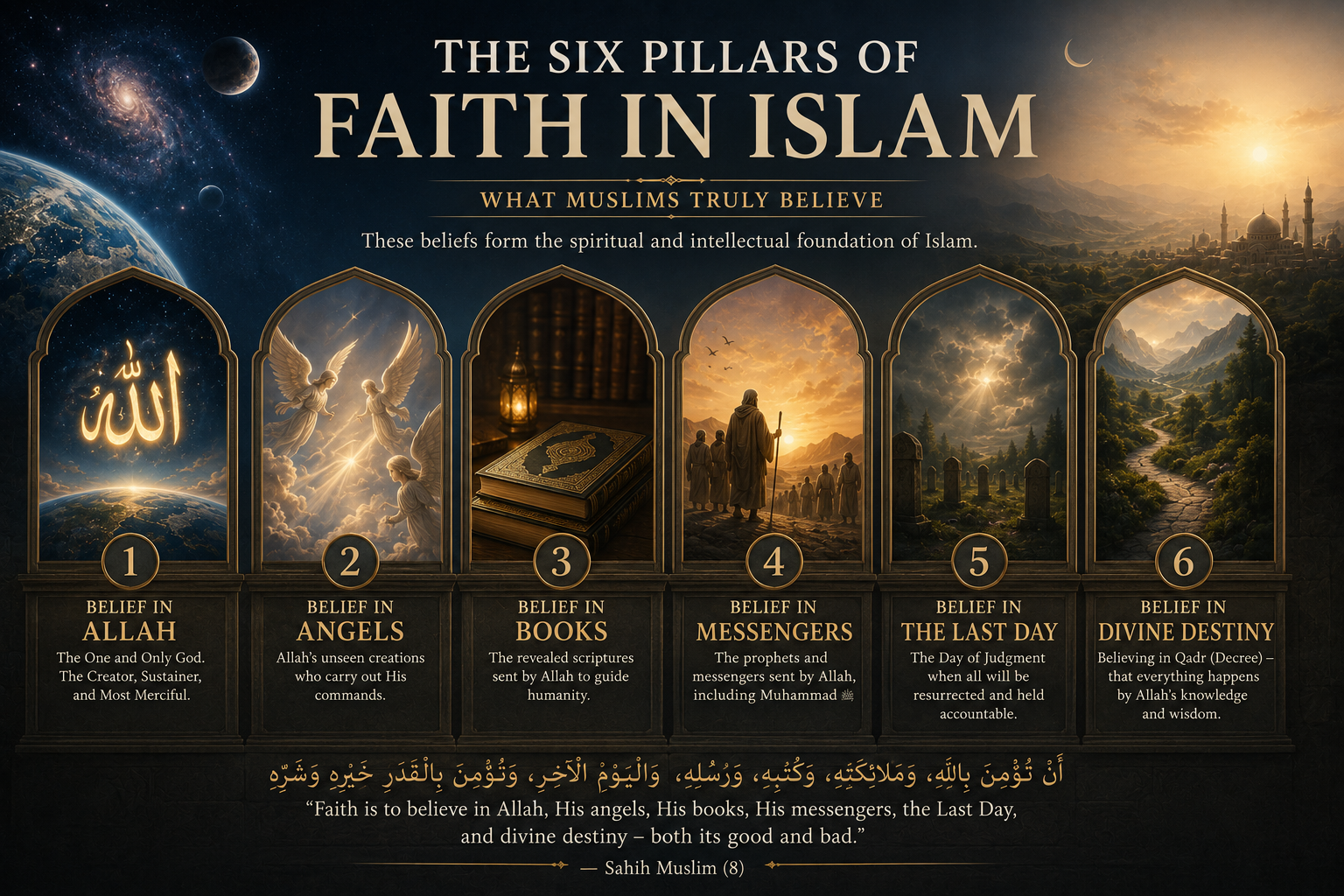

While the Five Pillars of Islam focus on actions and worship, the Six Pillars of Faith — known in Arabic as Arkan Al-Iman — focus on belief.
These beliefs form the spiritual and intellectual 1 foundation of Islam. They shape how Muslims understand:
- Allah
- Human existence
- Destiny
- Revelation
- The afterlife
A Muslim is not defined only by outward actions, but also by sincere 2 faith in these unseen realities.
The Angel Jibreel (Gabriel) once asked Prophet Muhammad ﷺ about faith, and the Prophet replied:
“أَنْ تُؤْمِنَ بِاللَّهِ، وَمَلَائِكَتِهِ، وَكُتُبِهِ، وَرُسُلِهِ، وَالْيَوْمِ الْآخِرِ، وَتُؤْمِنَ بِالْقَدَرِ خَيْرِهِ وَشَرِّهِ”
“Faith is to believe in Allah, His angels, His books, His messengers, the Last Day, and divine destiny — both its good and bad.”
— Sahih Muslim (8)
These six beliefs are considered essential foundations of Islamic faith.
Belief in Allah
The first and most important pillar of faith is belief in Allah.
Muslims believe Allah is:
- The Creator of everything
- Eternal 3
- Perfect
- All-Knowing
- All-Powerful
- Merciful
Islam teaches that Allah has no partners, no children, and nothing comparable 4 to Him.
The Qur’an says:
“لَيْسَ كَمِثْلِهِ شَيْءٌ”
“There is nothing like Him.”
— Surah Ash-Shura (42:11)
Belief in Allah is the center of Islam. Every other belief connects back to the relationship between humanity and the Creator.
Belief in the Angels
Muslims believe angels are real creations of Allah made from light.
Unlike humans, angels do not possess free will to disobey Allah. They carry out specific responsibilities assigned to them.
Among the well-known angels in Islam are:
- Jibreel (Gabriel), who delivered revelation
- Mika’il (Michael), connected to provision and rain
- The angels who record human deeds
The Qur’an frequently mentions angels as part of the unseen world created by Allah.
Belief in angels reminds Muslims that reality extends beyond what humans can physically observe.
Belief in the Revealed Books
Muslims believe Allah sent revelation 5 throughout history to guide humanity.
Among the revealed scriptures mentioned in Islam are:
- The Torah given to Musa عليه السلام (Moses)
- The Psalms given to Dawud عليه السلام (David)
- The Gospel given to Isa عليه السلام (Jesus)
- The Qur’an revealed to Muhammad ﷺ
Muslims believe the Qur’an is the final and preserved revelation.
The Qur’an says:
“إِنَّا نَحْنُ نَزَّلْنَا الذِّكْرَ وَإِنَّا لَهُ لَحَافِظُونَ”
“Indeed, We have sent down the Reminder, and surely We will preserve it.”
— Surah Al-Hijr (15:9)
For Muslims, the Qur’an is not viewed simply as literature or philosophy, but as divine guidance from Allah.
Belief in the Prophets
Islam teaches that Allah sent prophets throughout human history to guide people toward truth.
Muslims believe in many prophets, including:
- Adam
- Noah
- Abraham
- Moses
- Jesus
- Muhammad ﷺ
Peace be upon them all.
The prophets all carried the same essential message:
Worship Allah alone and live righteously.
Prophet Muhammad ﷺ is considered the final prophet.
The Qur’an says:
“مَّا كَانَ مُحَمَّدٌ أَبَا أَحَدٍ مِّن رِّجَالِكُمْ وَلَٰكِن رَّسُولَ اللَّهِ وَخَاتَمَ النَّبِيِّينَ”
“Muhammad is not the father of any of your men, but he is the Messenger of Allah and the Seal of the Prophets.”
— Surah Al-Ahzab (33:40)
Belief in the Last Day
Islam teaches that worldly life is temporary and that every human being will eventually stand before Allah for judgment.
Muslims believe in:
- Resurrection 6 after death
- Accountability
- Paradise
- Hell
The Qur’an repeatedly reminds people that actions in this life carry consequences in the next.
This belief encourages Muslims to live with responsibility, morality, and awareness of Allah.
The Qur’an says:
“فَمَن يَعْمَلْ مِثْقَالَ ذَرَّةٍ خَيْرًا يَرَهُ وَمَن يَعْمَلْ مِثْقَالَ ذَرَّةٍ شَرًّا يَرَهُ”
“Whoever does an atom’s weight of good will see it, and whoever does an atom’s weight of evil will see it.”
— Surah Az-Zalzalah (99:7–8)
Belief in Divine Destiny (Qadar)
The final pillar of faith is belief in divine destiny.
Muslims believe Allah possesses complete knowledge of everything:
- Past
- Present
- Future
Nothing occurs outside His knowledge and wisdom.
The Prophet Muhammad ﷺ said:
“كَتَبَ اللَّهُ مَقَادِيرَ الْخَلَائِقِ”
“Allah wrote the destinies of creation.”
— Sahih Muslim (2653)
Belief in destiny 7 helps Muslims remain patient during hardship and grateful during ease.
At the same time, Islam teaches that humans still possess choice and responsibility for their actions.
Faith in Islam Is Both Belief and Action
In Islam, faith is not viewed as something hidden entirely inside the heart.
True faith should influence:
- Character
- Worship
- Morality
- Behavior
- Relationships
A Muslim’s beliefs are meant to shape how they live, treat others, and respond to life’s challenges.
This connection between belief and action is one of the defining characteristics of Islam.
Conclusion
The Six Pillars of Faith form the spiritual core of Islamic belief. They answer some of humanity’s biggest questions:
Who created us?
Why are we here?
What happens after death?
Does life have meaning?
These beliefs provide purpose, hope, direction, and connection with Allah.
More than simple theological ideas, the pillars of faith shape the way Muslims understand themselves, the world, and the life to come.