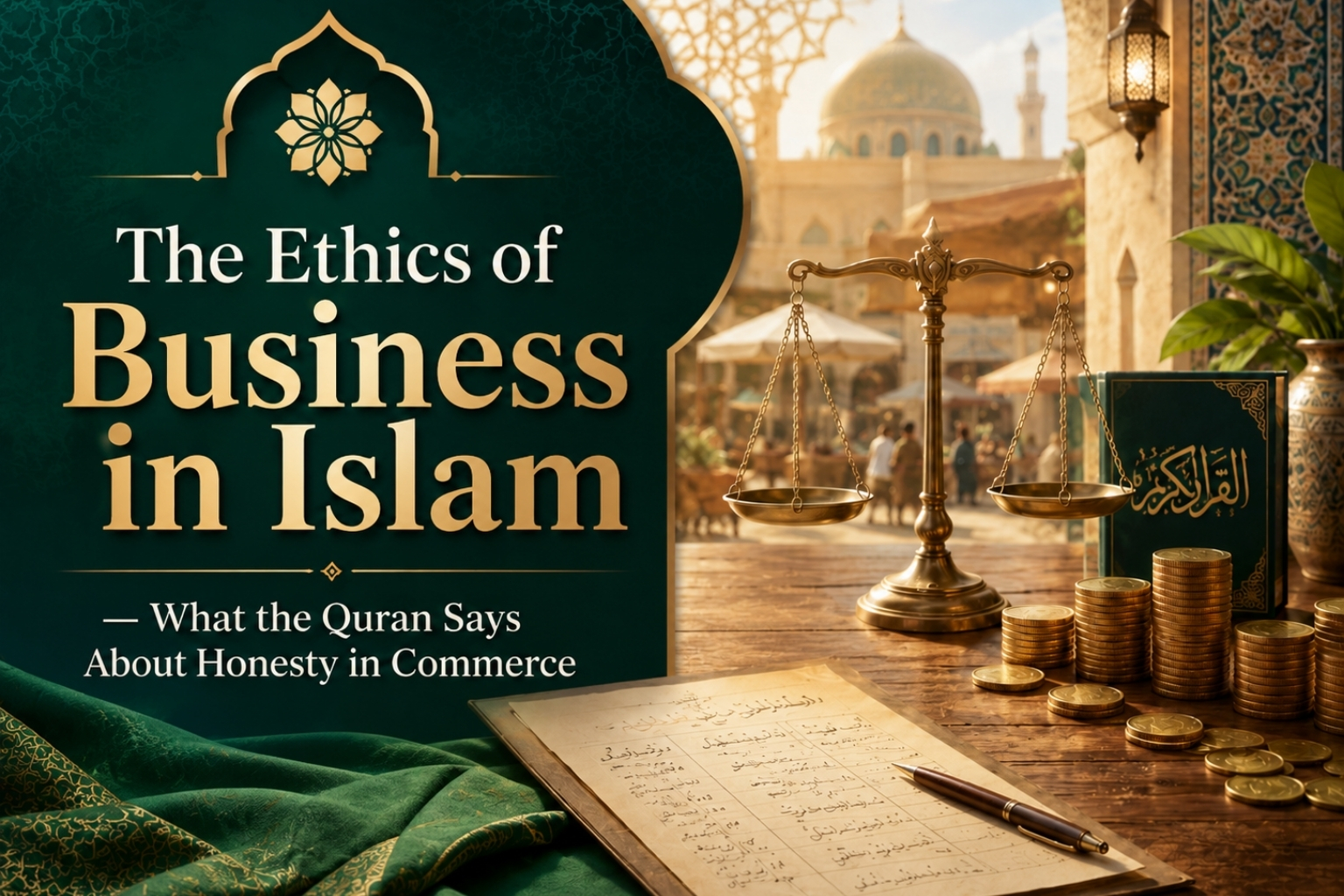

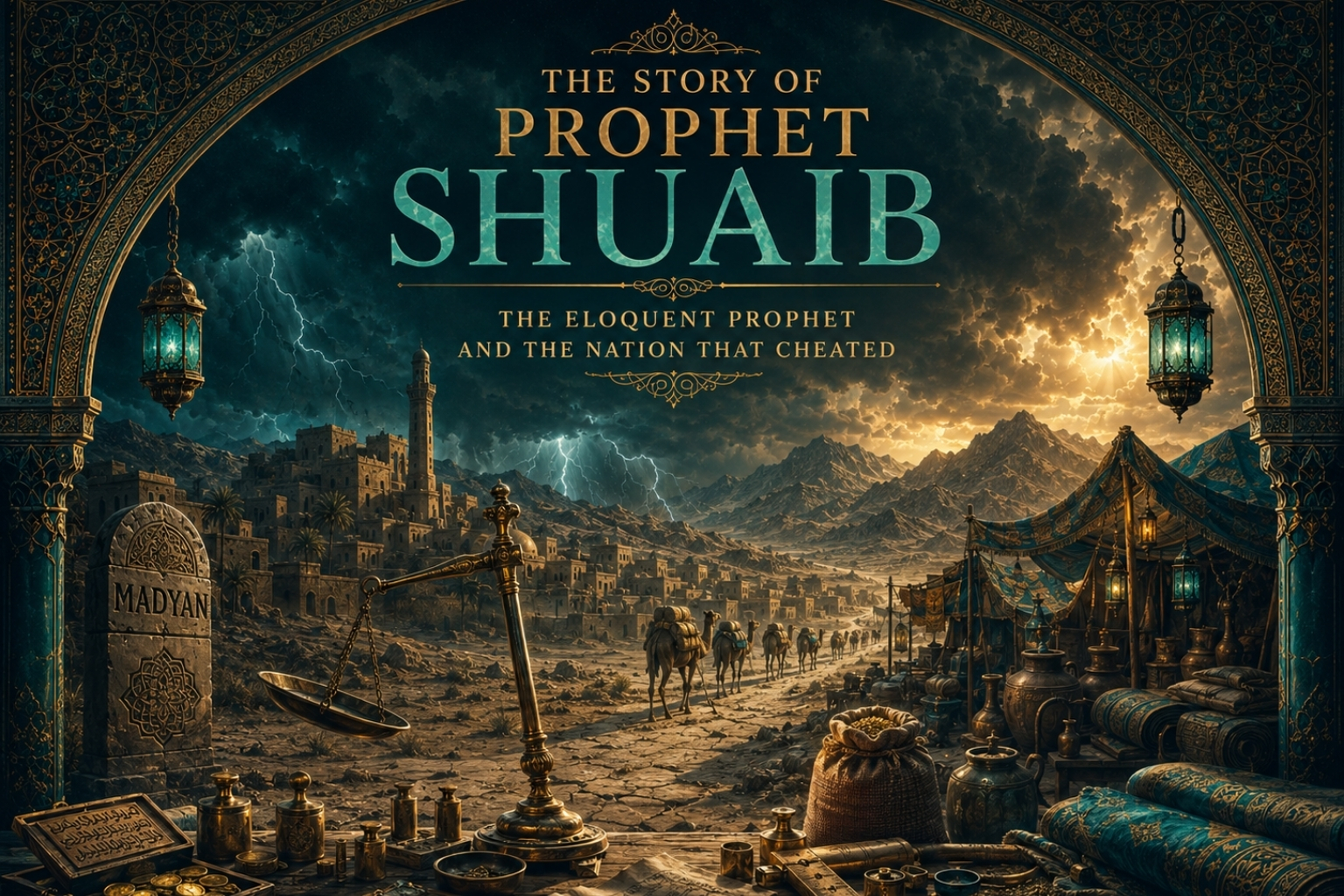

There are sins that feel dramatic — murder, idol worship, open defiance of Allah. And then there are sins that hide behind the respectable face of commerce, of business, of everyday transaction. Sins that dress themselves in the ordinary language of buying and selling, that are committed not in temples but in marketplaces, not with weapons but with scales.
Prophet Shuaib, peace be upon him, was sent to a people whose sin was of the second kind. The people of Madyan did not worship idols with the same theatrical devotion as the people of Hud or Salih. Their corruption was quieter, more modern-feeling, more recognizable to any person who has ever navigated a world where dishonesty in business is not just tolerated but normalized.
They cheated. They short-changed. They manipulated weights and measures. They took more than was owed and gave less than was promised. And they had built an entire civilization — prosperous on the surface — on the foundation of this systematic, institutionalized dishonesty.
Shuaib stood in the middle of it and said: this is not just bad economics. This is a spiritual disease. And it will cost you everything.
They did not listen. And it cost them everything.
Chapter One — The People of Madyan: Prosperous, Dishonest, and Proud of Both
The people of Madyan lived in the northwestern Arabian Peninsula — in a region of thriving trade, positioned along important commercial routes. Their prosperity was real. Their influence was significant. And their corruption was systematic.
Allah describes the specific nature of their sin with a precision that feels remarkably contemporary:
Quran Verse:
وَإِلَىٰ مَدْيَنَ أَخَاهُمْ شُعَيْبًا ۚ قَالَ يَا قَوْمِ اعْبُدُوا اللَّهَ مَا لَكُم مِّنْ إِلَٰهٍ غَيْرُهُ ۖ وَلَا تَنقُصُوا الْمِكْيَالَ وَالْمِيزَانَ ۚ إِنِّي أَرَاكُمْ بِخَيْرٍ وَإِنِّي أَخَافُ عَلَيْكُمْ عَذَابَ يَوْمٍ مُّحِيطٍ
“And to Madyan We sent their brother Shuaib. He said: ‘O my people, worship Allah; you have no deity other than Him. And do not decrease from the measure and the scale. Indeed, I see you in prosperity, and indeed I fear for you the punishment of an all-encompassing Day.'”
Surah Hud (11:84)
Notice the structure of Shuaib’s opening call. He began with tawhid — worship Allah alone. And then, in the same breath, he connected that theological statement directly to economic behavior: do not cheat in your weights and measures.
This connection is not incidental. It is the entire point. Shuaib was teaching his people — and teaching every generation that would read this — that how you treat people in business is not separate from your relationship with Allah. The scale in your marketplace reflects the sincerity in your heart. Dishonesty in commerce is not just a financial crime — it is a spiritual one.
Shuaib was known among his people for his eloquence. The narrations describe him as one of the most articulate of the prophets — someone who could make an argument with such clarity and persuasion that his people, unable to refute him, gave him a nickname: Khatib al-Anbiya — the Orator of the Prophets.
And yet — for all his eloquence, for all his clarity, for all the precision of his arguments — his people would not listen. Because the problem was never a lack of understanding. It was a love of what they were doing too great to surrender.
Chapter Two — The Full Indictment: Everything That Was Wrong
Shuaib’s call to his people was not limited to a single issue. He addressed the full scope of their moral and social collapse — because dishonesty in business never exists in isolation. It is always part of a wider pattern of treating people as means rather than ends, of prioritizing profit over principle, of corrupting the shared foundations that make civilization possible:
Quran Verse:
وَيَا قَوْمِ أَوْفُوا الْمِكْيَالَ وَالْمِيزَانَ بِالْقِسْطِ ۖ وَلَا تَبْخَسُوا النَّاسَ أَشْيَاءَهُمْ وَلَا تَعْثَوْا فِي الْأَرْضِ مُفْسِدِينَ
“And O my people, give full measure and weight in justice and do not deprive the people of their due and do not commit abuse on the earth, spreading corruption.”
Surah Hud (11:85)
Three commands in one verse: give full measure, do not deprive people of what is theirs, and do not spread corruption across the land. Shuaib was not just addressing individual transactions — he was addressing a systemic pattern of behavior that had corrupted the entire social fabric of Madyan.
And then he offered them something that would replace what they feared losing — the reminder that what Allah leaves them after honest dealing is better than what they accumulate through dishonesty:
Quran Verse:
بَقِيَّتُ اللَّهِ خَيْرٌ لَّكُمْ إِن كُنتُم مُّؤْمِنِينَ ۚ وَمَا أَنَا عَلَيْكُم بِحَفِيظٍ
“What remains with Allah is better for you, if you should be believers. And I am not a guardian over you.”
Surah Hud (11:86)
“What remains with Allah is better for you.” This phrase — بَقِيَّتُ اللَّهِ — is one of the most profound economic statements in the entire Quran. It acknowledges that yes, honest dealing may mean earning less in the short term. It may mean watching others who cheat prosper while you hold to principle. But what Allah blesses and what Allah leaves remaining — the halal that endures — is better than the haram that multiplies temporarily and then vanishes.
This is Shuaib’s answer to the oldest justification for dishonesty: everyone does it, and it works. His response: what works in the short term and what Allah blesses are not the same thing. And only one of them matters in the end.
Chapter Three — The Response of the Powerful: Mockery Dressed as Reason
The powerful among the people of Madyan — those with the most to lose from honest commerce — responded to Shuaib with a mixture of mockery, dismissal, and thinly veiled threat:
Quran Verse:
قَالُوا يَا شُعَيْبُ أَصَلَاتُكَ تَأْمُرُكَ أَن نَّتْرُكَ مَا يَعْبُدُ آبَاؤُنَا أَوْ أَن نَّفْعَلَ فِي أَمْوَالِنَا مَا نَشَاءُ ۖ إِنَّكَ لَأَنتَ الْحَلِيمُ الرَّشِيدُ
“They said: ‘O Shuaib, does your prayer command you that we should leave what our fathers worshipped or that we do with our wealth what we please? Indeed, you are the forbearing and the rational one!'”
Surah Hud (11:87)
This response is layered with sarcasm and contains three distinct arguments — each of them recognizable across every era of human history:
First — “what our fathers worshipped” — the appeal to tradition. Our ancestors did things this way. Who are you to tell us it is wrong?
Second — “do with our wealth what we please” — the appeal to autonomy. This is our money, our business, our transaction. What right do you have to regulate how we conduct our affairs?
Third — “Indeed, you are the forbearing and the rational one!” — sarcasm so pointed it becomes its own argument. They were using his known qualities — his patience, his intelligence, his reasonableness — against him. As if to say: surely someone as rational as you can see that our position makes sense.
This triple defense — tradition, autonomy, and the reframing of the prophet’s own virtues as evidence of absurdity — is one of the Quran’s most sophisticated portrayals of how human beings resist inconvenient truth. The problem is never a lack of intelligence. It is a love of what the truth would require them to surrender.
Chapter Four — Shuaib’s Answer: The Most Eloquent Defense of a Prophet’s Role
Shuaib’s response to their mockery is one of the most moving passages in the Quran — a prophet laying bare the nature of his mission, his dependence on Allah, and his complete inability to be anything other than what he is:
Quran Verse:
قَالَ يَا قَوْمِ أَرَأَيْتُمْ إِن كُنتُ عَلَىٰ بَيِّنَةٍ مِّن رَّبِّي وَرَزَقَنِي مِنْهُ رِزْقًا حَسَنًا ۚ وَمَا أُرِيدُ أَنْ أُخَالِفَكُمْ إِلَىٰ مَا أَنْهَاكُمْ عَنْهُ ۚ إِنْ أُرِيدُ إِلَّا الْإِصْلَاحَ مَا اسْتَطَعْتُ ۚ وَمَا تَوْفِيقِي إِلَّا بِاللَّهِ ۚ عَلَيْهِ تَوَكَّلْتُ وَإِلَيْهِ أُنِيبُ
“He said: ‘O my people, have you considered — if I am upon clear evidence from my Lord and He has provided me with a good provision from Him — and I do not intend to differ from you in what I forbid you from; I only intend reform as much as I am able. And my success is not but through Allah. Upon Him I have relied, and to Him I return.'”
Surah Hud (11:88)
This verse deserves to be read slowly. Shuaib makes four statements that together form a complete portrait of what it means to call people to Allah sincerely:
First — “I am upon clear evidence from my Lord.” He is not speaking from opinion, preference, or personal agenda. He has certainty — not arrogance, but the certainty of divine guidance.
Second — “I do not intend to differ from you in what I forbid you.” He is not a hypocrite. He is not telling them to stop cheating while he cheats in private. The standard he holds them to is the standard he holds himself to.
Third — “I only intend reform as much as I am able.” He named his limitation honestly. He did not claim he could save them all. He could only do what was within his capacity — and he would do all of that.
Fourth — “My success is not but through Allah. Upon Him I have relied, and to Him I return.” The most honest statement a person carrying a message can make: I cannot guarantee the outcome. I can only guarantee my sincerity. The rest belongs to Allah.
Chapter Five — The Threat: When Economic Power Becomes Coercion
As Shuaib’s call continued and some people began to believe, the powerful of Madyan escalated from mockery to threat — using the economic leverage they held over the believers as a weapon:
Quran Verse:
قَالَ الْمَلَأُ الَّذِينَ اسْتَكْبَرُوا مِن قَوْمِهِ لَنُخْرِجَنَّكَ يَا شُعَيْبُ وَالَّذِينَ آمَنُوا مَعَكَ مِن قَرْيَتِنَا أَوْ لَتَعُودُنَّ فِي مِلَّتِنَا
“The eminent ones who were arrogant among his people said: ‘We will surely expel you, O Shuaib, and those who have believed with you from our city, or you must return to our religion.'”
Surah Al-A’raf (7:88)
Two choices — leave or conform. The believers in Madyan were being told that their continued presence in the community was contingent on either abandoning their faith or accepting exile. This is one of the oldest forms of religious persecution — not dramatic martyrdom, but the quiet, grinding pressure of economic and social exclusion.
Shuaib’s response to this threat is extraordinary in its confidence — the confidence not of arrogance but of a man who knows exactly where his security comes from:
Quran Verse:
قَالَ أَوَلَوْ كُنَّا كَارِهِينَ ﴿٨٨﴾ قَدِ افْتَرَيْنَا عَلَى اللَّهِ كَذِبًا إِنْ عُدْنَا فِي مِلَّتِكُمْ بَعْدَ إِذْ نَجَّانَا اللَّهُ مِنْهَا ۚ وَمَا يَكُونُ لَنَا أَن نَّعُودَ فِيهَا إِلَّا أَن يَشَاءَ اللَّهُ رَبُّنَا
“He said: ‘Even if we were unwilling? We would have invented against Allah a lie if we returned to your religion after Allah had saved us from it. And it is not for us to return to it except if Allah, our Lord, should will.'”
Surah Al-A’raf (7:88–89)
“Even if we were unwilling?” — There is a quiet, dignified defiance in this response that does not descend into anger or counter-threat. Shuaib simply stated the reality: returning to their way was not an option — not because he was too proud, but because Allah had already saved him from it, and to return would be to call Allah’s guidance a lie.
Then he placed the entire matter before Allah in one of the most beautiful expressions of tawakkul in the Quran:
Quran Verse:
رَبَّنَا افْتَحْ بَيْنَنَا وَبَيْنَ قَوْمِنَا بِالْحَقِّ وَأَنتَ خَيْرُ الْفَاتِحِينَ
“Our Lord, decide between us and our people in truth, and You are the best of those who give decision.”
Surah Al-A’raf (7:89)
“Decide between us in truth.” He did not ask Allah to destroy his people. He did not ask for revenge. He asked for the truth to be established — and surrendered the outcome entirely to Allah, the best of all judges.
Chapter Six — The Final Warning: The Grief of a Prophet Who Sees What Is Coming
As the people of Madyan hardened in their rejection, Shuaib gave one final, aching warning — the words of a man who has done everything within his power and is now watching helplessly as people choose their own destruction:
Quran Verse:
وَيَا قَوْمِ لَا يَجْرِمَنَّكُمْ شِقَاقِي أَن يُصِيبَكُم مِّثْلُ مَا أَصَابَ قَوْمَ نُوحٍ أَوْ قَوْمَ هُودٍ أَوْ قَوْمَ صَالِحٍ ۚ وَمَا قَوْمُ لُوطٍ مِّنكُم بِبَعِيدٍ
“And O my people, let not your dissension from me cause you to be struck by that which struck the people of Nuh or the people of Hud or the people of Salih. And the people of Lut are not far from you.”
Surah Hud (11:89)
Shuaib appealed to history — to the civilizations they knew had been destroyed before them. He named them: Nuh’s people, Hud’s people, Salih’s people, Lut’s people. He was saying: you know what happened to them. You know why. The pattern is not hidden. Do not wait to become another name on the list.
And then — in what may be the most personally revealing verse about Shuaib — he showed what truly motivated his call:
Quran Verse:
وَاسْتَغْفِرُوا رَبَّكُمْ ثُمَّ تُوبُوا إِلَيْهِ ۚ إِنَّ رَبِّي رَحِيمٌ وَدُودٌ
“And seek forgiveness of your Lord and then repent to Him. Indeed, my Lord is Merciful and Loving.”
Surah Hud (11:90)
“Merciful and Loving.” — Wadud — the One who loves. This is the name of Allah that Shuaib chose to end his warning with. Not His power. Not His punishment. His love. Because Shuaib understood that the door of return was still open — and that behind that door was not an angry judge waiting to condemn, but a Lord who loved them and was waiting for them to come back.
This is the heart of every prophet’s call — not the punishment they warn of, but the mercy they are pointing toward.
Chapter Seven — The Punishment: When the Sky Becomes a Canopy of Fire
The people of Madyan rejected Shuaib completely. They told him his prayers had no power over them, threatened him with stoning, and continued in their corruption. And then the punishment came — in a form suited precisely to a people whose sin had been conducted in the open, in the marketplace, under the sky:
Quran Verse:
فَأَخَذَهُمْ عَذَابُ يَوْمِ الظُّلَّةِ ۚ إِنَّهُ كَانَ عَذَابَ يَوْمٍ عَظِيمٍ
“So the punishment of the day of the black cloud seized them. Indeed, it was the punishment of a terrible day.”
Surah Ash-Shu’ara (26:189)
Yawm al-Dhulla — the Day of the Shadow. Allah sent upon them a cloud that gathered over them — initially perhaps appearing as relief from the heat — and then descended with fire and destruction. The people who had cheated in the open, in the daylight, in the public marketplace — were destroyed under an open sky.
The Quran describes the completeness of their end:
Quran Verse:
وَلَمَّا جَاءَ أَمْرُنَا نَجَّيْنَا شُعَيْبًا وَالَّذِينَ آمَنُوا مَعَهُ بِرَحْمَةٍ مِّنَّا وَأَخَذَتِ الَّذِينَ ظَلَمُوا الصَّيْحَةُ فَأَصْبَحُوا فِي دِيَارِهِمْ جَاثِمِينَ
“And when Our command came, We saved Shuaib and those who believed with him by mercy from Us. And the blast seized those who had wronged, and they became within their homes corpses fallen prone.”
Surah Hud (11:94)
Shuaib and the believers were saved. The wrongdoers were destroyed in their homes — in the very places they had built with the wealth accumulated through dishonesty.
Chapter Eight — The Farewell: A Prophet’s Final Words to a Destroyed People
After the punishment fell, Shuaib turned to the ruins of Madyan and said words that are among the most poignant closing statements of any prophet in the Quran:
Quran Verse:
فَتَوَلَّىٰ عَنْهُمْ وَقَالَ يَا قَوْمِ لَقَدْ أَبْلَغْتُكُمْ رِسَالَاتِ رَبِّي وَنَصَحْتُ لَكُمْ ۖ فَكَيْفَ آسَىٰ عَلَىٰ قَوْمٍ كَافِرِينَ
“And he turned away from them and said: ‘O my people, I had certainly conveyed to you the messages of my Lord and advised you, so how could I grieve for a disbelieving people?'”
Surah Al-A’raf (7:93)
“How could I grieve for a disbelieving people?” — This is not callousness. It is the honest question of a man who had done everything — delivered the message completely, advised sincerely, warned repeatedly — and watched his people choose destruction anyway. The grief he might have felt was preempted by the knowledge that he had withheld nothing. He had nothing left to give that he had not already given.
This verse is Allah’s comfort to every person who has ever called someone to truth, done everything within their power, and watched that person choose otherwise. Your grief is real. Your love is real. But when the message has been delivered completely and sincerely — you are released from the burden of the outcome.
Hadith:
إِنَّ اللَّهَ لَيُمْلِي لِلظَّالِمِ حَتَّى إِذَا أَخَذَهُ لَمْ يُفْلِتْهُ
“Indeed, Allah gives respite to the wrongdoer. But when He seizes him, He does not let him escape.”
Recorded in Sahih Al-Bukhari, Hadith No. 4686, and Sahih Muslim, Hadith No. 2583
The Prophet Muhammad ﷺ confirmed this principle — divine respite is not divine approval. The prosperity of those who build their wealth on dishonesty is not evidence that Allah has blessed their path. It is evidence of His patience — a patience that has a limit, and when that limit is reached, the seizure is complete.
The people of Madyan prospered — and then they were gone. Their marketplace is silent. Their scales are dust. And Shuaib’s warning is read by billions, in a Book that has never changed, in the language of Allah Himself.
Timeless Lessons from the Story of Shuaib
- How you conduct your business is a reflection of your faith in Allah Shuaib connected the call to worship Allah directly to honest dealing in commerce — in the same sentence. Your faith is not confined to prayer and fasting. It extends to every transaction you make, every price you charge, every promise you keep or break. The marketplace is a place of worship or a place of disobedience. There is no neutral ground.
- Dishonesty in business is a spiritual disease, not just an economic one The people of Madyan were not punished for failing to pray. They were punished for cheating in their weights and measures — and for the broader corruption that accompanied it. Allah takes economic justice seriously because economic injustice is a form of oppression against His creation.
- What Allah blesses after honest dealing is better than what dishonesty accumulates بَقِيَّتُ اللَّهِ خَيْرٌ لَّكُمْ — what remains with Allah is better. The halal that Allah blesses endures. The haram that multiplies quickly vanishes — often taking everything built around it when it goes.
- “My success is not but through Allah” — the most honest thing a person carrying a message can say Shuaib named his limitation. He could only do what was within his capacity. He could not guarantee the outcome. His success — if it came — would come only through Allah. This is the only sustainable framework for doing anything important: complete sincerity in your effort, complete surrender of the outcome.
- Tradition and autonomy are not excuses for injustice “Our fathers did it” and “it is our money, we do what we please” — these are not defenses. Allah’s standard of justice is not inherited through lineage and does not yield to claims of personal freedom. What you do with your wealth, your scale, your transaction — is answerable.
- The door of tawbah remains open even as the warning is delivered Shuaib ended his most serious warning with “Indeed, my Lord is Merciful and Loving.” The punishment he described was real. And the mercy of Allah was equally real — available until the moment the punishment arrived. Never mistake a warning for a closed door. The warning is the open door.
- When you have delivered the message completely — you are released from the outcome Shuaib’s final words were: “I conveyed to you the messages of my Lord and advised you.” His account was complete. He had nothing left to give that he had not given. The outcome belonged to Allah and to the choices of his people. Do what is within your capacity — fully, sincerely — and release the rest.
Closing Reflection
Shuaib was called the Orator of the Prophets. He had words — beautiful, precise, eloquent words — and he used all of them. He argued from evidence. He appealed to history. He warned with names they knew. He ended with the mercy of Allah rather than His punishment. He named his own limitations honestly. He told them he did not intend to hold himself to a different standard than the one he preached.
And they did not listen.
Not because his words were insufficient. But because their love for what they were doing was greater than their willingness to hear the truth.
The marketplace of Madyan is gone. The scales that were rigged, the measures that were short, the transactions that cheated — all of it is dust. And Shuaib’s warning — preserved in Allah’s eternal Book — is being read today by a world in which dishonest weights and measures have simply been replaced by more sophisticated forms of the same ancient sin.
The question his story places before every person who reads it is the same question it placed before the people of Madyan:
What does your scale look like? Not the one in your marketplace. The one in your heart.
Quran Verse:
بَقِيَّتُ اللَّهِ خَيْرٌ لَّكُمْ إِن كُنتُم مُّؤْمِنِينَ
“What remains with Allah is better for you, if you should be believers.”
Surah Hud (11:86)
The blessed remnant of honest dealing — however small it looks beside the swollen profits of dishonesty — is worth more than everything the scale can be rigged to produce. It endures. It is multiplied. And it is what Allah sees when He looks at what you have built.
Tags: Prophet Shuaib · Shuaib in Islam · Jethro in Quran · People of Madyan · Business Ethics Islam · Honest Dealing Quran · Economic Justice Islam · Prophets of the Quran · Islamic Articles English · Quran Route · Prophets Series 13