

We live in an economic ecosystem characterized by vast systemic imbalances and profound financial anxiety. Modern societies frequently treat capital accumulation as the ultimate benchmark of human security. We are subtly conditioned by consumer culture to believe that our personal safety, social worth, and peace of mind are directly tied to the size of our savings accounts. This mindset fosters a persistent, low-level survival anxiety, directly driving chronic overthinking in Islam as we constantly worry about inflation, market volatility, and potential financial scarcity.
To address wealth disparities, the secular world relies on voluntary philanthropy, corporate social responsibility initiatives, or complex, fluctuating tax codes. Yet, these structures often fail to solve root issues. Voluntary charity rises and falls with economic moods, while high taxes are frequently bypassed through legal loopholes. This leaves the vulnerable at the mercy of unpredictable corporate generosity and keeps the wealthy locked in a defensive mindset, viewing any loss of capital as a direct threat to their stability.
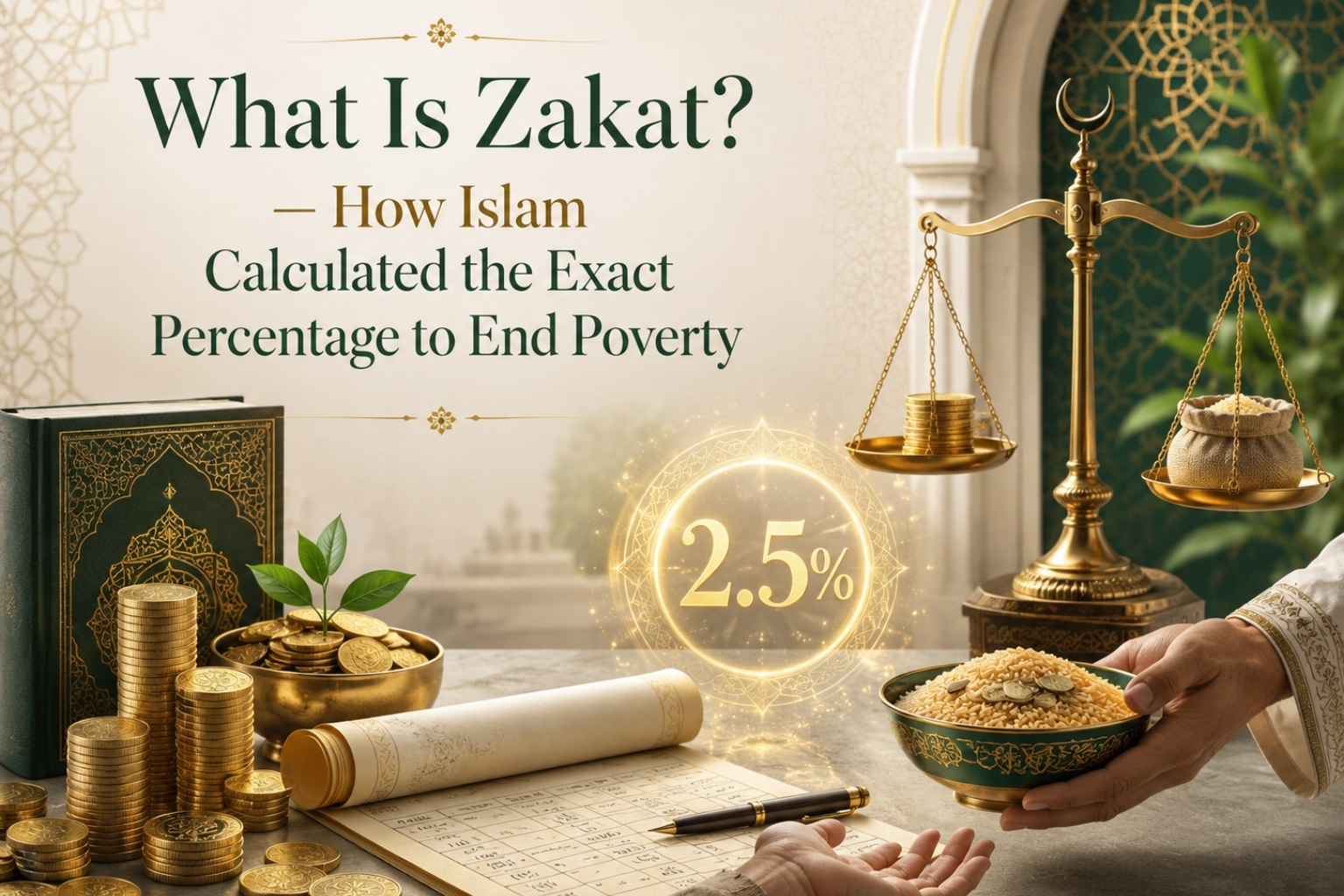
However, when we engage in Tadabbur (deep Quranic reflection), we discover that Islam approaches economic health not through arbitrary, fluctuating policies, but through a permanent, divinely calculated financial institution: Zakat (obligatory almsgiving). Zakat is not a voluntary tip or a standard government tax. In the framework of Islamic psychology and economics, it is a precise mathematical mechanism engineered by Al-Khaliq (The Creator) to systematically distribute wealth, eliminate poverty, and purify the human soul from the toxic grip of greed, unlocking a profound state of financial and internal peace of mind.
The Core Blueprint: The Right of the Poor
The word Zakat linguistically carries two profound meanings: purification (Tahārah) and growth (Numūw). This linguistic paradox reveals the core philosophy of Islamic economics: by giving away a portion of your wealth, you do not decrease it; instead, you purify the remainder and stimulate its growth.
Zakat stands as the third pillar of Islam, a mandatory financial obligation for every adult Muslim who possesses wealth above a specific threshold for an entire lunar year. Unlike optional charity (Sadaqah), the Quran explicitly frames Zakat as an absolute, legal right belonging to the vulnerable, not a favor bestowed upon them by the rich:
“وَالَّذِينَ فِي أَمْوَالِهِمْ حَقٌّ مَّعْلُومٌ * لِّلسَّائِلِ وَالْمَحْرُومِ”
“And those within whose wealth is a known right, for the petitioner and the deprived.”
— Surah Al-Ma’arij, 70:24-25
To understand the precision behind this divine system, the core parameters used to calculate and distribute Zakat are organized below into a clear, highly structured format:
The Core Asset Classes | The Minimum Threshold (Nisāb) | The Exact Percentage Due | The Targeted Recipients (Surah At-Tawbah, 9:60) |
1. Liquid Wealth • Cash savings • Gold and silver • Stocks and shares | Equivalent to the current market value of 85 grams of pure gold or 595 grams of pure silver. | 2.5% (Calculated on surplus wealth held for one lunar year). | • The Destitute (Al-Fuqarā’) • The Poor (Al-Masākīn) • Those in Debt (Al-Ghārimīn) • The Wayfarer (Ibn As-Sabīl) |
2. Agricultural Produce • Grains and fruits | Equivalent to 5 Wasqs (Approximately 653 kg). | • 10% for naturally irrigated land. • 5% for artificially irrigated land. | • Zakat Administrators • Those whose hearts are reconciled • To free captives/slaves • In the cause of Allah |
3. Livestock • Camels, cows, sheep | Minimum counts apply (e.g., 40 sheep/goats). | Specific animal counts graduated by herd size. | Distributed directly within the local community to satisfy immediate survival needs first. |
The Mathematical Mastery: The 2.5% Equilibrium
When looking closely at global financial systems, people often wonder how a seemingly small number like 2.5% could eradicate poverty. The secret lies in the fact that Zakat is not a tax on income, but an annual tax on stagnant, surplus wealth.
Modern economics relies heavily on the circulation of capital. When the wealthy hoard cash in bank vaults or speculative assets, capital stops moving, causing local economies to stagnate and leaving the working class starved for liquidity. Zakat solves this by placing a continuous, gentle pressure on idle capital. If a wealthy individual hoards millions in cash without investing it in productive businesses or distributing it, Zakat will consistently reduce that wealth by 2.5% every year.
Therefore, the divine law systematically incentivizes the wealthy to keep their money circulating through investment, trade, and direct welfare, ensuring a fluid, vibrant market where money constantly flows down to the lower economic tiers.
The Psychological Reset: Overcoming the Fear of Deprivation
When you choose to calculate and pay your Zakat as an intentional strategy for trusting Allah’s plan, your internal relationship with material wealth undergoes a radical, liberating shift.
Financial anxiety is fundamentally driven by a scarcity mindset—the terrifying, ego-driven belief that what you give away is permanently lost to you. This panic prompts people to hoard money, a behavior that paradoxically heightens stress by making them hypersensitive to every minor market fluctuation.
Islam shatters this psychological trap by altering how we perceive ownership. It teaches that your wealth does not originate from your intelligence, your labor, or your corporate strategy; it is a temporary trust (Amānah) given to you by Al-Razzaq (The Absolute Provider). The Prophet Muhammad delivered a powerful, uncompromising guarantee to completely neutralize the fear of financial loss:
“Charity does not decrease wealth.” — Sahih Muslim, 2588
Through Tadabbur, we realize that Zakat acts as a surgical strike against the spiritual disease of Shuhh (soul-destroying stinginess). By forcing yourself to cut a check for 2.5% of your total surplus capital every single year and handing it over to individuals who cannot offer you any corporate leverage or social favors in return, you train your mind to stop relying on numbers for your core sense of security. You detach your heart from the creation and anchor it firmly in the Creator, securing true, unshakeable peace of mind.
The Purification Filter: The Annual Zakat Protocol
To ensure your financial assets remain perfectly pure, untainted by greed, and fully blessed with divine expansion, run your capital through this structured, systematic sequence.
1.The Meticulous Wealth Audit:Step 1.
Establish a fixed date on the lunar calendar every year (such as a specific day in Ramadan). Calculate the total value of all your Zakat-eligible assets, including liquid cash, bank balances, gold, stocks, and business inventory, while subtracting your immediate, short-term liabilities.
2.The Verification of Nisab:Step 2.
Check the current market value of 85 grams of gold. If your net eligible wealth exceeds this threshold amount, you have met the criteria. Recognize that the 2.5% portion of this money is no longer legally yours; it is a deposit belonging directly to the vulnerable that must be returned.
3.The Awakening of Intention:Step 3.
Before transferring the funds, pause and establish a clear, quiet internal intention (Niyyah) in your heart. Mentally affirm: “O Allah, I am paying this Zakat solely to fulfill Your command, to purify my wealth, and to seek Your pleasure alone.”
4.The Dignified and Anonymous Delivery:Step 4.
Identify eligible recipients, prioritizing poor family members who are not your direct dependents, or trusted local distribution channels. Deliver the funds with absolute humility, ensuring you do not injure the dignity of the recipient with boastful behavior or reminders of your generosity.
Actionable Steps to Cultivate Financial Serenity
- Automate a Monthly “Sadaqah Buffer”: Do not limit your financial giving strictly to your annual Zakat calculation. Establish an automated, recurring monthly transfer of optional charity (Sadaqah) to a cause you trust. This consistent, rhythmic outflow of wealth acts as ongoing behavioral therapy, conditioning your subconscious mind to operate out of an abundance mindset throughout the year.
- Practice Pristine Financial Transparency: Take the time to clear away any ambiguity in your business transactions, outstanding debts, or tax filings. Keep an accurate, up-to-date ledger of your financial liabilities. Eliminating financial chaos and addressing debts promptly is a vital prerequisite for alleviating cognitive load and achieving permanent healing anxiety with the Quran.
- Reframe Career Setbacks Through the Lens of Rizq: If you experience a sudden professional loss, a market downturn, or a missed promotion, refuse to spiral into financial panic. Re-anchor your soul in the reality of Rizq (divine provision). Remind your overthinking intellect: “My salary is merely a channel, but Allah is the source. The channel can change or close, but the Source remains infinitely abundant under how to trust Allah.”
Conclusion
The brilliant, mathematically balanced framework of Zakat in Islam stands as an essential economic and spiritual compass for a generation drowning in systemic inequality, material comparison, and intense financial dread. Islam reminds you that your life, your career, and your bank account were never engineered to be insulated from the suffering of the surrounding world. You are not a isolated consumer floating in an amoral marketplace; you are an honorable custodian operating under the direct oversight of the Owner of All Sovereignty. When you choose to honor the legal rights of the poor, calculate your obligations with pristine precision, and anchor your lifestyle in trusting Allah’s plan, the suffocating weight of economic anxiety completely evaporates—leaving your mind, your wealth, and your enterprise beautifully wrapped in a state of absolute security, deep internal stillness, and everlasting success.