

We live in a world that never sleeps, yet suffers from a profound, collective insomnia of the soul. Long after the sun goes down, our glowing screens keep our minds locked in a state of artificial daylight. We scroll through endless feeds, parse through unread emails, and re-analyze our life choices late into the night. This nocturnal restlessness is where overthinking in Islam reaches its absolute peak. When the rest of the house is quiet, our worries become deafening—magnifying our fears about the future, our regrets about the past, and our perceived inadequacies.
To combat this late-night mental exhaustion, modern wellness culture strongly advocates for sleep hygiene routines, white-noise machines, or midnight meditation apps. While these tools can help calm the physical body, they rarely touch the underlying existential dread that keeps the mind awake. They can quiet the room, but they cannot quiet the heart.
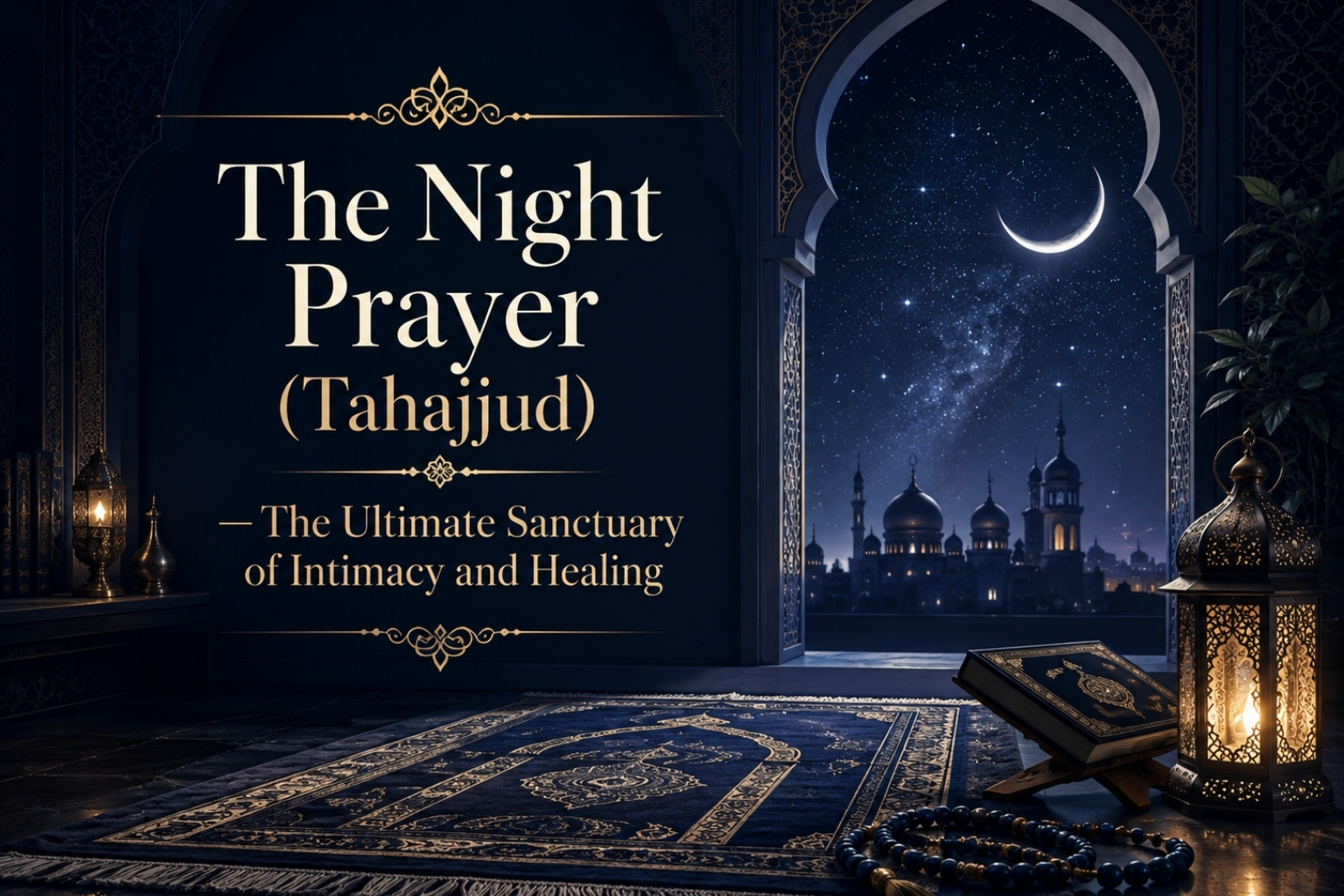
However, when we apply Tadabbur (deep Quranic reflection) to the prophetic lifestyle, we discover that Islam does not view the stillness of the night as an empty, lonely void to be feared or medicated away. Instead, it recognizes midnight as the most elite spiritual time zone on Earth: the realm of Tahajjud (the voluntary night prayer). Tahajjud is not an ordinary ritual duty; it is a private, unscripted appointment with the King of kings. In the framework of Islamic psychology, it serves as the ultimate clinical sanctuary for healing anxiety with the Quran, allowing a tired mind to find absolute, unshakeable peace of mind.
The Sacred Invitation: Dropping the Veil of the World
The word Tahajjud linguistically stems from the root hujūd, which carries a fascinating dual meaning: it means both sleeping and waking up to pray. Therefore, Tahajjud is structurally defined as a voluntary prayer performed during the night after one has woken up from a period of sleep, demanding a deliberate sacrifice of physical comfort.
Allah places such an immense premium on this midnight connection that He explicitly highlighted it in the Quran as the defining characteristic of His most spiritually elevated servants:
“تَتَجَافَىٰ جُنُوبُهُمْ عَنِ الْمَضَاجِعِ يَدْعُونَ رَبَّهُمْ خَوْفًا وَطَمَعًا وَمِمَّا رَزَقْنَاهُمْ يُنفِقُونَ”
“They arise from [their] beds; they supplicate their Lord in fear and aspiration, and from what We have provided them, they spend.”
— Surah As-Sajdah, 32:16
When you choose to stand on the prayer mat while the rest of the creation is completely unconscious, the spiritual dynamics of your life shift instantly. The noise of human opinions, worldly competition, and societal expectations completely evaporates. You are left standing in your raw, authentic humanity before the One who created you, entering a zone of absolute safety.
The Cosmic Descent: The Hours of Ultimate Leverage
In everyday life, the higher a person’s status, the harder it is to gain direct access to them. You must pass through secretaries, security clearances, and scheduled appointments. But Islamic theology turns this worldly hierarchy completely upside down during the final third of the night.
The Prophet Muhammad exposed an incredible cosmic mechanism that occurs every single night, offering a level of direct access to divine mercy that defies human comprehension:
“Our Lord, the Blessed, the Superior, descends every night to the nearest heaven when the last third of the night remains, saying: ‘Is there anyone to invoke Me, so that I may respond to his invocation? Is there anyone to ask Me, so that I may grant him his request? Is there anyone seeking My forgiveness, so that I may forgive him?'”
— Sahih al-Bukhari, 1145
Consider the profound psychological implications of this narration. While you are wide awake pacing your room, worrying about your bills, your career, your relationships, or your mental health, Al-Sami’ (The All-Hearing) is actively inviting you to hand those exact burdens over to Him.
Tahajjud is a masterclass in how to trust Allah. It teaches your intellect that you do not have to carry the terrifying weight of your life on your own fragile shoulders. By utilizing this midnight window, you trade your fragile, limited human effort for the infinite, boundless power of the Creator.
The Spiritual Mechanics of the Night Prayer
To help a beginner build a consistent and highly rewarding midnight practice, the practical and structural guidelines of Tahajjud are organized below into a clear, scannable format:
The Metric | The Practical Guidelines | The Internal & Psychological Target |
The Timing | Anytime after the mandatory Isha prayer until the first break of dawn (Fajr). The absolute optimal window is the last third of the night. | Capitalizes on the peak hours of global quiet, ensuring zero telephone notifications or domestic interruptions. |
The Number of Units | Performed in sets of 2 Rak’ahs each. You can pray as few as 2 Rak’ahs, up to 8 or more, concluding with 1 or 3 Rak’ahs of Witr. | Allows for absolute flexibility based on your current physical energy, eliminating the paralysis of perfectionism. |
The Recitation | Recite the Quran beautifully, audibly, and at a slow, measured pace. It is highly recommended to prolong the standing (Qiyam) and prostration (Sujud). | Engages your acoustic feedback loop, forcing a racing mind to anchor itself entirely in the divine text. |
The Supplication | Make free-form, emotionally vulnerable Du’a in your native language while in the state of Sujud or immediately after finishing. | Serves as an unedited, deeply therapeutic dump of your anxieties, fears, and hopes directly to Al-Wakil. |
The Neurobiology of Midnight Intimacy
One of the primary drivers of chronic anxiety is the psychological feeling of isolation—the deep, exhausting belief that nobody truly understands the hidden depth of your internal pain or the complexity of your struggles.
Tahajjud functions as a profound therapeutic remedy for this specific isolation. When you pray in the middle of the night, you are engaging in an act of absolute sincerity. Because there is no audience to applaud you, no social media platform to validate you, and no witness to see you, the walls of your social ego drop completely.
“Keep to the night prayer, for it was the habit of the righteous before you, a means of drawing close to your Lord, an expiation for your sins, and a deterrent from physical disease.” — Sunan At-Tirmidhi, 3549
By crying on the prayer mat in the dark, you undergo a profound psychological catharsis. You translate your unexpressed anxieties into spoken, tearful words directed at the only One who holds the ultimate power to change your reality. This intense vulnerability triggers a profound downregulation of your nervous system, washing away internal tension and leaving your heart wrapped in an unshakeable sense of emotional security, pristine clarity, and long-term peace of mind.
The Four-Step Protocol to Master the Midnight Wake-Up
If waking up in the dark currently feels like an impossible physical hurdle due to your exhausting schedule, utilize this structured prophetic sequence to build a sustainable Tahajjud habit:
1.The Strategic Early Lockout:Step 1.
Consciously finish your dinner and log off all digital screens within 60 minutes of completing your mandatory Isha prayer. Refuse the temptation to engage in late-night revenge scrolling, which actively spikes cortisol and fragments your deep sleep cycles.
2.The Prophetic Sleep Position & Intention:Step 2.
As you lie down on your right side, establish a firm, clear, and quiet internal intention (Niyyah) in your heart: “O Allah, I am closing my eyes right now with the explicit purpose of waking up to stand before You in Tahajjud.” The scholars note that if you sleep with this intention and miss your alarm, Allah writes the full reward of the prayer in your ledger regardless.
3.The Immediate Launch (The 5-Second Rule):Step 3.
The moment your midnight alarm sounds, refuse to debate with your ego (Nafs). Do not hit snooze. Immediately sit upright, wipe the sleep from your face with your hands, and state audibly: “Alhamdulillah” (Praise be to Allah). Walk directly to the sink to perform a crisp, cool session of Wudu.
4.The Low-Bar Launch Strategy:Step 4.
Do not overwhelm your nervous system by trying to pray for an hour on your first night. Start by standing on the mat for just ten minutes, performing two quick, beautiful Rak’ahs followed by two minutes of emotional Du’a. Building the neurological habit of consistency is vastly more important than volume for a beginner.
Actionable Steps to Secure Everlasting Tranquility
- Utilize the “Pre-Fajr” Cushion: If waking up at 3:00 AM feels completely unachievable for your current work life, do not abandon the night prayer entirely. Set your alarm just 20 minutes before the start time of Fajr. Wake up, make Wudu, and pray your Tahajjud units in that brief window. It still legally qualifies as the last third of the night and requires zero alteration to your core sleep block.
- Transform Your Sujud into an Unedited Mental Sandbox: When you lower your forehead to the ground during Tahajjud, completely eliminate any sense of formal hesitation. Do not worry about formatting your Arabic perfectly if it is not your native tongue. Speak to Allah from the depths of your heart in your own language. Pour out your raw frustration, your exhaustion, and your hopes under trusting Allah’s plan.
- Maintain the Secrecy Filter: Once you begin to master the beautiful habit of the night prayer, guard it with absolute secrecy. Refuse the urge to casually mention to friends, family, or social media circles that you were awake praying last night. Keeping this sanctuary completely anonymous protects the purity of your intention and ensures that your midnight escape remains a private, highly secure line of communication between you and your Creator.
Conclusion
The exquisite, luminous, and deeply restorative practice of Tahajjud in Islam stands as the ultimate spiritual harbor for a human generation adrift in an ocean of hyper-connectivity, chronic overthinking, and structural anxiety. Islam reminds you that you do not have to consume your life running on empty, waiting for an emotional breakdown to force a pause. Your precious mind was engineered to be systematically unburdened in the quiet safety of the night, resting under the direct, loving care of Al-Wadud (The Loving) and Al-Basir (The All-Seeing). When you choose to step onto the mat in the dark, claim your direct access to the cosmic descent, and anchor your ultimate confidence in trusting Allah’s plan, the suffocating fog of worldly worry completely dissolves—leaving your soul beautifully wrapped in an unshakeable state of absolute security, deep internal stillness, and everlasting spiritual success.