
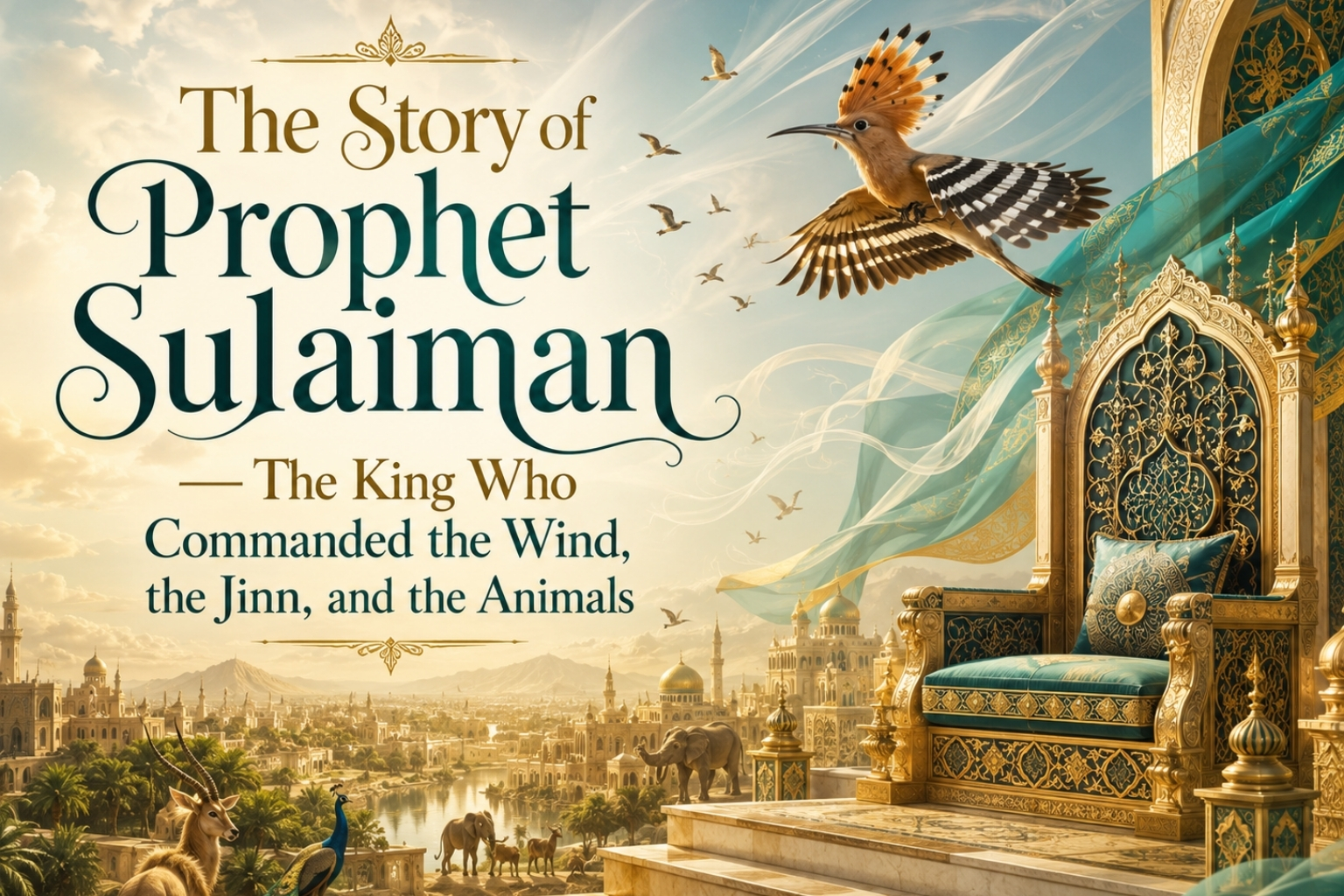

There has never been a kingdom like his. Not before. Not since. Not in the imagination of the greatest human minds — and not in the recorded history of the most powerful civilizations that have ever existed.
Prophet Sulaiman, peace be upon him, was given by Allah a dominion so complete, so unprecedented, so explicitly beyond the reach of any human being before or after him, that Allah Himself declared it a unique gift — never to be repeated:
“My Lord, forgive me and grant me a kingdom that will not belong to anyone after me.”
And Allah granted it.
He commanded the wind. He understood the language of birds and ants. The Jinn built for him whatever he willed — palaces, temples, sculptures, pools. He could travel in a single morning which would take a caravan months to cross. A queen who ruled one of the greatest civilizations on earth came to him, saw his kingdom, and surrendered not to his power — but to his God.
And through all of it — through power that would have destroyed any ordinary human being with arrogance — Sulaiman remained what his father Dawud had raised him to be: a servant of Allah. A king who knew that everything he held was a gift. A man who, at the height of his dominion, could still say with complete sincerity:
“My Lord, enable me to be grateful for Your favor.”
Chapter One — The Inheritance: Born Into Prophethood and Wisdom
Sulaiman was the son of Prophet Dawud, peace be upon him — which means he was born into a household of prophethood, wisdom, and devoted worship. But his gifts were his own — given directly by Allah, tested early, and evident from childhood.
The Quran records an early display of Sulaiman’s wisdom — a legal case brought before Dawud involving sheep that had grazed in and destroyed another man’s field. Dawud ruled one way. Sulaiman — still a young man — proposed an alternative that was more just and more balanced. Allah records that He guided Sulaiman to the more precise judgment:
Quran Verse:
وَدَاوُودَ وَسُلَيْمَانَ إِذْ يَحْكُمَانِ فِي الْحَرْثِ إِذْ نَفَشَتْ فِيهِ غَنَمُ الْقَوْمِ وَكُنَّا لِحُكْمِهِمْ شَاهِدِينَ ﴿٧٨﴾ فَفَهَّمْنَاهَا سُلَيْمَانَ ۚ وَكُلًّا آتَيْنَا حُكْمًا وَعِلْمًا
“And Dawud and Sulaiman, when they judged concerning the field — when the sheep of the people overran it and We were witness to their judgment. And We gave understanding of it to Sulaiman, and to each of them We gave judgment and knowledge.”
Surah Al-Anbiya (21:78–79)
Both father and son were given judgment and knowledge — Allah honored both. But Sulaiman received a more precise understanding in this case. This early display of wisdom was a sign of what was to come — a kingdom built not merely on power, but on a penetrating ability to see through complexity to the truth at its heart.
Chapter Two — The Kingdom That Has Never Been Repeated
When Sulaiman became king, he made a prayer that stands as one of the most remarkable requests in prophetic history — remarkable not for its humility but for its audacity, offered with complete sincerity to the One who alone could grant it:
Quran Verse:
قَالَ رَبِّ اغْفِرْ لِي وَهَبْ لِي مُلْكًا لَّا يَنبَغِي لِأَحَدٍ مِّن بَعْدِي ۖ إِنَّكَ أَنتَ الْوَهَّابُ
“He said: ‘My Lord, forgive me and grant me a kingdom that will not belong to anyone after me. Indeed, You are the Bestower.'”
Surah Sad (38:35)
“A kingdom such as this will not belong to anyone after me.” This was not arrogance. This was a prophet asking Allah for something specific — a unique dominion that would itself be a sign of Allah’s power and generosity. And Allah — Al-Wahab, the Bestower — granted it completely.
Allah describes the scope of what was given:
Quran Verse:
فَسَخَّرْنَا لَهُ الرِّيحَ تَجْرِي بِأَمْرِهِ رُخَاءً حَيْثُ أَصَابَ ﴿٣٦﴾ وَالشَّيَاطِينَ كُلَّ بَنَّاءٍ وَغَوَّاصٍ ﴿٣٧﴾ وَآخَرِينَ مُقَرَّنِينَ فِي الْأَصْفَادِ
“So We subjected him to the wind, blowing gently at his command wherever he directed. And the devils — every builder and diver — and others bound together in shackles.”
Surah Sad (38:36–38)
The wind — one of the most ungovernable forces in nature — obeyed his command. The Jinn — beings of unseen power, builders and divers — worked in his direction. Even those among the Jinn who refused were bound and made to serve. The scope of this authority over creation was unlike anything Allah had given or would give to any human being.
Chapter Three — The Language of Creation: Birds, Ants, and the Hoopoe
Among the most extraordinary gifts given to Sulaiman was the ability to understand the language of animals — every creature’s communication was accessible to him. And the Quran records two remarkable encounters that demonstrate what this gift meant in practice.
The Ants:
Sulaiman was leading his armies — human soldiers, Jinn warriors, and birds — across a valley when he heard something that most kings would never notice:
Quran Verse:
حَتَّىٰ إِذَا أَتَوْا عَلَىٰ وَادِ النَّمْلِ قَالَتْ نَمْلَةٌ يَا أَيُّهَا النَّمْلُ ادْخُلُوا مَسَاكِنَكُمْ لَا يَحْطِمَنَّكُمْ سُلَيْمَانُ وَجُنُودُهُ وَهُمْ لَا يَشْعُرُونَ
“Until, when they came upon the valley of the ants, an ant said: ‘O ants, enter your dwellings that you not be crushed by Sulaiman and his soldiers while they perceive not.'”
Surah An-Naml (27:18)
An ant. Warning her colony. Acknowledging that Sulaiman and his army might harm them — and that the harm would be unintentional, not deliberate. The ant gave Sulaiman’s army the benefit of the doubt even while warning of the danger.
Sulaiman heard this — understood it — and his response reveals the quality of his character at the height of his power:
Quran Verse:
فَتَبَسَّمَ ضَاحِكًا مِّن قَوْلِهَا وَقَالَ رَبِّ أَوْزِعْنِي أَن أَشْكُرَ نِعْمَتَكَ الَّتِي أَنْعَمْتَ عَلَيَّ وَعَلَىٰ وَالِدَيَّ وَأَنْ أَعْمَلَ صَالِحًا تَرْضَاهُ وَأَدْخِلْنِي بِرَحْمَتِكَ فِي عِبَادِكَ الصَّالِحِينَ
“So he smiled, amused at her speech, and said: ‘My Lord, enable me to be grateful for Your favor which You have bestowed upon me and upon my parents and to do righteousness of which You will approve. And admit me by Your mercy into the ranks of Your righteous servants.'”
Surah An-Naml (27:19)
He smiled. He was amused — delighted by the extraordinary nature of his gift, by the fact that he could hear what no other king could hear. And then — immediately — he turned that delight into gratitude. His first response to the miracle of his own ability was not pride. It was a prayer. Enable me to be grateful. Enable me to do righteousness. Admit me among the righteous.
A man commanding the wind and the Jinn, leading armies of humans and birds — and his prayer is to be admitted among the righteous servants of Allah. This is the character of Sulaiman.
The Hoopoe:
Sulaiman noticed the absence of the hoopoe bird from his assembled forces — and demanded an explanation. The hoopoe arrived with news that would change the course of his reign:
Quran Verse:
فَقَالَ أَحَطتُ بِمَا لَمْ تُحِطْ بِهِ وَجِئْتُكَ مِن سَبَإٍ بِنَبَإٍ يَقِينٍ ﴿٢٢﴾ إِنِّي وَجَدتُّ امْرَأَةً تَمْلِكُهُمْ وَأُوتِيَتْ مِن كُلِّ شَيْءٍ وَلَهَا عَرْشٌ عَظِيمٌ ﴿٢٣﴾ وَجَدتُّهَا وَقَوْمَهَا يَسْجُدُونَ لِلشَّمْسِ مِن دُونِ اللَّهِ
“He said: ‘I have encompassed what you have not encompassed, and I have come to you from Sheba with certain news. Indeed, I found a woman ruling them, and she has been given all things, and she has a great throne. I found her and her people prostrating to the sun instead of Allah.'”
Surah An-Naml (27:22–24)
A bird brought intelligence about a distant kingdom — a queen of extraordinary power whose people worshipped the sun. And Sulaiman’s response was not military calculation. It was the response of a prophet: he sent a letter calling her to Allah.
Chapter Four — The Queen of Sheba: Power Meeting Greater Power
The Queen of Sheba — Bilqis in Islamic tradition — was herself a ruler of remarkable gifts. She governed with wisdom, consulted her advisors, and assessed situations with a clarity that her own people recognized. When Sulaiman’s letter arrived — beginning with the words “In the name of Allah, the Most Gracious, the Most Merciful” — she consulted her council:
Quran Verse:
قَالَتْ يَا أَيُّهَا الْمَلَأُ أَفْتُونِي فِي أَمْرِي مَا كُنتُ قَاطِعَةً أَمْرًا حَتَّىٰ تَشْهَدُونِ
“She said: ‘O eminent ones, advise me in my affair. I would not decide a matter until you are present.'”
Surah An-Naml (27:32)
Her advisors offered military resistance — they had power and were willing to fight. But Bilqis was wiser than her advisors. She decided to send gifts first — to test Sulaiman, to see whether he was a king who wanted tribute or something else entirely.
Sulaiman’s response to the gifts was immediate and unambiguous:
Quran Verse:
فَلَمَّا جَاءَ سُلَيْمَانَ قَالَ أَتُمِدُّونَنِ بِمَالٍ فَمَا آتَانِيَ اللَّهُ خَيْرٌ مِّمَّا آتَاكُمْ بَلْ أَنتُم بِهَدِيَّتِكُمْ تَفْرَحُونَ
“So when they came to Sulaiman, he said: ‘Do you provide me with wealth? But what Allah has given me is better than what He has given you. Rather, it is you who rejoice in your gift.'”
Surah An-Naml (27:36)
“What Allah has given me is better than what He has given you.” Not arrogance — truth. The man who commanded the wind and the Jinn had no need of gold. He returned the gifts and sent a message: come, submit to Allah, or face consequences.
Bilqis decided to come in person.
Chapter Five — The Throne and the Palace: Two Miracles That Opened a Queen’s Heart
Before Bilqis arrived, Sulaiman issued a challenge to those around him — who could bring her throne before she reached him?
A Jinn of great power offered to bring it before the assembly ended. But then a man — described in the Quran as having knowledge of the Book — said something more extraordinary:
Quran Verse:
قَالَ الَّذِي عِندَهُ عِلْمٌ مِّنَ الْكِتَابِ أَنَا آتِيكَ بِهِ قَبْلَ أَن يَرْتَدَّ إِلَيْكَ طَرْفُكَ ۚ فَلَمَّا رَآهُ مُسْتَقِرًّا عِندَهُ قَالَ هَٰذَا مِن فَضْلِ رَبِّي لِيَبْلُوَنِي أَأَشْكُرُ أَمْ أَكْفُرُ
“One who had knowledge from the Scripture said: ‘I will bring it to you before your glance returns to you.’ And when he saw it placed before him, he said: ‘This is from the favor of my Lord to test me whether I will be grateful or ungrateful.'”
Surah An-Naml (27:40)
The throne of Bilqis — from a distant kingdom — appeared before Sulaiman in the blink of an eye. And Sulaiman’s response was again the same: “This is from the favor of my Lord — to test me whether I will be grateful or ungrateful.”
Every miracle was, for Sulaiman, another test of gratitude. Not an occasion for self-congratulation. A test. Will you be grateful? Will you remember who gave this?
Then, to test Bilqis’s perception, Sulaiman had her throne slightly altered and asked if it was hers. She gave a carefully non-committal answer that revealed her shrewdness. And then she was led into Sulaiman’s palace — where the floor was made of clear glass over flowing water:
Quran Verse:
قِيلَ لَهَا ادْخُلِي الصَّرْحَ ۖ فَلَمَّا رَأَتْهُ حَسِبَتْهُ لُجَّةً وَكَشَفَتْ عَن سَاقَيْهَا ۚ قَالَ إِنَّهُ صَرْحٌ مُّمَرَّدٌ مِّن قَوَارِيرَ
“It was said to her: ‘Enter the palace.’ But when she saw it, she thought it was a body of water and uncovered her shins. He said: ‘Indeed, it is a palace paved with glass.'”
Surah An-Naml (27:44)
She had been deceived by appearance — mistaking solid glass for water. And in that moment of being shown that what she thought was real was not — something shifted. She recognized that her entire life had been built on appearances, on the worship of the sun, on power that did not reach to the truth behind creation.
She surrendered:
Quran Verse:
قَالَتْ رَبِّ إِنِّي ظَلَمْتُ نَفْسِي وَأَسْلَمْتُ مَعَ سُلَيْمَانَ لِلَّهِ رَبِّ الْعَالَمِينَ
“She said: ‘My Lord, indeed I have wronged myself, and I submit with Sulaiman to Allah, Lord of the worlds.'”
Surah An-Naml (27:44)
A queen who ruled one of the greatest civilizations of the ancient world looked at Sulaiman’s kingdom — at the throne brought in a blink of an eye, at the palace of glass, at the man who smiled at ants and prayed to be among the righteous — and she saw in all of it something that her own sun-worship could never offer.
She saw the signature of Allah.
And she surrendered to it.
Chapter Six — The Test of Distraction: When the Horses Took His Attention
Even Sulaiman — with all his wisdom and devotion — was not immune to the tests that power and beauty bring. The Quran records a moment when his attention was drawn away from his afternoon prayer by the sight of his magnificent horses:
Quran Verse:
إِذْ عُرِضَ عَلَيْهِ بِالْعَشِيِّ الصَّافِنَاتُ الْجِيَادُ ﴿٣١﴾ فَقَالَ إِنِّي أَحْبَبْتُ حُبَّ الْخَيْرِ عَن ذِكْرِ رَبِّي حَتَّىٰ تَوَارَتْ بِالْحِجَابِ
“When there were displayed before him in the afternoon the well-trained horses. And he said: ‘Indeed, I gave preference to the love of good things over the remembrance of my Lord’ — until it was hidden by the veil.”
Surah Sad (38:31–32)
The sun set. Sulaiman realized he had missed his prayer — absorbed by the display of his horses. And his response — like his father Dawud before him — was immediate:
Quran Verse:
رُدُّوهَا عَلَيَّ ۖ فَطَفِقَ مَسْحًا بِالسُّوقِ وَالْأَعْنَاقِ
“Return them to me, and he began striking the legs and necks.”
Surah Sad (38:33)
Scholars have discussed the exact meaning of this verse extensively. The most widely accepted understanding is that Sulaiman commanded the horses to be brought back and began stroking them — dedicating them fully to Allah’s cause in a gesture of redirecting what had distracted him back to the service of his Lord. Rather than allowing the horses to remain a source of distraction, he made them an act of worship.
This is the prophetic response to distraction: not punishment of the thing that drew the attention, but redirection of it toward Allah.
Chapter Seven — The Wind and the Morning: The Dimensions of His Kingdom
The Quran describes the scope of Sulaiman’s domain over the wind in terms that convey both its power and its precision:
Quran Verse:
وَلِسُلَيْمَانَ الرِّيحَ غُدُوُّهَا شَهْرٌ وَرَوَاحُهَا شَهْرٌ
“And to Sulaiman We underwent the wind — its morning course was a month’s journey and its afternoon course was a month’s journey.”
Surah Saba (34:12)
A month’s journey in the morning. A month’s journey in an afternoon. The wind that carried Sulaiman covered in hours what would take a human being traveling by conventional means two months. His dominion was not just over a region — it was over the geometry of distance itself, as Allah made the earth beneath the wind contract for him.
And all of this was accompanied by the Jinn who built whatever he commanded:
Quran Verse:
يَعْمَلُونَ لَهُ مَا يَشَاءُ مِن مَّحَارِيبَ وَتَمَاثِيلَ وَجِفَانٍ كَالْجَوَابِ وَقُدُورٍ رَّاسِيَاتٍ
“They made for him what he willed of elevated chambers, statues, bowls like reservoirs, and stationary kettles.”
Surah Saba (34:13)
A civilization built by Jinn — temples, sculptures, massive cooking vessels. The material civilization of Sulaiman’s kingdom was unlike anything the ancient world had seen — because its builders were unlike anything the ancient world had access to.
Chapter Eight — The Death That Taught a Lesson to the Jinn
The end of Sulaiman’s life is narrated in one of the most remarkable passages in the Quran — a death that itself became a lesson about the limits of knowledge, even for the Jinn:
Quran Verse:
فَلَمَّا قَضَيْنَا عَلَيْهِ الْمَوْتَ مَا دَلَّهُمْ عَلَىٰ مَوْتِهِ إِلَّا دَابَّةُ الْأَرْضِ تَأْكُلُ مِنسَأَتَهُ ۖ فَلَمَّا خَرَّ تَبَيَّنَتِ الْجِنُّ أَن لَّوْ كَانُوا يَعْلَمُونَ الْغَيْبَ مَا لَبِثُوا فِي الْعَذَابِ الْمُهِينِ
“And when We decreed for his death, nothing indicated his death to them except a creature of the earth eating his staff. But when he fell, it became clear to the Jinn that if they had known the unseen, they would not have continued in humiliating punishment.”
Surah Saba (34:14)
Sulaiman died standing — leaning on his staff. And because the Jinn could not perceive the unseen, they continued their labor, not knowing their master was gone — until a woodworm ate through the staff and the body fell.
This verse dismantles one of the greatest claims ever made about the Jinn — that they know the unseen, that they have access to hidden knowledge. Allah used the death of Sulaiman to expose this claim forever. If they had known the unseen, they would have known he was dead. They did not know. The only beings who know the unseen are those whom Allah permits to know what He permits.
The Jinn know no more of the unseen than Allah chooses to reveal to any of His creation.
Hadith:
إِنَّ عِفْرِيتًا مِنَ الْجِنِّ تَفَلَّتَ عَلَيَّ الْبَارِحَةَ لِيَقْطَعَ عَلَيَّ صَلَاتِي، فَأَمْكَنَنِي اللَّهُ مِنْهُ، فَأَرَدْتُ أَنْ أَرْبِطَهُ إِلَى سَارِيَةٍ مِنْ سَوَارِي الْمَسْجِدِ حَتَّى تُصْبِحُوا وَتَنْظُرُوا إِلَيْهِ أَجْمَعُونَ، فَذَكَرْتُ دَعْوَةَ أَخِي سُلَيْمَانَ: رَبِّ اغْفِرْ لِي وَهَبْ لِي مُلْكًا لَا يَنْبَغِي لِأَحَدٍ مِنْ بَعْدِي
“An ifrit from the Jinn attacked me last night to interrupt my prayer, and Allah gave me power over him. I wanted to tie him to one of the pillars of the mosque so you could all see him in the morning. But I remembered the prayer of my brother Sulaiman: ‘My Lord, forgive me and grant me a kingdom that will not belong to anyone after me.'”
Recorded in Sahih Al-Bukhari, Hadith No. 461
The Prophet Muhammad ﷺ himself — when he had power over a Jinn that attacked him during prayer — chose not to use that power, out of respect for Sulaiman’s unique request. He called Sulaiman “my brother” — the brotherhood of prophethood — and honored the exclusivity of Sulaiman’s gift by not claiming a share of it.
This hadith reveals two extraordinary things: that the Prophet Muhammad ﷺ had the ability but chose not to exercise it — and that his restraint was itself an act of honoring Sulaiman and Allah’s promise to him.
Timeless Lessons from the Story of Sulaiman
- It is permissible — and sometimes necessary — to ask Allah for great things Sulaiman asked for a kingdom unlike any before or after. He asked Allah — Al-Wahab, the Bestower — for something extraordinary, and Allah granted it. Asking Allah for great things is not arrogance. It is recognition of who Allah is. Limit your requests to your imagination — not to Allah’s capacity.
- The measure of a gift is what you do with it — and what you say when you receive it. At every miracle — the throne brought in a blink, the ant’s warning — Sulaiman’s response was gratitude and the prayer to be among the righteous. Greatness is not in the gift. It is in the character of the one who receives it.
- The language of the smallest creature matters when you are listening to Allah. Sulaiman heard an ant warn her colony and smiled. He was not too great for the smallest detail of Allah’s creation. The man who hears Allah’s signs in an ant’s warning is the man fit to command the wind.
- Genuine da’wah calls people to Allah — not to submission to yourself Sulaiman responded to Bilqis’s gifts with a message: come to Allah, not to me. His entire engagement with the Queen of Sheba was oriented toward her Islam — and when she surrendered, she surrendered to Allah and His Lord, not to Sulaiman’s power.
- What distracts you from dhikr can be redirected to serve Allah. When the horses distracted Sulaiman from prayer, he did not destroy them. He redirected them — dedicating them to Allah’s cause. The things that pull your attention from Allah are not necessarily evil. The question is what you do with them after you recognize the distraction.
- Power is a test of gratitude — nothing more “This is from the favor of my Lord to test me whether I will be grateful or ungrateful.” Sulaiman said this at the height of his power — when his throne appeared in a blink, when his armies filled the horizon, when queens came from distant lands to surrender to him. Power is a test. The test is always: are you grateful?
- The Jinn do not know the unseen — and anyone who claims otherwise is lying. Sulaiman’s death proved, in the most dramatic way possible, that the Jinn have no access to hidden knowledge. The entire industry of fortune-telling, spiritual consultation, and claims of Jinn-based knowledge of the future is exposed by a woodworm eating a staff. Do not give your money, your trust, or your faith to those who claim to know what Allah alone knows.
- Brotherhood among prophets transcends time The Prophet Muhammad ﷺ called Sulaiman “my brother” — and honored his unique request by not claiming a share of his gift. The prophets of Allah form a single family across all of time — each honoring the other, each pointing toward the same Lord.
Closing Reflection
The kingdom of Sulaiman has never been repeated. The wind has not obeyed another human command. The Jinn have not served another human master. A throne has not traveled from a distant kingdom in the blink of an eye since the day his palace was built.
These things were given once. To one man. By a Lord who said “I am Al-Wahab — the Bestower” — and then demonstrated it completely.
And what does the Quran show us of the man who held all of this? A man who smiled at an ant. A man who prayed to be admitted among the righteous. A man who looked at the greatest miracle he had ever witnessed and said immediately: this is from the favor of my Lord — to test me whether I will be grateful.
The most powerful human kingdom in history was governed by a man whose greatest concern was whether he was grateful enough.
That is the lesson Allah preserved in the story of Sulaiman — not the wind, not the Jinn, not the glass palace, not the queen who surrendered. The lesson is the man who held it all and still — in every moment that Allah records — turned it back toward Allah with gratitude.
Quran Verse:
رَبِّ أَوْزِعْنِي أَن أَشْكُرَ نِعْمَتَكَ الَّتِي أَنْعَمْتَ عَلَيَّ وَعَلَىٰ وَالِدَيَّ وَأَنْ أَعْمَلَ صَالِحًا تَرْضَاهُ وَأَدْخِلْنِي بِرَحْمَتِكَ فِي عِبَادِكَ الصَّالِحِينَ
“My Lord, enable me to be grateful for Your favor which You have bestowed upon me and upon my parents and to do righteousness of which You will approve. And admit me by Your mercy into the ranks of Your righteous servants.”
Surah An-Naml (27:19)
The prayer of a man who commanded the wind.
May it be the prayer of every person who reads it — regardless of what they command, what they hold, what they have been given.
Enable me to be grateful. Admit me among the righteous.
That is enough. That has always been enough.