
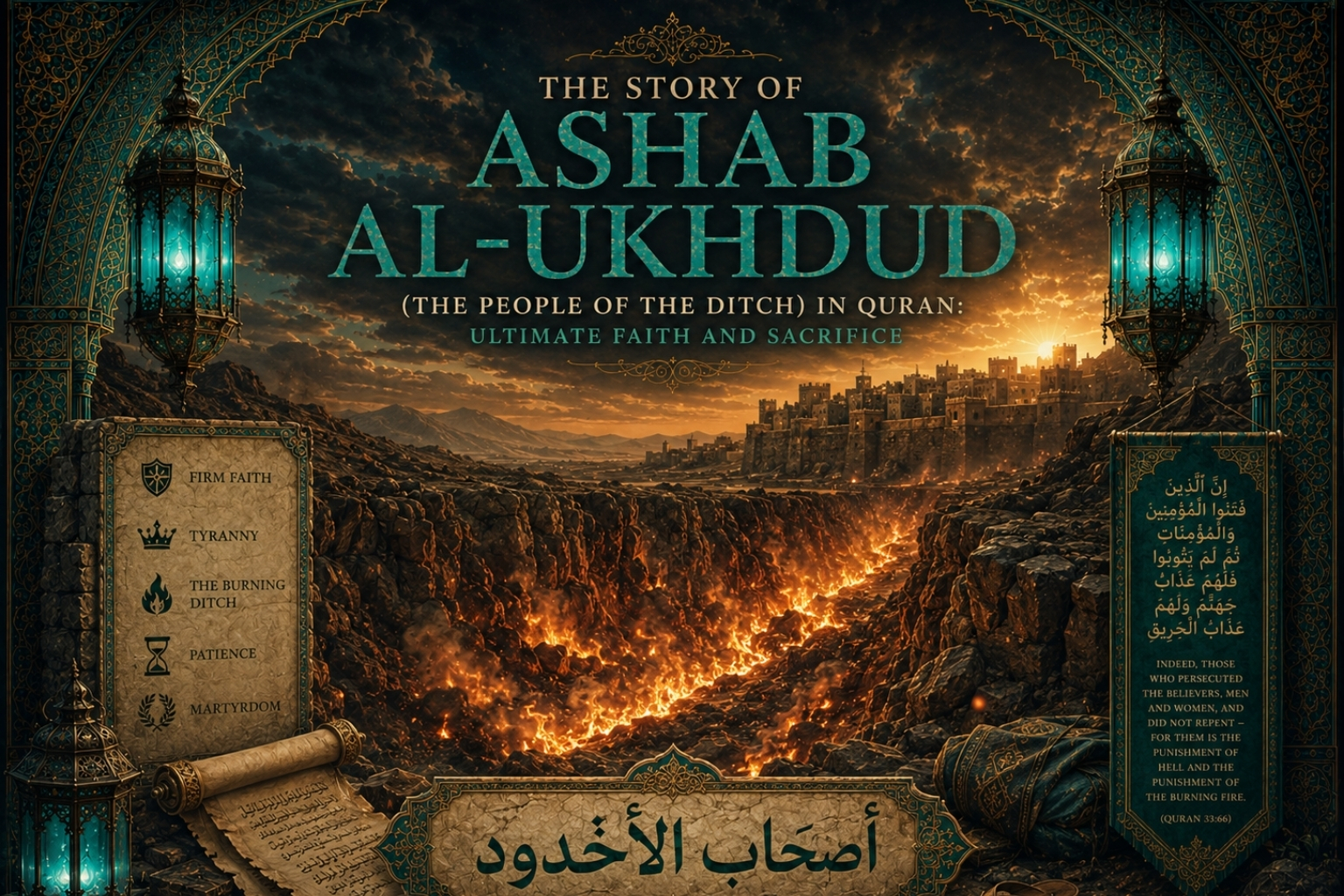

Among the most emotionally gripping and spiritually elevating narratives recorded in Islamic tradition is the chronicle of Ashab al-Ukhdud, known as The People of the Ditch or The People of the Trench. Found in Surah Al-Buruj (the 85th chapter of the Quran) and meticulously detailed by the Prophet Muhammad in the authentic Hadith, this profound historical account takes place in ancient Yemen (the kingdom of Najran) before the advent of Islam.
Revealed to the Prophet Muhammad during the brutal early years of the Makkah persecution, the story of the People of the Ditch in Islam serves as an eternal source of strength for believers. It highlights the absolute reality of faith (Iman) that cannot be crushed by state-sponsored terrorism, torture, or the threat of death.
The Tyrant, the Sorcerer, and the Faithful Boy
The narrative begins with a tyrannical, narcissistic king who claimed divinity and forced his citizens to worship him. To maintain his iron grip over the population, he relied heavily on an aging, powerful court sorcerer. Realizing his death was approaching, the sorcerer requested that the king appoint a brilliant young boy to become his apprentice and inherit his dark occult knowledge.
Every day, as the boy walked to the sorcerer’s palace, he passed by a secluded Christian monk who worshipped Allah upon the true, unaltered monotheistic message of Prophet Isa (Jesus). Drawn to the pure, logical words of the monk, the boy began sitting with him secretly, quickly realizing that the sorcerer’s magic was a demonic illusion and that Allah alone deserved worship.
The Catalyst: Testing the Truth
The boy’s faith was tested when a massive, terrifying beast blocked a public highway, trapping the townsfolk. Seeking a definitive sign to know whether the monk’s path or the sorcerer’s path was the absolute truth, the boy picked up a small stone and made a sincere supplication:
“اللَّهُمَّ إِنْ كَانَ أَمْرُ الرَّاهِبِ أَحَبَّ إِلَيْكَ مِنْ أَمْرِ السَّاحِرِ فَاقْتُلْ هَذِهِ الدَّابَّةَ حَتَّى يَمْضِيَ النَّاسُ”
“O Allah, if the affair of the monk is more beloved to You than the affair of the sorcerer, then kill this beast so that the people may pass.”(— Sahih Muslim)
He threw the stone, and the massive beast collapsed dead instantly. The news spread like wildfire. The boy was blessed by Allah with the miracle of healing the blind and curing lepers, always emphasizing to those he healed: “I do not heal anyone; it is Allah who heals.”
The Boy’s Martyrdom: A Public Declaration of Faith
Eventually, the tyrant king discovered the boy’s secret monotheism. He systematically tortured the monk and the king’s own prime minister (who had converted through the boy) and executed them when they refused to renounce their faith in Allah.
The king then tried to execute the boy by throwing him off a mountain peak and drowning him in the sea, but each time, the boy made a simple Dua (“O Allah, save me from them by whatever means You will”), and the royal soldiers perished while the boy walked back to the king unharmed.
Realizing the king’s frustration, the boy told the tyrant: “You will never be able to kill me unless you do exactly what I command you.” He instructed the king to gather the entire population in an open plain, tie him to a tree trunk, take an arrow from his own quiver, and loudly declare:
“بِاسْمِ اللَّهِ رَبِّ الْغُلاَمِ”
“In the name of Allah, the Lord of the boy.” (— Sahih Muslim)
The king, blinded by his desire to destroy the boy, did exactly as told. He fired the arrow, and it struck the boy’s temple, killing him instantly. Seeing this magnificent sacrifice, the entire population of the city shouted in unison: “We believe in the Lord of the boy!”
The Fiery Ditches and the Ultimate Sacrifice
Infuriated that his plan had completely backfired and that monotheism had triumphed, the tyrant king ordered his army to dig massive trenches (Ukhdud) throughout the main streets of the city. They filled them with fuel, igniting roaring, inescapable fires.
The soldiers stood over the trenches, issuing a brutal ultimatum to every citizen: either renounce your belief in Allah or be hurled alive into the raging fire.
“قُتِلَ أَصْحَابُ الْأُخْدُودِ النَّارِ ذَاتِ الْوَقُودِ إِذْ هُمْ عَلَيْهَا قُعُودٌ وَهُمْ عَلَىٰ مَا يَفْعَلُونَ بِالْمُؤْمِنِينَ شُهُودٌ”
“Cursed were the companions of the trench. [Containing] the fire full of fuel, when they were sitting near it, and they, to what they were doing against the believers, were witnesses.” (Surah Al-Buruj, 85:4-7)
Thousands of men, women, and children willingly threw themselves into the flames, prioritizing their eternal soul over worldly survival. The Quran specifically highlights the psychological motive of the oppressors:
“وَمَا نَقَمُوا مِنْهُمْ إِلَّا أَن يُؤْمِنُوا بِاللَّهِ الْعَزِيزِ الْحَمِيدِ”
“And they resented them not except because they believed in Allah, the Exalted in Might, the Praiseworthy.” (— Surah Al-Buruj, 85:8)
The Miracle of the Speaking Infant
The Hadith records a deeply moving miracle that occurred at the edge of the pit. A young mother carrying her infant baby hesitated, naturally feeling a wave of maternal fear and maternal instinct to save her child from the roaring fire.
In that critical moment of hesitation, Allah caused the suckling infant to speak clearly, giving his mother the ultimate spiritual validation:
“يَا أُمَّهْ اصْبِرِي فَإِنَّكِ عَلَى الْحَقِّ”
“O my mother! Remain patient, for indeed you are upon the truth.” (— Sahih Muslim)
Comforted and re-energized by this divine miracle, the mother smiled, held her baby tightly, and stepped forward into the flames, entering eternal Paradise.
Core Spiritual Lessons from Ashab al-Ukhdud
- The True Definition of Victory: From a purely materialistic perspective, the believers lost their lives, and the king temporarily survived. However, in the sight of Allah, the believers achieved the ultimate victory (Al-Fawz al-Kabir) by dying upon pure monotheism, while the tyrant secured eternal damnation.
- Sacrificing the Self for the Collective Guidance: The young boy willingly gave the king the exact blueprint to take his life because he realized his individual martyrdom would guide an entire nation to Allah.
- The Arrogance of Tyranny: Dictators throughout history use the exact same playbook—fear, public intimidation, and violence—to suppress religious freedom and absolute truth.
- The Door of Repentance Remains Open: Even after the king burned thousands of innocent believers alive, Allah states in the subsequent verses of Surah Al-Buruj: “Indeed, those who have tortured the believing men and believing women and then have not repented…” Scholars note that Allah’s mercy is so vast that He would have forgiven even these monsters had they genuinely repented.
Conclusion
The breathtaking story of Ashab al-Ukhdud stands as a timeless monument of unwavering conviction. It reminds Muslims worldwide that our ultimate destination is not this temporary world, but the Afterlife. When faced with ideological pressure, modern materialism, or persecution, the sacrifices of the people of the trench inspire us to hold tightly to the rope of Allah, confident that worldly trials are fleeting, but the divine reward for faith is everlasting.