

There is an act of worship performed by over two million Muslims every year during Hajj — and by millions more during Umrah throughout the year — that does not commemorate a prophet’s miracle, a divine revelation, or a military victory.
It commemorates a mother running.
Seven times. Between two hills. In a valley with no water and no people. Searching desperately for something to save her dying infant son.
Hajar — the mother of Prophet Ismail, peace be upon him, the wife of Prophet Ibrahim, peace be upon him — is one of the most remarkable women in all of human history. She is not named in the Quran. She does not speak in the Quran. She has no chapter named after her, no direct divine address preserved in Allah’s eternal Book.
And yet — Allah made her footsteps an act of worship that will be performed until the end of time. He made the well that appeared beneath her infant son’s feet the most famous water in the world, drunk by billions of believers across fourteen centuries. He made the valley where she was left alone the most visited place on earth.
Hajar did not receive revelation. She did not perform a miracle. She did not found a religion or lead an army or build a civilization.
She ran. She searched. She refused to stop moving even when movement seemed futile. And she said — when her husband told her Allah had commanded him to leave her in an empty desert — the most complete sentence of Tawakkul ever uttered by a human being:
“Then Allah will not neglect us.”
That sentence. That trust. That refusal to collapse in the face of the impossible — is the reason two million people walk between two hills every year in her memory.
This is her story.
Chapter One — Who Was Hajar? A Woman of Unknown Origin and Extraordinary Destiny
The details of Hajar’s origin are discussed among scholars of Islamic tradition. What is consistent across the narrations is that she came to be with Prophet Ibrahim, peace be upon him, as a servant — and that Ibrahim eventually married her.
The Prophet Muhammad ﷺ himself honored her origins with a statement that elevates her nationality rather than diminishing it:
Hadith:
فَإِنَّ أُمَّ إِسْمَاعِيلَ كَانَتْ أُمَّ الْعَرَبِ
“Indeed, the mother of Ismail was the mother of the Arabs.”
Recorded in Sahih Al-Bukhari, Hadith No. 3364
The mother of the Arabs. — Through her son Ismail, the Arab tribes descended. Through Ismail, the lineage reached Muhammad ﷺ — the final prophet to all of humanity. The woman whose origins were humble became the mother of the most consequential prophetic lineage in human history.
But none of this was visible when the story began. When Hajar first appears in the prophetic narrations, she was a woman with an infant son, dependent on a husband who was about to walk away.
Chapter Two — The Command That Made No Sense: Left in an Empty Valley
Ibrahim received a divine command that defied every human instinct of care and protection: take your wife Hajar and your infant son Ismail to the valley of Makkah — a valley with no water, no vegetation, no people — and leave them there.
The detailed narration of what happened was preserved in one of the most vivid accounts in the entire hadith literature — narrated by Ibn Abbas, may Allah be pleased with him, and recorded in Sahih Al-Bukhari:
Hadith:
فَانْطَلَقَ إِبْرَاهِيمُ حَتَّى إِذَا كَانَ عِنْدَ الثَّنِيَّةِ حَيْثُ لَا يَرَوْنَهُ اسْتَقْبَلَ بِوَجْهِهِ الْبَيْتَ ثُمَّ دَعَا بِهَؤُلَاءِ الدَّعَوَاتِ وَرَفَعَ يَدَيْهِ
“Ibrahim went away until when he was at the mountain pass where they could not see him, he turned his face toward the House and raised his hands, calling upon Allah with these supplications.”
Recorded in Sahih Al-Bukhari, Hadith No. 3364
He left. And as he walked away, unable to face them, he turned and made the prayer preserved in the Quran:
Quran Verse:
رَّبَّنَا إِنِّي أَسْكَنتُ مِن ذُرِّيَّتِي بِوَادٍ غَيْرِ ذِي زَرْعٍ عِندَ بَيْتِكَ الْمُحَرَّمِ رَبَّنَا لِيُقِيمُوا الصَّلَاةَ فَاجْعَلْ أَفْئِدَةً مِّنَ النَّاسِ تَهْوِي إِلَيْهِمْ وَارْزُقْهُم مِّنَ الثَّمَرَاتِ لَعَلَّهُمْ يَشْكُرُونَ
“Our Lord, I have settled some of my descendants in an uncultivated valley near Your sacred House, our Lord, that they may establish prayer. So make hearts among the people incline toward them and provide for them from the fruits that they might be grateful.”
Surah Ibrahim (14:37)
He did not arrange logistics. He did not leave a survival manual. He left a prayer — asking Allah to make hearts incline toward them, to provide for them from the fruits of the earth. He trusted Allah with what he could not provide himself.
But what happened between the leaving and the prayer — in the moments when Hajar watched her husband walk away — is preserved in a narration that captures one of the most profound exchanges in prophetic history.
Hajar called after Ibrahim. She asked him why. She asked where he was going. He did not answer. She followed him. She pulled at him. He kept walking.
Then she asked the question that changed everything:
“Did Allah command you to do this?”
He said: “Yes.”
And she said — immediately, without hesitation, without the need to think it through:
“Then He will not neglect us.”
Hadith:
فَقَالَتْ: آللَّهُ أَمَرَكَ بِهَذَا؟ قَالَ: نَعَمْ. قَالَتْ: إِذًا لَا يُضَيِّعُنَا
“She said: ‘Did Allah command you to do this?’ He said: ‘Yes.’ She said: ‘Then He will not neglect us.'”
Recorded in Sahih Al-Bukhari, Hadith No. 3364
Seven words in Arabic — Idhan la Yudayyiuna — and they contain the most complete theology of Tawakkul ever expressed in human speech.
She did not say: I hope He will not neglect us. She did not say: Perhaps He will provide for us. She did not say: I trust that things will work out.
She said: He will not neglect us. Present tense certainty. No qualifier. No doubt. The decision has already been made by the One who commands. The outcome is already secured by the One whose command it was.
She turned back. And Ibrahim walked away — turning once at the mountain pass to raise his hands in prayer for the people he had just left behind.
Chapter Three — The Valley, The Infant, and The Provisions Running Out
Hajar had provisions — a bag of dates, a container of water. She nursed her infant son. She drank from the water.
And then the water ran out.
Hadith:
فَلَمَّا نَفِدَ مَا عِنْدَهَا مِنَ الْمَاءِ عَطِشَتْ وَعَطِشَ ابْنُهَا، وَجَعَلَتْ تَنْظُرُ إِلَيْهِ يَتَلَوَّى
“When what she had of water was exhausted, she became thirsty and her son became thirsty. She began looking at him as he writhed.”
Recorded in Sahih Al-Bukhari, Hadith No. 3364
“As he writhed.” — The infant Ismail, dying of thirst, moving in the convulsions of dehydration. Hajar watching. Unable to provide. Unable to fix what was happening to her child.
This moment — a mother watching her infant die of thirst in a waterless valley — is the context in which one of the greatest acts of faith in human history took place. Not in a comfortable moment of reflection. Not in a time of ease and spiritual clarity. In the most desperate, helpless, heartbroken moment a mother can experience.
And in that moment — Hajar ran.
Chapter Four — The Running: Seven Times Between Two Hills
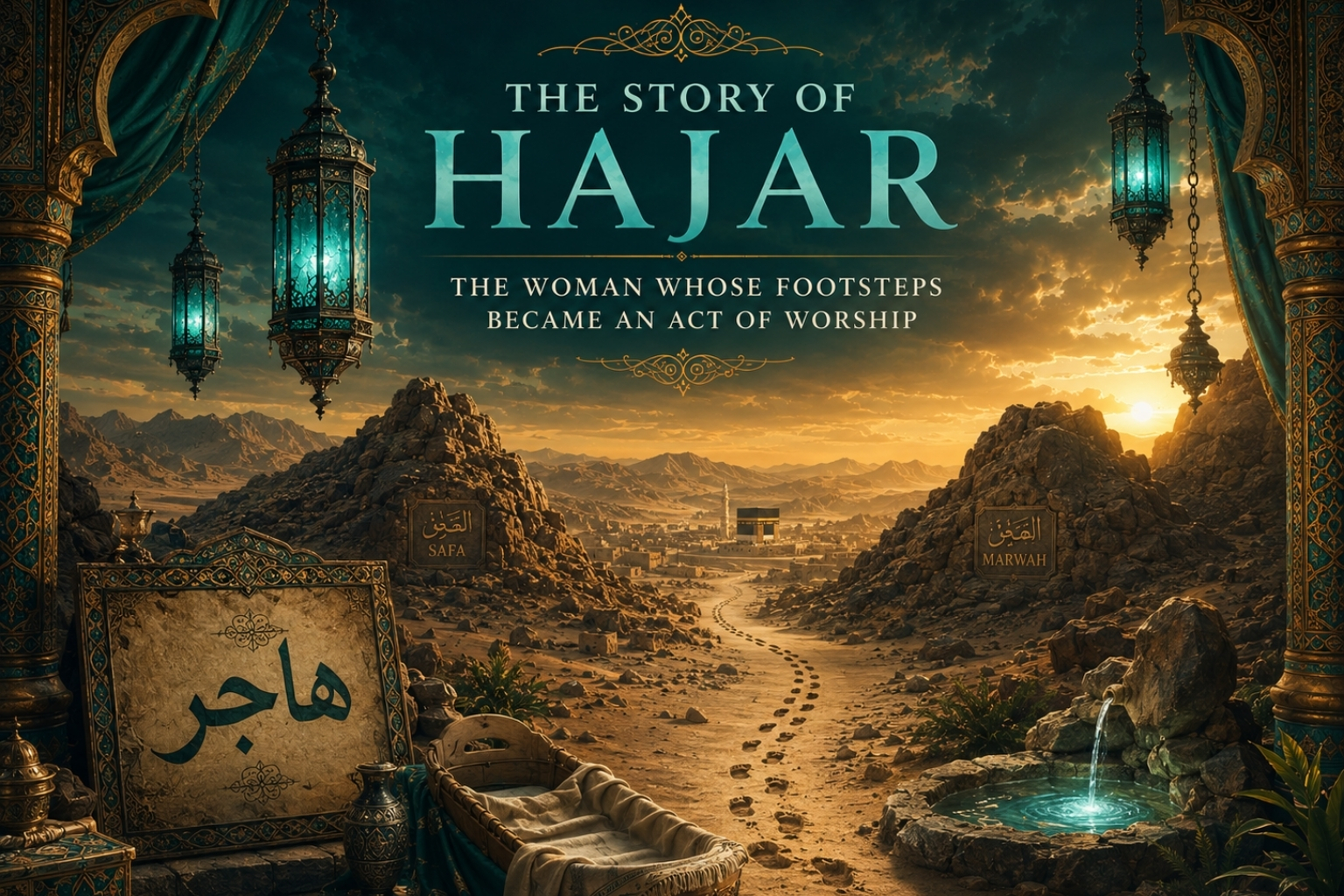
Hajar could not bear to watch her son die. She left him and ran to the nearest high ground — the hill of Safa — and climbed it, looking toward the valley, searching for any sign of water or people or caravan. She saw nothing.
She descended from Safa and ran through the valley toward the hill of Marwa — running so fast, when she reached the low ground between the hills, that her garment was lifted by her speed. She climbed Marwa. She looked again. She saw nothing.
Seven times. Back and forth. Safa to Marwa, Marwa to Safa. Each time climbing, searching, looking, finding nothing. Each time descending and running again. Not because the previous run had given her a reason to hope. But because stopping was not an option she could choose while her son was still alive.
The Prophet Muhammad ﷺ described this running in detail — and then connected it explicitly to the act of worship performed by every Muslim who makes Hajj or Umrah:
Hadith:
فَذَلِكَ سَعْيُ النَّاسِ بَيْنَهُمَا
“And that is the running of the people between them.”
Recorded in Sahih Al-Bukhari, Hadith No. 3364
That is the running of the people between them. — When a Muslim performs Sa’i — the seven circuits between Safa and Marwa that are a required part of Hajj and Umrah — they are not performing an abstract ritual. They are walking in the footsteps of a mother who refused to stop moving when her child was dying. They are commemorating the act of a woman who had no reason to hope — and kept running anyway.
Allah did not make a prophet’s miracle the basis of this act of worship. He made a mother’s desperate love the basis of it. Because a mother who will not stop searching for water for her dying child is one of the purest expressions of the human capacity for action in the face of hopelessness — and Allah honored it with permanence.
Chapter Five — The Water: When Allah Answered the Running
On her seventh circuit — as Hajar reached Marwa for the last time — she heard a sound. She stilled herself to listen:
Hadith:
فَسَمِعَتْ صَوْتًا فَقَالَتْ: صَهٍ. تُرِيدُ نَفْسَهَا. ثُمَّ تَسَمَّعَتْ فَسَمِعَتْ أَيْضًا. فَقَالَتْ: قَدْ أَسْمَعْتَ إِنْ كَانَ عِنْدَكَ غَوَاثٌ
“She heard a sound and said: ‘Be quiet!’ — meaning to herself. Then she listened and heard it again. She said: ‘You have made yourself heard — if you have any rescue.'”
Recorded in Sahih Al-Bukhari, Hadith No. 3364
She heard Jibreel — or the angel sent by Allah — and she said to herself: be quiet, listen carefully. And then, with extraordinary directness, she addressed the sound: “if you have any rescue.” Not a plea. Not a prayer. A challenge — the words of a woman who had been running for her child and was still, even now, in action mode rather than victim mode.
She went back toward Ismail — and found water flowing beneath his feet. Jibreel had struck the ground, and the well of Zamzam had begun to flow:
Hadith:
فَجَعَلَتْ تَحْفِرُ. قَالَ: وَجَعَلَتْ تَغْرِفُ مِنَ الْمَاءِ فِي سِقَائِهَا وَهُوَ يَفُورُ بَعْدَ مَا تَغْرِفُ
“She began to scoop the water into her vessel while it was gushing after she scooped.”
Recorded in Sahih Al-Bukhari, Hadith No. 3364
And the Prophet Muhammad ﷺ made a remark about this scooping that has captured the imagination of scholars ever since:
Hadith:
يَرْحَمُ اللَّهُ أُمَّ إِسْمَاعِيلَ، لَوْ تَرَكَتْ زَمْزَمَ — أَوْ قَالَ: لَوْ لَمْ تَغْرِفْ مِنَ الْمَاءِ — لَكَانَتْ زَمْزَمُ عَيْنًا مَعِيناً
“May Allah have mercy on the mother of Ismail. Had she left Zamzam — or had she not scooped from the water — it would have been a flowing spring.”
Recorded in Sahih Al-Bukhari, Hadith No. 3364
The Prophet Muhammad ﷺ invoked Allah’s mercy upon Hajar — centuries after her death — while commenting on her action. He said: had she not scooped, the water would have been an open, freely flowing spring. Her scooping — her active, hands-on engagement with the miracle — shaped the nature of the well itself.
This is profound: Hajar’s action did not merely receive the miracle. It participated in it. The way she engaged with Allah’s provision shaped what that provision became. Her hands in the water, scooping, gathering — turned what might have been an open spring into the contained, purposeful well of Zamzam.
The water she scooped with her hands in a desert valley has been flowing for over four thousand years. Millions of Muslims carry it home from Makkah today. It has never run dry.
Chapter Six — “Zam Zam”: The Word That Named the Water
As Hajar scooped the water and tried to contain it — saying “Zam zam” — meaning “stop, stop” or “gather, gather” — those sounds became the name of the most famous well in human history:
Hadith:
فَقَالَ النَّبِيُّ ﷺ: يَرْحَمُ اللَّهُ أُمَّ إِسْمَاعِيلَ، لَوْ تَرَكَتْهَا — وَقَالَ عَمْرٌو لَوْ لَمْ تَغْرِفْ مِنَ الْمَاءِ — لَكَانَ زَمْزَمُ عَيْناً مَعِيناً
“The Prophet ﷺ said: ‘May Allah have mercy on the mother of Ismail. Had she left it — and Amr said: had she not scooped from the water — Zamzam would have been a flowing spring.'”
Recorded in Sahih Al-Bukhari, Hadith No. 3364
The name of the most sacred well in Islam — visited by millions annually, drunk by billions across centuries — comes from the words of a desperate mother trying to manage the water appearing beneath her dying infant’s feet.
Allah preserved her words in the name of the well. He made her spontaneous exclamation into the permanent title of one of the most significant geographical and spiritual locations in human civilization.
Nothing Hajar did was lost. Not the running. Not the scooping. Not the words she said in the heat of the moment. Everything was preserved — in a well, in a ritual, in a name, in the prophetic tradition, in the hearts of Muslims who drink Zamzam water and say a prayer before they do.
Chapter Seven — The Tribe of Jurhum: When Allah Sent the People
After the water appeared, birds began to circle above the valley. A tribe — the Jurhum — saw the birds from a distance and understood that birds circling meant water. They came to investigate.
They found Hajar — a woman alone in a waterless valley with an infant and a newly flowing well. And her response to their arrival is itself a masterclass in confident, dignified engagement:
Hadith:
فَقَالُوا لَهَا: أَتَأْذَنِينَ لَنَا أَنْ نَنْزِلَ عِنْدَكِ؟ فَقَالَتْ: نَعَمْ وَلَكِنْ لَا حَقَّ لَكُمْ فِي الْمَاءِ. قَالُوا: نَعَمْ
“They said to her: ‘Will you permit us to settle near you?’ She said: ‘Yes, but you have no right to the water.’ They said: ‘Agreed.'”
Recorded in Sahih Al-Bukhari, Hadith No. 3364
She gave them permission. But she negotiated the terms first. She welcomed the company, the safety, the community — and she protected the resource that Allah had given her and her son. She said: you may come, but the water is mine to manage.
A woman alone in a desert — and she set the terms of the agreement.
This is Hajar: not a passive recipient of Allah’s provision, not a woman who simply waited for things to happen to her, but an active, decisive, dignity-preserving participant in everything Allah sent her way.
The tribe settled. The valley became populated. Ismail grew up among the Jurhum, learned Arabic from them, and married among them. And when Ibrahim returned — making the visits that the narrations describe — he found not a dead wife and a dead son in an empty valley, but a thriving community built around the well that Hajar’s running and Allah’s mercy had produced.
Chapter Eight — Ibrahim’s Return: The Prayer That Still Answers
When Ibrahim returned and saw what Allah had built through Hajar’s faithfulness — a settlement, a people, a son grown into a young man of extraordinary character — he made the prayer that Allah preserved in the Quran:
Quran Verse:
رَبِّ اجْعَلْ هَٰذَا الْبَلَدَ آمِنًا وَارْزُقْ أَهْلَهُ مِنَ الثَّمَرَاتِ مَنْ آمَنَ مِنْهُم بِاللَّهِ وَالْيَوْمِ الْآخِرِ
“My Lord, make this a secure city and provide its people with fruits — whoever of them believes in Allah and the Last Day.”
Surah Al-Baqarah (2:126)
He prayed for the city that had grown from Hajar’s faithfulness. He prayed for the provision that would sustain it. He prayed for its security. And every one of those prayers was answered — in a city that has been continuously inhabited since Hajar first arrived, that receives millions of visitors annually, that is called the most blessed city on earth.
The prayer was answered. The city stands. The water flows. And millions walk between Safa and Marwa every year — in the footsteps of a woman whose trust in Allah turned a waterless valley into the spiritual center of the world.
Chapter Nine — Her Legacy: What Hajar Left the World
Hajar left no written record. She received no revealed scripture. She was not a prophet. She has no chapter named after her in the Quran.
And yet her legacy is embedded in the five pillars of Islam in a way that no other individual — other than the prophets themselves — can claim:
In Hajj — the fifth pillar of Islam — the Sa’i between Safa and Marwa is an obligatory act. Every Muslim who makes Hajj walks her path. Every Umrah includes her running. There is no complete Hajj without retracing her footsteps.
In Zamzam — the water she scooped — Muslims drink it as a blessed act of worship, carry it home as a gift, and receive it as a means of healing and blessing. The well she managed with her own hands is the source of water for every pilgrim who has visited Makkah since.
In Makkah itself — the city that grew from the settlement that formed around the well that appeared beneath her son’s feet. Without Hajar, there is no Zamzam. Without Zamzam, there is no settlement. Without the settlement, there is no Makkah. Without Makkah, there is no Ka’bah rebuilt by Ibrahim and Ismail. Without the Ka’bah, the entire geographical and spiritual orientation of Islamic prayer is different.
The direction every Muslim faces when they pray — the Qiblah — points toward a city that exists because Hajar said: “Then Allah will not neglect us” and meant it.
Hadith:
رَحِمَ اللَّهُ أُمَّ إِسْمَاعِيلَ
“May Allah have mercy on the mother of Ismail.”
Recorded in Sahih Al-Bukhari, Hadith No. 3364
The Prophet Muhammad ﷺ said this. Centuries after Hajar had died. He invoked Allah’s mercy upon her — in a hadith, preserved in the most authenticated collection of prophetic narrations, read by billions of Muslims — because she deserved to be remembered with mercy. Because what she did mattered. Because Allah had honored what she did — and the Prophet ﷺ was honoring it too.
Timeless Lessons from the Story of Hajar
- “Then Allah will not neglect us” — the seven most powerful words of Tawakkul When Ibrahim confirmed that Allah had commanded him to leave, Hajar did not ask him to stay. She did not collapse. She did not rage. She said: then He will not neglect us. This is the sentence that defines her life — and the sentence that every believer should memorize and mean. When Allah has decreed your situation — trust that He has also decreed your provision within it.
- Keep running even when there is nothing visible to run toward. Hajar ran seven times. There was nothing visible on the horizon during any of those runs — no caravan, no person, no well. She ran anyway. Because her son was alive and she had not yet exhausted all possible movement. Divine provision often comes after the last run — not the first. Do not stop moving until Allah stops you.
- Your active engagement with the miracle shapes the miracle itself Had Hajar not scooped, Zamzam would have been an open spring. Her hands in the water changed the nature of what Allah provided. Do not be passive before Allah’s provision. Engage with it actively. Use what He gives you with your full capacity. Your participation in His gift is part of the gift’s design.
- Set dignified terms even when you are at your most vulnerable When the Jurhum tribe arrived — Hajar alone, recently rescued from near-death in a desert — she still negotiated. You may settle here, but the water is mine to manage. She did not surrender her agency because she was grateful for the company. Dignity and gratitude are not in conflict. You can welcome help and set terms simultaneously.
- Allah preserves everything — even the words you say in the heat of the moment “Zam zam” — the words she said while trying to manage the water. Allah made them the permanent name of the most sacred well in Islam. Nothing you do in Allah’s service is wasted — not the desperate running, not the scooping, not even the spontaneous words you say in a moment of urgency.
- The legacy of a faithful woman can redirect the spiritual orientation of the entire world The Qiblah — the direction of prayer for over a billion Muslims — points toward Makkah. Makkah exists because of Hajar. Every Muslim prayer, five times a day, across fourteen centuries, in every time zone on earth — is oriented toward the city that grew from the faithfulness of a woman who said: “Then Allah will not neglect us.” You do not know what the legacy of your faithfulness will produce across time.
- Allah honors motherly love with permanence The Sa’i was not made obligatory to commemorate a battle or a revelation. It was made obligatory to commemorate a mother’s desperate love for her dying son. Allah looked at a mother running between two hills in a desert — and said: this is worth remembering forever. Let every pilgrim walk where she walked. The love of a mother is not small in Allah’s sight. He made it a pillar of one of Islam’s greatest acts of worship.
Closing Reflection
She was left in a valley with no water, no people, and a dying infant. She asked one question — did Allah command this? — and when the answer was yes, she closed the door on every other question.
“Then He will not neglect us.”
She ran. Seven times. With no reason to hope except the certainty that Allah does not command and then abandon. She kept moving until movement was no longer necessary — until the water appeared beneath her son’s feet, until Jibreel struck the earth, until the miracle arrived.
And then she scooped. With her own hands. She did not stand back and let the miracle happen around her. She participated in it — and in participating, she shaped it.
The well she scooped with her hands has never run dry. The path she ran between two hills has been walked by millions every year for fourteen centuries. The city that grew from her faithfulness is the spiritual center of the world’s largest religion. The water she managed is carried home by pilgrims from every country on earth.
She is not named in the Quran. She has no chapter to herself.
But Allah named a well after her words. He made her footsteps a required act of worship. He preserved her story in the most authenticated hadith collection in Islam. And He inspired the final prophet — centuries after her death — to invoke mercy upon her by name.
Hadith:
يَرْحَمُ اللَّهُ أُمَّ إِسْمَاعِيلَ
“May Allah have mercy on the mother of Ismail.”
Recorded in Sahih Al-Bukhari, Hadith No. 3364
May Allah have mercy on the mother of Ismail.
The woman who ran when she had no reason to run.
The woman who scooped when she had no reason to hope.
The woman who said — before the water came, before the tribe arrived, before the city grew, before the millions walked in her footsteps —
“Then Allah will not neglect us.”
He didn’t.
He never does.