
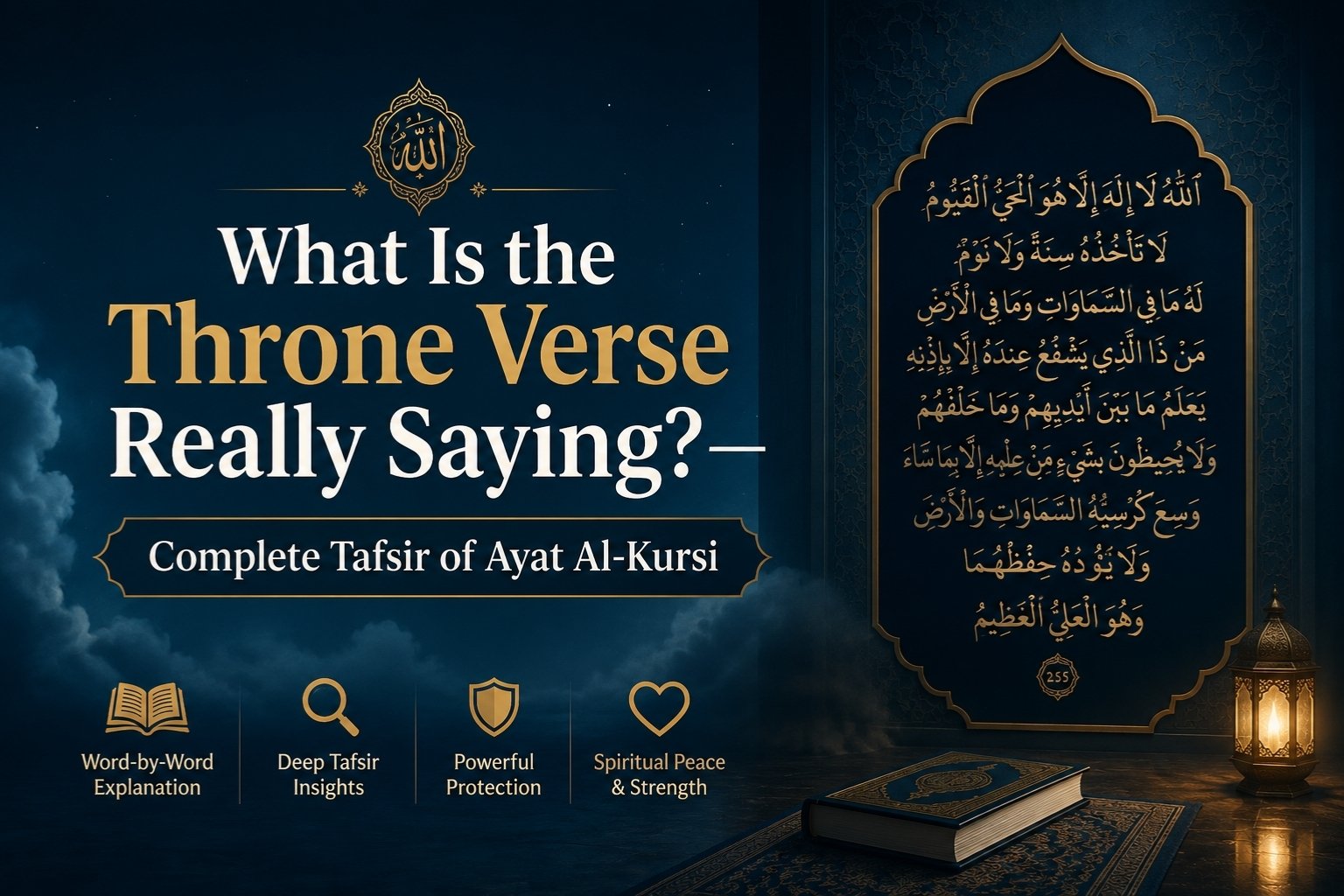

There is a single verse in the Quran that the Prophet Muhammad ﷺ called the greatest verse in the entire Book.
The greatest. Afdal — highest in rank, most excellent, most supreme.
When he was asked which verse of the Quran was the greatest, he did not hesitate. He asked the companion who stood before him — Abu Dharr, in one narration — what the greatest verse was. Abu Dharr did not know. And the Prophet ﷺ placed his hand on Abu Dharr’s chest and said:
أَبَا ذَرٍّ، آيَةُ الْكُرْسِيِّ
“Abu Dharr — Ayat Al-Kursi.”
Recorded in Musnad Ahmad, Hadith No. 21459
One verse. Fifty words in Arabic. And within those fifty words — according to fourteen centuries of Islamic scholarship — the most concentrated, the most complete, and the most profound description of Allah found anywhere in the Quran.
Most Muslims have memorized it. Almost every Muslim has heard that reciting it after each prayer, and before sleep, carries immense reward and protection. But few people have truly read it — not in the sense of moving through the words, but in the sense of stopping at each phrase and asking: what is Allah actually saying here? What does each attribute mean? Why are they arranged in this specific order? What does it feel like to understand, at depth, what you are reciting?
This is the complete tafsir of Ayat Al-Kursi. Every phrase. Every name. Every layer of meaning that the scholars have uncovered across fourteen centuries — made accessible for every reader in every generation.
By the end of this article, you will never recite this verse the same way again.
The Full Verse: Arabic and English
اللَّهُ لَا إِلَٰهَ إِلَّا هُوَ الْحَيُّ الْقَيُّومُ ۚ لَا تَأْخُذُهُ سِنَةٌ وَلَا نَوْمٌ ۚ لَهُ مَا فِي السَّمَاوَاتِ وَمَا فِي الْأَرْضِ ۗ مَن ذَا الَّذِي يَشْفَعُ عِندَهُ إِلَّا بِإِذْنِهِ ۚ يَعْلَمُ مَا بَيْنَ أَيْدِيهِمْ وَمَا خَلْفَهُمْ ۖ وَلَا يُحِيطُونَ بِشَيْءٍ مِّنْ عِلْمِهِ إِلَّا بِمَا شَاءَ ۚ وَسِعَ كُرْسِيُّهُ السَّمَاوَاتِ وَالْأَرْضَ ۖ وَلَا يَئُودُهُ حِفْظُهُمَا ۚ وَهُوَ الْعَلِيُّ الْعَظِيمُ
“Allah — there is no deity except Him, the Ever-Living, the Sustainer of existence. Neither drowsiness overtakes Him nor sleep. To Him belongs whatever is in the heavens and whatever is on the earth. Who is it that can intercede with Him except by His permission? He knows what is before them and what will be after them, and they encompass not a thing of His knowledge except for what He wills. His Kursi extends over the heavens and the earth, and their preservation tires Him not. And He is the Most High, the Most Great.”
Surah Al-Baqarah (2:255)
The Context: Where Does This Verse Sit?
Ayat Al-Kursi sits in the middle of Surah Al-Baqarah — the longest chapter in the Quran. It arrives after a long sequence of verses about divine guidance, human accountability, light and darkness, and the nature of faith and disbelief. The two verses immediately before it (2:253–254) speak of the differences Allah has placed between the messengers, and then a warning about the Day of Judgment — the day when no friendship, no intercession, and no ransom will avail anyone unless Allah permits it.
Then comes Ayat Al-Kursi — almost as if to answer the implicit question that the warning raises: if no intercession avails on that Day without permission, then who is the One whose permission governs everything? The verse answers that question with the most comprehensive portrait of Allah in the entire Quran.
The two verses immediately after it (2:256–257) contain La ikraha fi al-din — “there is no compulsion in religion” — and the declaration that Allah is the Wali (Protector) of the believers, bringing them from darkness into light.
Ayat Al-Kursi, then, stands at the center of a theological movement: from human accountability to divine sovereignty to divine protection. It is the hinge point — the verse that makes sense of everything around it by establishing who Allah is before anything else is said about what He does.
Why Is It Called “The Throne Verse”?
The name Ayat Al-Kursi — the Verse of the Throne — comes from the mention of Allah‘s Kursi near the end of the verse. Kursi in Arabic literally means a chair or seat — but in theological usage it refers to something immeasurably greater.
The scholars have discussed the nature of the Kursi at length. The dominant position — supported by the hadith — is that the Kursi is an immense, real, created entity:
The Prophet Muhammad ﷺ said, as reported by Ibn Abbas:
مَا السَّمَاوَاتُ السَّبْعُ فِي الْكُرْسِيِّ إِلَّا كَحَلْقَةٍ مُلْقَاةٍ بِأَرْضٍ فَلَاةٍ، وَفَضْلُ الْعَرْشِ عَلَى الْكُرْسِيِّ كَفَضْلِ تِلْكَ الْفَلَاةِ عَلَى تِلْكَ الْحَلْقَةِ
“The seven heavens in comparison to the Kursi are like a ring thrown in a vast desert. And the superiority of the Throne (Arsh) over the Kursi is like the superiority of that vast desert over that ring.”
Recorded in Al-Silsilah Al-Sahihah by Al-Albani, No. 109
The seven heavens — everything we know of the observable universe and beyond it — are like a ring lying in a desert, compared to the Kursi. And the Kursi itself is like that same ring, compared to the Throne of Allah.
The verse is named after the Kursi not because it is the most important idea in the verse, but because the mention of the Kursi is the most arresting, the most scale-breaking moment — the point at which the human mind confronts the absolute incomparability of Allah‘s greatness. Everything up to the mention of the Kursi is building toward it. And the verse ends — after the Kursi — with the two names that seal it: Al-‘Aliyy Al-‘Azim. The Most High. The Most Great.
Phrase by Phrase: The Complete Tafsir
اللَّهُ لَا إِلَٰهَ إِلَّا هُوَ
“Allah — there is no deity except Him.”
The verse begins with the name Allah — standing alone, as a single word, before anything else is said. The scholars of Arabic rhetoric note that beginning with the name itself, without any verb or predicate, creates a particular effect: the name lands with complete weight, undiluted, before the mind has been directed anywhere else.
Allah — and then immediately: la ilaha illa Huwa — there is no deity except Him. This is the Shahadah — the declaration of faith — embedded at the opening of the greatest verse in the Quran. Before any of Allah‘s attributes are described, the verse establishes the absolute singularity of divine sovereignty: there is no other. No partner. No rival. No alternative source of power, protection, or authority in the universe.
The word ilah — deity — means the one who is worshipped, the one who is turned to in need, the one upon whom ultimate reliance is placed. La ilaha — there is no such being — illa Huwa — except Him. The entire verse that follows is an elaboration of why that is true. Every attribute described is a reason why no other ilah is conceivable. By the end of the verse, the opening declaration is not just asserted — it is demonstrated.
الْحَيُّ الْقَيُّومُ
“The Ever-Living, the Sustainer of Existence.”
These are the two most important names in Ayat Al-Kursi — and, according to the scholars, the two names that form the foundation of all of Allah‘s other names and attributes.
Al-Hayy — The Ever-Living
Al-Hayy means the One who is alive — but alive in a manner that shares nothing with creaturely life except the word. Created life is contingent: it began, it will end, it depends on sustenance and conditions and the continued permission of Allah to exist. Allah‘s life — Hayat Allah — is self-subsistent, eternal, without beginning, without end, requiring nothing to sustain it. He was alive before the universe existed. He will be alive after it ceases. Nothing threatens it. Nothing diminishes it.
Every other attribute of Allah depends on this one. His knowledge, His power, His will, His mercy — all of these are attributes of a living Being. Without Al-Hayy, nothing else follows. Life is the precondition of all the others.
Al-Qayyum — The Sustainer of Existence
Al-Qayyum is perhaps the most extraordinary name in the Quran. It comes from the root q-w-m — to stand, to establish, to maintain. But Qayyum is an intensive form — not one who sustains, but the One whose entire nature is to sustain. The One who stands by Himself and by whom everything else stands.
The scholars describe Al-Qayyum as having two dimensions simultaneously:
- Allah is self-subsistent: He depends on nothing, needs nothing, relies on nothing for His own existence.
- Allah sustains all else: every created thing, at every moment, depends entirely on Allah continuing to sustain its existence. If Allah were to withdraw His sustaining action for a single instant, everything in creation would cease to exist.
Imam Ibn Al-Qayyim writes that Al-Hayy and Al-Qayyum together contain the entirety of Allah‘s attributes. Al-Hayy encompasses all attributes of Allah‘s essence — His knowledge, His power, His will, His hearing, His sight. Al-Qayyum encompasses all attributes of Allah‘s actions — His creating, His sustaining, His giving life and causing death, His providing for all of creation.
Everything that follows in Ayat Al-Kursi is a detail — a specific expression — of what it means that Allah is Al-Hayy Al-Qayyum.
لَا تَأْخُذُهُ سِنَةٌ وَلَا نَوْمٌ
“Neither drowsiness overtakes Him nor sleep.”
After the two foundational names, the verse immediately offers the first specific implication: Allah does not sleep. Neither sinah — drowsiness, the first heaviness of the eyes before sleep — nor nawm — sleep itself.
The order is significant. The verse mentions drowsiness before sleep — because Allah is being exalted above even the precursor of sleep, the very first trace of it, before it fully arrives. It is not that Allah stays awake by effort, fighting off sleep. Sleep does not approach Him at all. The concept does not apply.
Why mention this immediately after Al-Hayy Al-Qayyum? Because sleep is the most universal human experience of existence being temporarily suspended. Every human being — every created being — has its consciousness interrupted, its awareness dimmed, its active engagement with the world paused. Sleep is the most ordinary reminder that creaturely existence is fragile, contingent, dependent.
Allah‘s existence is none of these things. His awareness is never interrupted. His attention to His creation is never dimmed. At every moment of every night, when every created being that sleeps has withdrawn from consciousness, Allah‘s awareness is as complete as it was in the brightest moment of day.
For the believer lying awake at 3 a.m. — when the night feels most isolating, when the thought that no one is aware of your situation presses hardest — this phrase is Allah‘s direct answer: I am awake. I am always awake. Drowsiness does not approach me. I am aware of you now, in this moment, with the same complete awareness with which I am aware of everything.
لَهُ مَا فِي السَّمَاوَاتِ وَمَا فِي الْأَرْضِ
“To Him belongs whatever is in the heavens and whatever is on the earth.”
The first three phrases established who Allah is. Now the verse turns to what belongs to Him — and the answer is total.
Lahu — to Him. The preposition of exclusive possession comes first, before what is possessed, creating emphasis: it belongs to Him — not to anyone else, not partially, not in some contested sense. To Him.
Whatever is in the heavens and whatever is on the earth — everything. The verse does not list categories: it uses the most comprehensive possible expression. Not “the sun and the moon and the stars.” Not “the mountains and the seas and the living creatures.” Whatever is in the heavens — all of it. Whatever is on the earth — all of it.
Ownership here is not like human ownership — which is contingent, temporary, and can be transferred. Allah‘s ownership of creation is the ownership of a Creator over what He made from nothing, sustains at every moment, and can return to nothing at any instant. It is the most absolute ownership conceivable — the ownership of Al-Qayyum over everything that exists only because He sustains it.
The implication for the believer is profound: everything you think you own, everything you think you control, everything in your life that you hold — it belongs to Allah. This is not a threat. It is a liberation. You are a steward of what belongs to Allah, not the burdened owner of a world you must carry alone. Whatever He takes from you was His. Whatever He gives to you is His gift. The weight of ownership is not yours to bear.
مَن ذَا الَّذِي يَشْفَعُ عِندَهُ إِلَّا بِإِذْنِهِ
“Who is it that can intercede with Him except by His permission?”
This is one of the most rhetorically powerful moments in the entire verse. After establishing that everything in the heavens and earth belongs to Allah, the verse poses a question — and the question is designed to demolish a specific false idea.
In the Arabia of the Prophet Muhammad ﷺ‘s time, the central justification for idol worship was intercession. The idols were not worshipped as gods in themselves — they were worshipped as intercessors, intermediaries, beings who could approach the divine on the worshipper’s behalf. “We only worship them so that they may bring us closer to Allah” (Surah Az-Zumar, 39:3).
The question who can intercede with Him except by His permission does not deny intercession entirely — it relocates its source. Intercession exists. Prophets and angels and the righteous will intercede on the Day of Judgment. But every act of intercession happens only because Allah permits it. No intercessor has independent access. No intercessor can act without Allah‘s authorization.
The idol, the saint, the intermediary — none of them have the capacity to intercede of their own authority. They can only intercede if and when Allah allows it. So why direct worship toward the intermediary rather than the One who controls whether the intermediary can act?
The question answers itself. And in answering itself, it dismantles the entire architecture of intercession-based polytheism. All power of intercession belongs to Allah — which means He is the One to turn to, directly, without intermediary, without prior permission needed, because you are already in His presence by virtue of prayer itself.
يَعْلَمُ مَا بَيْنَ أَيْدِيهِمْ وَمَا خَلْفَهُمْ
“He knows what is before them and what will be after them.”
The verse now turns to Allah‘s knowledge — and the formulation chosen is the most comprehensive possible expression of temporal omniscience.
Ma bayna aydihim — what is before them, literally “what is between their hands” — refers to everything that lies in front of them: the future, what is coming, what they are walking toward.
Wa ma khalfahum — what is behind them — refers to everything in the past: what has already happened, what they have done, what preceded their existence.
Together: Allah knows everything. The past in its entirety. The future in its entirety. Every created being is surrounded by Allah‘s knowledge — it stretches ahead of them into their future and behind them into their past, and they are enclosed within it on every side.
The pronoun hum — them — refers to all of creation. Every human being. Every angel. Every created thing that exists. Everything they have done and everything they will do is already known to Allah, completely, without exception.
For the believer who wonders whether Allah is aware of their specific situation — this phrase is the answer. Not “He knows some things.” Not “He knows the big things.” He knows what is before you and what is behind you. Your history and your future. The thing you did that no one else knows about and the thing that has not yet happened that you are afraid of. All of it is already within His knowledge.
وَلَا يُحِيطُونَ بِشَيْءٍ مِّنْ عِلْمِهِ إِلَّا بِمَا شَاءَ
“And they encompass not a thing of His knowledge except for what He wills.”
This phrase completes the picture of divine knowledge by showing its other side: if Allah‘s knowledge encompasses all of creation, what does creation know of Allah?
Nothing — except what He chooses to reveal.
The word yuhitun — “encompass” — means to surround something, to contain it within your grasp, to know it fully from all sides. Created beings cannot encompass any aspect of Allah‘s knowledge. They cannot surround it, contain it, fully grasp it. The most knowledgeable human being, the greatest scholar, the most enlightened mind — they know only what Allah has permitted them to know. The entirety of human knowledge is a gift of divine permission, not an achievement of human reach.
This has immense consequences for human humility before divine revelation. When Allah tells us something about Himself — about His nature, His attributes, His actions — we are receiving what He chose to reveal. We cannot go beyond it by our own reasoning and claim certainty. We cannot reject it because our minds cannot fully contain it. We receive what He gives, knowing that what He gave is infinitely less than what He is.
وَسِعَ كُرْسِيُّهُ السَّمَاوَاتِ وَالْأَرْضَ
“His Kursi extends over the heavens and the earth.”
And here it is — the phrase that gives the verse its name. The moment the scale breaks.
Wasi’a Kursiyyuhu al-samawati wa al-ard — His Kursi has extended over, has encompassed, has encompassed within it the heavens and the earth.
The seven heavens and the earth — everything in the observable universe and beyond, the totality of physical creation as we know it — are encompassed by the Kursi of Allah. And the Kursi itself, as the hadith established, is to the Throne of Allah as a ring in a vast desert.
The purpose of this statement is not to give cosmological information for its own sake. It is to produce a particular experience in the reader — the collapse of the human sense of scale. Everything you have ever known, everything the human mind can conceive of as “the universe,” is smaller than a ring in a desert compared to the Kursi. And the Kursi is smaller than that ring, compared to the Throne of Allah.
The verse is asking you to hold that scale in your mind — and then read the next phrase.
وَلَا يَئُودُهُ حِفْظُهُمَا
“And their preservation tires Him not.”
La ya’uduhu — it does not weigh upon Him, does not burden Him, does not tire Him, does not cost Him effort.
After establishing that the Kursi encompasses the heavens and the earth — after asking the human mind to contemplate that incomprehensible scale — Allah says: maintaining all of it requires no effort from Him.
The preservation of the seven heavens and the earth — the ongoing sustaining of every atom, every star, every living creature, every moment in time across the entire span of creation — is effortless for Allah. It does not fatigue Him. It does not diminish Him. It does not require Him to exert Himself.
This is the practical implication of Al-Qayyum: the self-sustaining One who sustains all else. Sustaining all of creation is not an achievement for Allah — it is simply His nature, expressed outward. The way a river does not struggle to be wet.
For the human being who feels that their affairs are too small, too ordinary, too insignificant to be within Allah‘s concern — this phrase dismantles that thought entirely. Allah sustains the seven heavens and the earth without effort. The sustaining of your affairs — the answering of your prayer, the provision of your sustenance, the care of your soul — is not an additional burden on a Being who is already stretched thin. It costs Him nothing. You are not an imposition.
وَهُوَ الْعَلِيُّ الْعَظِيمُ
“And He is the Most High, the Most Great.”
The verse ends with two names — and they are the perfect seal.
Al-‘Aliyy — The Most High
Al-‘Aliyy encompasses two types of highness that the scholars always discuss together:
‘Uluww al-dhat — the highness of Allah‘s being above His creation. Allah is above the heavens, above the Throne, above all of creation — in a manner that befits His majesty, without resemblance to anything created.
‘Uluww al-qadr — the highness of Allah‘s rank and status. He is supreme over everything in terms of power, sovereignty, honor, and authority. Nothing is above Him. Nothing rivals Him. Nothing can diminish His supremacy.
Al-‘Azim — The Most Great
Al-‘Azim — the One of immense greatness, incomparable magnitude, the One before whom everything else is diminished in comparison. The Kursi encompasses the heavens and the earth. The Throne encompasses the Kursi. And Al-‘Azim encompasses it all.
The scholars note the beauty of ending with these two names specifically. The entire verse has been an ascent — from the declaration of Allah‘s singularity, to His names, to His wakefulness, to His ownership of all things, to His absolute sovereignty over intercession, to His complete knowledge, to the scale of the Kursi — and it ends by stepping back from all the specific details and saying: above all of this, transcending all of this, encompassing all of this — Al-‘Aliyy Al-‘Azim.
All the attributes that came before are true and real and immense. And Allah is still greater than all of them together.
The Ten Attributes: What the Verse Contains
The scholars of tafsir have enumerated the divine attributes established within Ayat Al-Kursi, finding it to be — in fifty Arabic words — the most concentrated statement of divine attributes in the entire Quran:
Oneness — La ilaha illa Huwa: there is no deity but Him. Life — Al-Hayy: eternal, self-subsistent, uncreated life. Self-subsistence and universal sustaining — Al-Qayyum: needing nothing, sustaining everything. Freedom from any imperfection — La ta’khudhus sinatun wa la nawm: utterly transcending the limitations of created beings. Total ownership — Lahu ma fi al-samawati wa ma fi al-ard: absolute proprietorship over all creation. Absolute sovereignty — Man dha alladhi yashfa’u indahu illa bi idhnihi: no power operates without His permission. Complete knowledge — Ya’lamu ma bayna aydihim wa ma khalfahum: past and future encompassed entirely. Incomparability of divine knowledge — Wa la yuhituna bi shay’in min ‘ilmihi illa bima sha’a: creation knows only what He permits. Immeasurable greatness — Wasi’a Kursiyyuhu al-samawati wa al-ard: scale beyond human comprehension. Effortless power — Wa la ya’uduhu hifzuhuma: sustaining all creation without fatigue or effort.
And the seal: Al-‘Aliyy Al-‘Azim — the Most High, the Most Great — which transcends and encompasses all ten.
Why the Scholars Called It the Greatest Verse
Imam Ibn Kathir writes that Ayat Al-Kursi is the greatest verse in the Quran because it is the most comprehensive description of Allah — more names, more attributes, more implications of divine greatness concentrated into a single verse than anywhere else in the Book.
Imam Al-Qurtubi notes that the verse moves through the attributes in a deliberate sequence — each phrase building on the one before, each attribute illuminating the next, until by the end the reader has received the most complete portrait of Allah the Quran offers in a single continuous statement.
The scholars also point to what the verse achieves practically: it answers every question a human being could have about whether Allah is sufficient. Is He alive? Al-Hayy. Is He attentive? He does not sleep. Is He powerful enough to handle everything? Everything belongs to Him. Is He aware of my situation? He knows what is before them and behind them. Is maintaining my affairs a burden for Him? Their preservation tires Him not. Is He truly supreme? Al-‘Aliyy Al-‘Azim.
Every anxiety the human heart carries about whether Allah is enough — Ayat Al-Kursi answers it.
The Protection of Ayat Al-Kursi
The Prophet Muhammad ﷺ described specific, named protections attached to the recitation of this verse.
In the famous narration recorded in Sahih Al-Bukhari — in which a devil came to Abu Hurairah in the form of a man and was caught stealing from the charity of Ramadan — the devil told Abu Hurairah:
“When you go to bed, recite Ayat Al-Kursi, for there will remain over you a protector from Allah, and no devil will approach you until morning.”
When Abu Hurairah reported this to the Prophet Muhammad ﷺ, he responded:
صَدَقَكَ وَهُوَ كَذُوبٌ
“He told you the truth, though he is a liar.”
Recorded in Sahih Al-Bukhari, Hadith No. 5010
A devil confirmed the protection of Ayat Al-Kursi — and the Prophet ﷺ confirmed that the devil was telling the truth, even while noting his nature as a liar.
The scholars reflect on this narration with a particular emphasis: the protection of Ayat Al-Kursi is not magical — it is theological. You are not protected because you said certain sounds. You are protected because you affirmed, with understanding and sincerity, that Allah is Al-Hayy Al-Qayyum — that He never sleeps, that everything belongs to Him, that nothing acts without His permission. When you truly believe what you are reciting, you have placed yourself within the fortress of divine sovereignty. The devil has no door through which to enter a heart that has truly submitted to Al-‘Aliyy Al-‘Azim.
The Prophet Muhammad ﷺ also said:
مَنْ قَرَأَ آيَةَ الْكُرْسِيِّ دُبُرَ كُلِّ صَلَاةٍ مَكْتُوبَةٍ لَمْ يَمْنَعْهُ مِنْ دُخُولِ الْجَنَّةِ إِلَّا أَنْ يَمُوتَ
“Whoever recites Ayat Al-Kursi after every obligatory prayer, nothing will prevent him from entering Paradise except death.”
Recorded in Al-Mu’jam Al-Kabir by Al-Tabarani, authenticated by Al-Albani
Nothing prevents entry into Paradise except death — meaning: the moment death comes, Paradise follows. Recitation after every obligatory prayer, with understanding and sincerity, is among the greatest deeds a Muslim can perform in their daily life.
What Changes When You Understand It
There is a difference between reciting Ayat Al-Kursi and receiving Ayat Al-Kursi.
Reciting it is moving through the words — present in the sound, absent in the meaning. Most people who have memorized it since childhood recite it this way, through no fault of their own. The words were given before the understanding could follow.
Receiving it is something else. It is pausing at Al-Hayy and feeling the weight of what it means that Allah is self-subsistently, eternally, uninterruptibly alive. It is pausing at la ta’khudhus sinah and letting it land that right now — in this very moment — while your eyes are heavy and your mind is tired and the night is pressing on you — Allah is fully awake and fully aware. It is reaching wasi’a Kursiyyuhu and allowing the scale to break open — the seven heavens like a ring in a desert — and then reading wa la ya’uduhu hifzuhuma and receiving the fact that maintaining all of that costs Him nothing.
When you receive it, the prayer after it changes. The sleep before which you recite it changes. The 3 a.m. moment when the fear or the grief or the loneliness presses hardest — it changes. Because you are not alone with your thoughts in the darkness. You are in the presence of Al-Hayy Al-Qayyum — the One who is awake, the One who sustains, the One whose Kursi encompasses everything that exists, the One for whom your preservation is effortless.
A Final Reflection: Fifty Words That Contain Everything
The Prophet Muhammad ﷺ said it is the greatest verse in the Quran. And when you have read it carefully — when you have sat with each phrase and allowed it to arrive fully — you understand why.
It is not the greatest verse because it is the most beautiful, though it is extraordinary in its language. It is not the greatest verse because it contains the most commands, though it contains the most complete portrait of Allah in the entire Book.
It is the greatest verse because it answers, in fifty words, the only question that ultimately matters: Who is Allah?
He is the One there is no deity but. He is the Ever-Living, the Sustainer of existence. He does not sleep. Everything belongs to Him. No one intercedes with Him except by His permission. He knows your past and your future. You know of Him only what He chooses to reveal. His Kursi encompasses the seven heavens and the earth. Sustaining it all is effortless for Him. He is the Most High, the Most Great.
That is who is with you, watching over you, aware of you, sustaining you at every moment.
Say it again after your next prayer. Slowly. One phrase at a time.
اللَّهُ لَا إِلَٰهَ إِلَّا هُوَ الْحَيُّ الْقَيُّومُ
“Allah — there is no deity except Him, the Ever-Living, the Sustainer of existence.”
Surah Al-Baqarah (2:255)
You have just named who is in charge of everything that concerns you.