
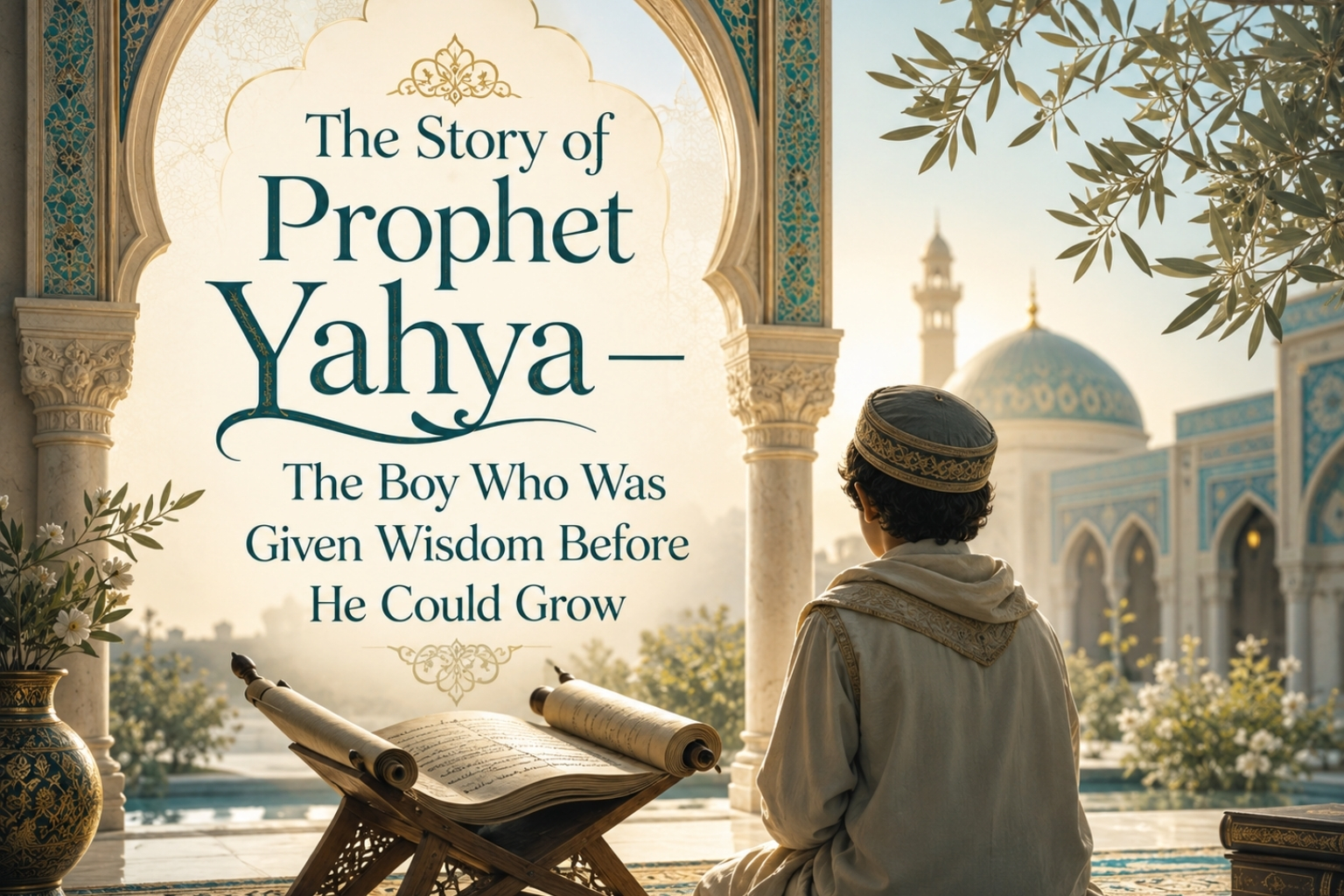

There are people who spend a lifetime searching for wisdom — reading, traveling, experiencing, failing, rising — and arrive at the end of long years with something approaching clarity about who they are and what they are here for.
And then there is Prophet Yahya, peace be upon him — a boy who was given wisdom before he had finished growing.
Not the accumulated wisdom of experience. Not the hard-won clarity of decades. But something Allah placed directly into his heart while he was still a child — a divine gift so complete and so early that the Quran marks it with a phrase that has no parallel in the description of any other prophet: “We gave him judgment while still a boy.”
Yahya did not arrive at his mission gradually. He was given it young. He carried it fully. He lived it completely. And he was taken from this world before old age — martyred for speaking a truth that a king did not want to hear.
His life was short by worldly measure. His mention in the Quran is brief. But what Allah said about him in those few verses — and the salutation with which Allah honored him across the three great thresholds of human existence — places him among the most completely honored figures in the entire Quranic narrative.
He was the miracle that answered his father’s prayer. He was the prophet who confirmed what was coming before it arrived. He was the man who told the truth to power and paid for it with his life.
And Allah greeted him with peace — at his birth, at his death, and at his resurrection.
Chapter One — Born as an Answer: The Weight of Being a Miracle
Yahya was not born into ordinary circumstances. He was the answer to a prayer that every rational indicator had said was impossible — the prayer of an elderly prophet with weakened bones and a barren wife who had asked Allah for an heir to continue the prophetic mission.
To be born as the answer to an impossible prayer is itself a weight. It means that from the first breath, your existence is evidence of Allah’s direct intervention in the world. It means that every day of your life is a living testimony that Allah does what He says He will do — regardless of what seems possible.
Yahya carried this weight — not as a burden, but as a foundation. He knew, from the earliest awareness of his own story, that he was here because Allah had specifically, personally, miraculously placed him here. That knowledge shaped everything about how he lived.
Allah describes the moment of his birth and the gifts given to him from the very beginning:
Quran Verse:
يَا يَحْيَىٰ خُذِ الْكِتَابَ بِقُوَّةٍ ۖ وَآتَيْنَاهُ الْحُكْمَ صَبِيًّا ﴿١٢﴾ وَحَنَانًا مِّن لَّدُنَّا وَزَكَاةً ۖ وَكَانَ تَقِيًّا ﴿١٣﴾ وَبَرًّا بِوَالِدَيْهِ وَلَمْ يَكُن جَبَّارًا عَصِيًّا
“O Yahya, take the scripture with determination. And We gave him judgment while still a boy — and affection from Us and purity — and he was fearing of Allah — and dutiful to his parents — and he was not a disobedient tyrant.”
Surah Maryam (19:12–14)
Six qualities. Named by Allah Himself. Each one a complete portrait of a different dimension of Yahya’s character:
“Take the scripture with determination” — The first thing Allah said to Yahya was not “you are special” or “you are chosen” — it was a command: take the scripture. With quwwah — with strength, with seriousness, with the full engagement of a person who understands what they are holding. The first word to Yahya was a commission, not a compliment.
“Judgment while still a boy” — Hukm sabiyya — divine wisdom, discernment, prophetic understanding, given before the normal years of formation had passed. This is the miracle within the miracle. Yahya was already a miracle of birth — and then Allah placed inside him, while he was still a child, the quality of judgment that most people never reach regardless of how long they live.
“Affection from Us” — Hanan min ladunna — a tenderness, a warmth, a mercy of heart that was a direct gift from Allah. Not a quality he developed through kind treatment or good role models — though he had those too. But something Allah personally placed in him: the capacity to feel deeply, to care genuinely, to approach others with a warmth that comes from divine source.
“Purity” — Zakat — a cleansing, a moral and spiritual purity that Allah gave him directly. He was not immune to the tests of the world — but his soul was given a particular clarity and cleanliness that made him resistant to the corruption that so easily takes hold in others.
“Fearing of Allah” — Taqiyya — the quality his father had prayed for. Zakariyya had asked specifically for a son who would be pleasing to Allah, a son of righteousness. Allah answered with this: a boy whose consciousness of Allah — his taqwa, his awareness that Allah sees and knows everything — was the organizing principle of his entire life.
“Dutiful to his parents” — Barran bi walidayhi — he was kind, obedient, honoring Zakariyya and his mother. The miracle child did not become arrogant with his gifts. The prophet did not use his station to exempt himself from the obligations of a son. He was — to the end — good to the elderly parents who had prayed for him.
“Not a disobedient tyrant” — He was not jabbar — not domineering, not self-important, not the kind of person who uses power or position or special status to override others. The combination of extraordinary gifts with complete humility is one of the rarest qualities in human history. Allah gave it to Yahya directly.
Chapter Two — The Salutation Across Three Thresholds
After describing his character, Allah honored Yahya with a salutation whose structure is unique in the entire Quran:
Quran Verse:
وَسَلَامٌ عَلَيْهِ يَوْمَ وُلِدَ وَيَوْمَ يَمُوتُ وَيَوْمَ يُبْعَثُ حَيًّا
“And peace be upon him the day he was born and the day he dies and the day he is raised alive.”
Surah Maryam (19:15)
Three days. Three thresholds. Three moments at which Allah personally extends His peace to Yahya:
The day he was born — the moment of his entry into the world, the moment he took his first breath as the answer to an impossible prayer. Allah’s peace was with him from the very first instant.
The day he dies — the moment of departure from this world. For most human beings, this is the most frightening threshold — the unknown crossing, the surrender of everything familiar. Allah greeted Yahya there with peace.
The day he is raised alive — the Day of Resurrection, when every soul that has ever lived stands before Allah. On that day — the most overwhelming day in the history of all existence — Allah’s peace is with Yahya.
The Prophet Isa, peace be upon him — whose coming Yahya confirmed — also received a version of this salutation. But scholars note a profound difference in the phrasing: Isa said it of himself — “peace is upon me the day I was born…” — while Allah said it of Yahya directly, in third person, as a divine declaration rather than a self-report.
Allah spoke of Yahya’s peace. That is its weight.
Chapter Three — The Confirmer of the Word: His Connection to Isa
Yahya’s prophetic mission was not self-contained. It was, in its most essential dimension, a preparation for something greater than itself — the coming of Prophet Isa, peace be upon him, whom the Quran calls “a word from Allah“:
Quran Verse:
فَنَادَتْهُ الْمَلَائِكَةُ وَهُوَ قَائِمٌ يُصَلِّي فِي الْمِحْرَابِ أَنَّ اللَّهَ يُبَشِّرُكَ بِيَحْيَىٰ مُصَدِّقًا بِكَلِمَةٍ مِّنَ اللَّهِ
“So the angels called him while he was standing in prayer in the chamber: ‘Indeed, Allah gives you good tidings of Yahya, confirming a word from Allah.'”
Surah Al-Imran (3:39)
Musaddiqan bi kalimatin min Allah — confirming a word from Allah. Yahya came before Isa — older by a short time, beginning his mission before Isa began his — and his role was to confirm, to prepare, to point toward what was coming.
This is among the most selfless prophetic roles imaginable. Yahya was not the destination of his own mission. He was preparing for someone else’s. His job was to make the ground ready for a word from Allah — and then to step aside.
A person whose mission is to prepare for another’s greater mission, and who fulfills that supporting role completely and without ego — is doing something that requires extraordinary spiritual clarity. Yahya had it. The boy, given wisdom before he could fully grow, understood, from the beginning, that his greatness was not in being the center of the story but in serving the story that Allah was telling.
Chapter Four — The Ascetic Life: A Man Who Chose the Wilderness
The character of Yahya’s life — as known from Islamic tradition and the broader context of Quranic revelation — was marked by extraordinary asceticism and withdrawal from worldly comfort. He lived simply, ate plainly, wore rough clothing, and spent his life in prayer, fasting, and the calling of people to repentance and the worship of Allah.
This was not self-punishment. It was the natural expression of a soul whose taqwa — its awareness of Allah — was so complete that the attractions of worldly comfort simply did not compete. When you are given hanan — divine affection — directly from Allah, the substitutes that the world offers do not have the same pull.
The Prophet Muhammad ﷺ described Yahya in a way that captures the simplicity and the depth of his character:
Hadith:
مَا مِنْ أَحَدٍ لَقِيَ اللَّهَ لَمْ يُشْرِكْ بِهِ شَيْئًا إِلَّا كَانَ حَقًّا عَلَى اللَّهِ أَنْ يُدْخِلَهُ الْجَنَّةَ، وَإِنْ زَنَى وَإِنْ سَرَقَ، وَإِنْ شَرِبَ الْخَمْرَ ـ كَانَ حَقًّا عَلَى اللَّهِ أَنْ يُدْخِلَهُ الْجَنَّةَ
And specifically about Yahya:
Hadith:
لَمْ يُذْنِبْ قَطُّ، وَلَمْ يَهُمَّ بِذَنْبٍ
“He never committed a sin, and never inclined toward one.”
Recorded by Ibn Kathir in Al-Bidaya wal-Nihaya, drawing on multiple chains of narration
Never committed a sin. Never even inclined toward one. The boy given divine wisdom, divine purity, divine affection, and divine taqwa — grew into a man whose entire life was a single, unbroken line of faithful submission to Allah. Not because the tests were absent — they were not. But because the gifts Allah placed in him from childhood made the right path not just visible but irresistible.
Chapter Five — Speaking Truth to Power: The Martyrdom of Yahya
The life of Yahya was brought to its end not by old age, not by illness, not by the passage of time — but by a truth he refused to stop speaking.
The ruler of his time — the Herodian king — had entered into an unlawful relationship with a woman he was not permitted to marry. Yahya declared it forbidden. He did not calculate the political risk. He did not weigh his own safety against the inconvenience of the truth. He said what Allah had made clear — and he kept saying it.
The king’s family arranged his execution. Yahya was beheaded — his head brought on a platter to those who had ordered his death.
He was martyred for refusing to make the truth conditional on the comfort of those in power.
This is the final expression of every quality Allah had placed in him from childhood. The taqwa that had governed his entire life required, in its ultimate test, that he say what Allah required him to say — even when saying it would cost him everything. The hanan — the tenderness of heart — did not make him soft about the truth. The hukm — the judgment given to him as a boy — told him clearly what was right. And the determination with which he had been commanded to take the scripture — “take it with determination” — meant there was no room for backing down.
He had been given every quality he needed to live fully and truthfully. And he used every one of them — including, at the end, the quality that does not announce itself but is the proof of all the others: the willingness to stand in the truth even when standing costs everything.
Allah had already spoken of his peace at the moment of his death. He received it.
Chapter Six — Yahya in the Second Heaven: Honored After Departure
When the Prophet Muhammad ﷺ ascended through the heavens on the Night of the Isra’ wal-Mi’raj, he met Yahya — alongside Isa, peace be upon them both — in the second heaven:
Hadith:
ثُمَّ صَعِدَ بِي إِلَى السَّمَاءِ الثَّانِيَةِ، فَاسْتَفْتَحَ جِبْرِيلُ، قِيلَ: مَنْ هَذَا؟ قَالَ: جِبْرِيلُ، قِيلَ: وَمَنْ مَعَكَ؟ قَالَ: مُحَمَّدٌ، قِيلَ: وَقَدْ أُرْسِلَ إِلَيْهِ؟ قَالَ: نَعَمْ، فَفُتِحَ لَنَا، فَإِذَا أَنَا بِيَحْيَى وَعِيسَى وَهُمَا ابْنَا الْخَالَةِ، فَرَحَّبَا بِي وَدَعَوَا لِي بِخَيْرٍ
“Then he ascended with me to the second heaven and Jibreel requested entry. It was said: ‘Who is this?’ He said: ‘Jibreel.’ It said: ‘And who is with you?’ He said: ‘Muhammad.’ It was said: ‘Has he been sent for?’ He said: ‘Yes.’ So it was opened for us, and there I found Yahya and Isa — they are maternal cousins — and they welcomed me and prayed for good for me.”
Recorded in Sahih Al-Bukhari, Hadith No. 3207
Yahya and Isa — together. The one who confirmed, and the one who was confirmed. The one who prepared the way, and the one for whom the way was prepared. Side by side in the second heaven — welcoming the final prophet with warmth and with prayer.
Yahya had been martyred in this world. He had been denied the length of years that other prophets lived. But in the heavens — in the station Allah had prepared for him — he was there, welcoming, praying for good, at peace.
The salutation had been fulfilled. Peace be upon him the day he was born. The day he dies. The day he is raised alive.
He was raised. He was at peace. He was welcoming the Prophet ﷺ with du’a.
Timeless Lessons from the Story of Yahya
- Wisdom given young is a gift and a responsibility — take it with determination The first command to Yahya was: take the scripture with determination. Being given gifts early — intelligence, clarity, spiritual sensitivity, understanding — is not a reason for ease. It is a commission for serious engagement. The gifts are not for display. They are for work.
- Divine affection is the purest form of tenderness — seek it from Allah, not from the world “Affection from Us” — Allah placed warmth in Yahya’s heart directly. The tenderness that comes from Allah — through worship, through proximity to Him, through the Quran — is qualitatively different from the warmth that comes from human approval or worldly comfort. Seek the source.
- Taqwa — consciousness of Allah — is the organizing principle of a complete life Every quality Yahya possessed flowed from his taqwa. His dutifulness to his parents, his truthfulness before power, his asceticism, his purity — all of it was the natural expression of a soul that was continuously aware of Allah. Build taqwa and everything else follows. Neglect it and no other quality compensates.
- A supporting role in Allah’s plan is not a lesser role Yahya came to confirm Isa. His mission was preparatory. And Allah honored him with one of the most complete descriptions of character in the Quran, a divine salutation across three thresholds, and a place in the second heaven. There is no such thing as an insignificant role in Allah’s plan. There is only faithfulness or unfaithfulness to the role you have been given.
- Truth spoken to power is the final exam of taqwa Yahya had taqwa in the prayer chamber, in the wilderness, in his simple life. And then the exam came in the form of a king who did not want to hear what Allah required him to say. Taqwa that holds in private but collapses before power is not taqwa — it is performance. Yahya’s was real. The martyrdom proved it.
- How young you are given your gifts does not determine how fully you can use them Yahya was given judgment as a child. He used it fully — in his mission, in his confirmation of Isa, in his speaking of truth to power, in his complete fulfillment of every quality Allah had placed in him. Age is not the limiting factor in fulfilling what Allah has given you. Willingness is.
- The peace of Allah at your birth, death, and resurrection is worth more than every worldly recognition Yahya was martyred. His life was cut short. He did not build an empire or leave political legacy. But Allah greeted him at birth, at death, and at resurrection with His own peace — and placed him in the second heaven alongside Isa, welcoming the final prophet. The accounting that matters is Allah’s accounting. And in Allah’s accounting, Yahya was complete.
Closing Reflection
A boy was given wisdom before he was old enough to have earned it. A child was placed in a world that needed him to be more than a child — and he was. He took the scripture with determination. He confirmed what was coming before it arrived. He lived with divine affection in his heart and divine awareness in his consciousness. He spoke a truth that cost him his life — and spoke it anyway, because the taqwa that had organized every moment of his living organized also the manner of his dying.
He was not given a long life. He was given a complete one.
And Allah — who sees completeness differently than we do, who measures fullness not by years but by faithfulness — honored him with words that have never been said of any other figure in exactly this way:
Quran Verse:
وَسَلَامٌ عَلَيْهِ يَوْمَ وُلِدَ وَيَوْمَ يَمُوتُ وَيَوْمَ يُبْعَثُ حَيًّا
“And peace be upon him the day he was born and the day he dies and the day he is raised alive.”
Surah Maryam (19:15)
Three thresholds. Three moments when everything is most uncertain for a human being — when you arrive, when you depart, when you return.
At all three of them — Allah’s peace was already there, waiting for Yahya.
May we live the kind of life — in whatever years we are given, in whatever role we are assigned, with whatever gifts we are trusted with — that earns us even a fraction of that peace.